Introduction 2
In today’s fast-paced software development world, Containerization in DevOps has become a game-changing approach that enables organizations to build, test, and deploy applications faster and more efficiently. With the increasing demand for scalable and reliable systems, containerization helps developers and operations teams work seamlessly together.
Unlike traditional virtualization, containerization allows applications to run consistently across different environments by packaging code, dependencies, and configurations together. This ensures fewer compatibility issues and faster delivery cycles.
Whether you are a beginner or an experienced IT professional, understanding containerization in DevOps is essential to staying competitive in the modern tech landscape.
What is Containerization in DevOps?
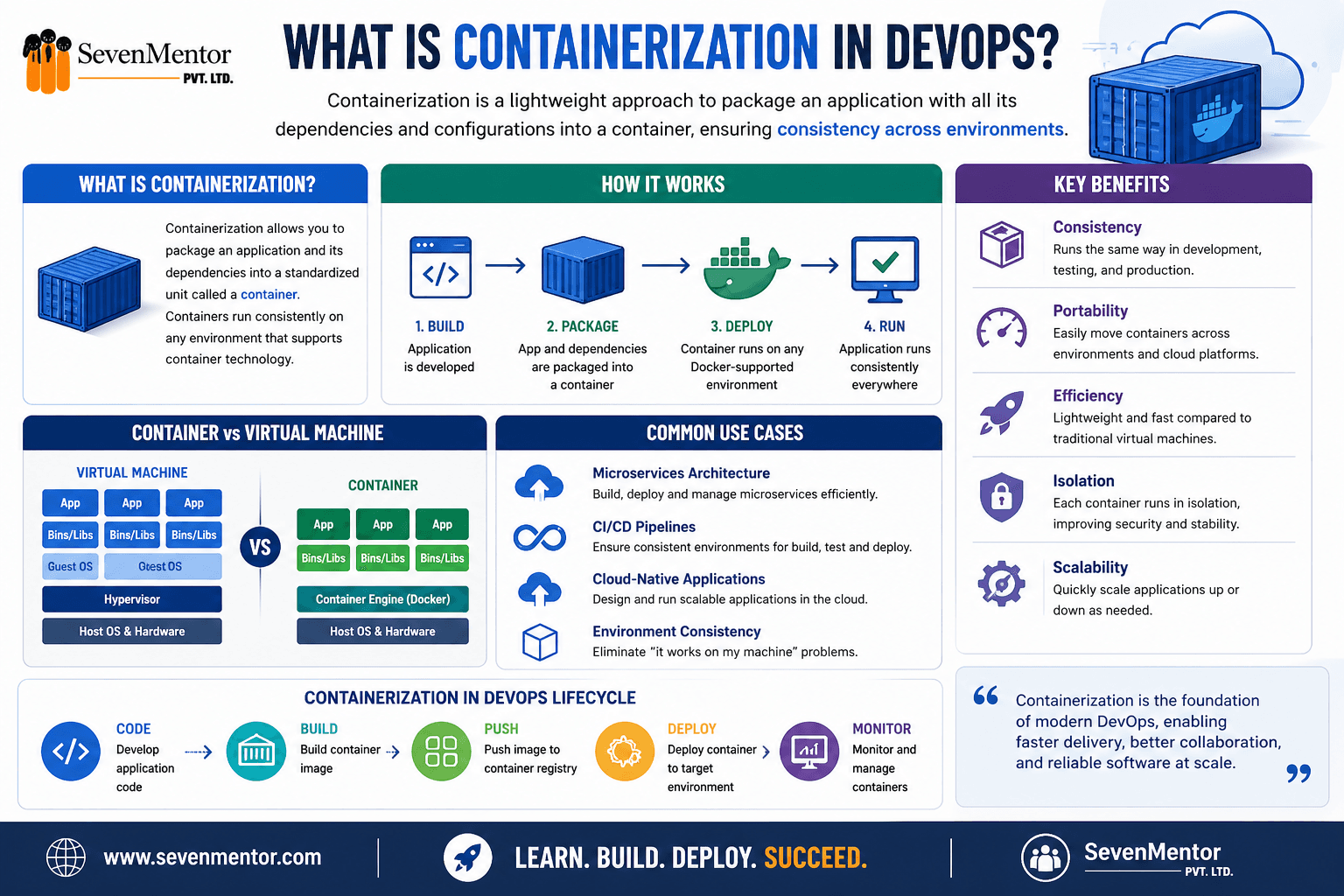
Containerization in DevOps refers to the process of packaging an application along with all its dependencies into a lightweight, portable container. These containers can run consistently across multiple environments such as development, testing, and production.
Key Features of Containerization
- Lightweight and efficient
- Platform-independent
- Fast deployment
- Easy scalability
- Improved resource utilization
In DevOps, containerization bridges the gap between development and operations, ensuring smoother collaboration and faster releases.
Why Containerization is Important in DevOps
The importance of containerization in DevOps lies in its ability to solve common development challenges such as environment inconsistencies and slow deployment processes.
Benefits of Containerization
1. Consistency Across Environments
Containers ensure that applications run the same way everywhere, eliminating the “it works on my machine” problem.
2. Faster Deployment
Since containers are lightweight, they can be deployed quickly, reducing time-to-market.
3. Scalability
Containerized applications can scale easily based on user demand.
4. Efficient Resource Utilization
Containers share the host OS, making them more efficient than virtual machines.
5. Improved Collaboration
Developers and operations teams can work together seamlessly using standardized environments.
How Containerization Works in DevOps
Understanding how containerization in DevOps works is crucial for implementing it effectively.
Step-by-Step Process
- Code Development
- Developers write application code.
- Container Image Creation
- The code and dependencies are packaged into a container image.
- Testing
- The container is tested in different environments.
- Deployment
- The container is deployed to production.
- Scaling and Monitoring
- Containers are scaled and monitored based on performance.
This workflow ensures faster and more reliable application delivery.
Popular Containerization Tools in DevOps
Several tools support containerization in DevOps, making the process easier and more efficient.
1. Docker
The most widely used containerization platform that allows developers to create and manage containers easily.
2. Kubernetes
An orchestration tool that automates container deployment, scaling, and management.
3. OpenShift
A Kubernetes-based platform that provides additional developer tools and security features.
4. Podman
A daemon-less container engine that offers enhanced security and flexibility.
5. Docker Swarm
A native clustering tool for managing Docker containers.
These tools play a crucial role in implementing DevOps containerization strategies.
Containerization vs Virtualization
Understanding the difference between containerization and virtualization helps clarify why containerization in DevOps is preferred.

Explore Other Demanding Courses
No courses available for the selected domain.
Use Cases of Containerization in DevOps
1. Microservices Architecture
Containerization is widely used to deploy microservices independently.
2. Continuous Integration/Continuous Deployment (CI/CD)
Containers streamline CI/CD pipelines by ensuring consistent environments.
3. Cloud-Native Applications
Containers are perfect for cloud-based applications due to their scalability.
4. Application Modernization
Legacy applications can be modernized using containerization.
5. Dev/Test Environments
Developers can quickly create and replicate environments.
Challenges of Containerization in DevOps
While containerization in DevOps offers many benefits, it also comes with challenges.
1. Security Concerns
Containers share the host OS, which can pose security risks.
2. Complexity in Management
Managing multiple containers requires orchestration tools.
3. Networking Issues
Container networking can be complex in large-scale systems.
4. Monitoring and Logging
Tracking container performance requires advanced tools.
5. Learning Curve
Beginners may find containerization concepts difficult initially.
Best Practices for Containerization in DevOps
To maximize the benefits of containerization in DevOps, follow these best practices:
1. Use Minimal Base Images
Smaller images reduce vulnerabilities and improve performance.
2. Implement Security Measures
Use scanning tools and follow security guidelines.
3. Automate CI/CD Pipelines
Automation improves efficiency and reduces errors.
4. Monitor Containers
Use monitoring tools to track performance and issues.
5. Optimize Resource Usage
Allocate resources efficiently to avoid wastage.
Future of Containerization in DevOps
The future of containerization in DevOps looks promising as organizations continue to adopt cloud-native technologies.
Emerging Trends
- Increased adoption of Kubernetes
- Integration with AI and automation
- Serverless containerization
- Enhanced security solutions
Containerization will continue to play a vital role in shaping modern DevOps practices.
Conclusion
In conclusion, containerization in DevOps is a powerful approach that enhances application development, deployment, and scalability. It simplifies workflows, improves collaboration, and ensures consistency across environments.
As businesses continue to embrace digital transformation, mastering DevOps containerization becomes essential for IT professionals. By learning containerization tools and best practices, you can build a successful career in DevOps and stay ahead in the competitive tech industry.
If you’re looking to gain hands-on experience and industry-ready skills, enrolling in a professional DevOps training program can be a great step forward.
Frequently Asked Questions (FAQs):
1. What is containerization in DevOps?
Containerization in DevOps is the process of packaging applications and their dependencies into containers to ensure consistent performance across environments.
2. Why is containerization important in DevOps?
It improves deployment speed, scalability, and consistency while reducing environment-related issues.
3. Which tools are used for containerization?
Popular tools include Docker, Kubernetes, OpenShift, Podman, and Docker Swarm.
4. Is containerization better than virtualization?
Yes, containerization is more lightweight, faster, and efficient compared to virtualization.
5. Is containerization difficult to learn?
No, with proper guidance and practice, beginners can easily learn containerization concepts and tools.
Related Links:
DevOps Interview Questions and Answers
Do visit our channel to know more: SevenMentor
Abhijeet Dahatonde
Expert trainer and consultant at SevenMentor with years of industry experience. Passionate about sharing knowledge and empowering the next generation of tech leaders.
Call the Trainer and Book your free demo Class..... Call now!!!
| SevenMentor Pvt Ltd.
© Copyright 2025 | SevenMentor Pvt Ltd.