What is Software Testing and Why is It a Top Career Choice Today?
Software testing is the process of evaluating a software application for testing purposes to ensure it functions correctly and as specified in the requirements. Many businesses are moving to online platforms and therefore require stable and effective finance, healthcare, and retail software. Testing identifies the dynamic security vulnerabilities as well as functional defects, performance problems, and usability problems that could affect users of the software. By learning a software testing course, you will learn how to test software and move from being able to test raw code to testing a complete and reliable application ready for release onto the market.
A career in software testing is one of the most stable fields for the long term. With expanding software ecosystems, quality assurance (QA) professionals are always in demand and do not depend on languages and frameworks of software being developed. A very fulfilling career that requires the analytical mindset of an analyst and execution of a technical nature.
- Immense Career Stability: As companies grow, they require more QA engineering teams at different stages of software development.
- Many freshers joining the IT world can easily get into the software testing domain with the right software testing course and competitive course fees, while not needing a very deep coding background and being able to learn the required parts of coding on the job.
- Very Lucrative Salary Growth: Entry-level testing professionals get paid around 3.2 to 5 LPA. Manual and automation testing professionals can expect a hike to 6 to 10 LPA. Senior professionals with expertise in advanced tools can command a salary of 12 to 18+ LPA.
- Future-Proof Skillset: Skills related to software testing are future-proof. From mobile apps to complex cloud-based platforms, there is plenty of software being built. Thus, a certified testing professional will always have a job.
Why Choose SevenMentor for Your Software Testing Training?
Looking for the Best Software Testing Course Two things matter most—hands-on practical & industry-specific mentors. Here, at SevenMentor, we are focused on providing the best software testing training program to the aspiring candidates. We have carved a niche for ourselves in the realm of software testing training program, as our training methodology is centered towards delivering live practical training sessions instead of just delivering traditional lecture-based sessions. This is the reason why our training sessions resemble the real-time work of a QA team of a corporate organization. Our training sessions help the candidate to acquire a sufficient level of expertise in software testing to easily face off against the technical interview of any organization.
We at SevenMentor bridge academic knowledge & corporate expectations by imparting training in a collaborative & feedback-oriented environment. Our industry expert & seasoned faculties guide each & every student in every step by reviewing the test case documentation, script, test report, and defect traceability.
You will be out of the books and create test plans, execute complex test cases, and manage live defect logs in a live environment.
- Comprehensive Tools Coverage: We teach all the manual and automation testing tools that are used on a daily basis by QA teams of MNCs all over the globe, like manual UI testing, backend database testing, etc., along with automation testing tools.
- Flexible Batch Options: Since everyone is busy on weekdays, our batches are scheduled on weekdays as well as on weekends. Also, we provide an online software testing course where you can learn at your own pace anytime from anywhere.
- End-to-End Placement Assistance: Our Career Cell is active to aid and guide the trainees from writing a resume to mock technical tests and from improving soft skills to conducting a campus placement drive.
What Hands-On Tools and Technologies Will You Master?
Software testing training is specifically designed to teach software quality assurance using the most popular tools and methodologies utilized by software testing organizations globally. The initial portion of our software testing training course covers absolute manual testing skills such as SDLC and STLC. We subsequently proceed to the automated testing methods that are generally utilized by organizations today by developing logical reasoning skills via the manual testing phase followed by executing test scripts via code in the automated testing phase.
Our software testing training covers a wide array of QA tools and frameworks currently used around the globe. First, we start with manual testing of software in absolute detail, covering the aspects of the Software Development Life Cycle (SDLC) as well as the Software Testing Life Cycle (STLC), followed by a dive into the automated testing. Thus, the participants are able to develop critical logical thinking skills before jumping into writing code for the automated testing.Upon completion of course the candidate would be able to appear for ISTQB certification held pan-India & abroad and make candidates stand out from the rest of the crowd.
- Selenium WebDriver & Java: In this module students will learn to write automated test scripts for browser-based testing. As part of this learning, students will also learn the basic of object-oriented programming in Java that can be put to use for optimizing and running the test scripts created.
- TestNG Framework: This will enable students to manage test suites, assert values, generate reports, and even run all tests in multi-threaded mode for a very fast test run.
- JIRA & Bugzilla: We shall go in depth in 2 of the leading project management software used by the top corporations to log, track, and manage bugs in software.
- Postman for API Testing: Move beyond the UI interface for validating data exchange, response codes, and endpoint security of web services.
- SQL & JMeter: Learn how to do database testing using targeted SQL queries and load testing a server from increasing levels of traffic using JMeter’s powerful features.
How Does Learning Through Live Testing Projects Transform Your Skills?
Readers will get to know about bug cycles and test scripts through the textbook; however, learning about them and actually working through failures and documenting them is a different ball game all together. Assignments at SevenMentor will be created and done in active application environments, and learners will see how software quality assurance fits into live deployment cycles on web, mobile, and enterprise applications.
This hands-on experience will give you the critical thinking, deductive skills, and structural skills needed for a quality assurance tester. The assignments are set up within active application environments where you will work within an organization’s QA role testing out multi-tiered builds to see firsthand how the quality assurance for software integrates with the organization’s release cycles following code edits to dependent modules.
- Deep Requirement Analysis: To design an absolute manual testing matrix for a given project brief through deep analysis.
- End-to-End Test Case Production: Learn how to make test cases with the proper test logic to create a full manual test plan for a given project scope covering all possible operation parameters.
- Defect Identification and Reporting: Be able to identify a system defect, reproduce it to verify the same, and document it as per the corporate specified format for reporting test-discovered defects.
- Edge-Case Evaluation: Test beyond typical user behavior and paths. Determine how software behaves given input at the boundary of expected values and also behaviors of system in very unusual usage scenarios, including intermittent failure and other edge cases that affect core operational components of the application under test.
What Placement Assistance and Career Support Do We Provide?
At SevenMentor we are committed to training our students and placing them in jobs so that they can start earning while they continue to learn and work on real-time projects under the guidance of experienced faculty members. We have a large network of associations with various IT companies, software product companies, and tech hubs all across, and we ensure that our students are placed in the best possible jobs in the best possible companies through our placement cell.
We start working on your career growth as early as possible in your training period. We work on making your technical portfolio as strong as your live projects so that it can get noticed by hiring managers while you are applying for jobs for automation testing, scripting for testing frameworks, API validation, and defect management.
- Personalized Resume Architecture: SevenMentor teams up with trainees to develop a strong resume that lists out their core skills in automation testing, use of scripting frameworks, API validation, and defect management, among others.
- Rigorous Mock Interviews: The test of time & a whole lot of hard work. Go through simulation rounds, which will include rounds conducted by HR as well as other rounds to test candidates' logical ability, to give them manual design challenges, and to test their coding skills in live environments.
- Corporate Soft Skills Grooming—Learn how to present a bug to a Dev team and how to collaborate with a Dev team and get them to test features that you as a tester haven’t been able to cover. Also learn how to justify your test coverage in a Scrum meeting.
- Exclusive Placement Drives: All the training to get you placed in the best software testing jobs in the area through our campus recruitment drives.
Which Flexible Learning Modes Match Your Schedule Perfectly?
Each student at SevenMentor is a unique individual. Each individual has their own routine and has to fulfill their professional commitments and also attend to their academic commitments. We make upskilling extremely easy to access by having the option of various training formats at multiple locations. SevenMentor classrooms and online training modules have identical material, live projects on doing real-time tasks, and the same level of individualized attention and feedback from a mentor.
The best part is that our approach ensures that there is a perfect balance between in-depth study and flexibility to adhere to one’s schedule while helping working professionals switch to a new domain or upskill to better their current careers without any hiatus.
- Offline Classroom Classes: We have a number of offline classroom training centers across locations in Hinjewadi, Kothrud, Shivajinagar, and more. Our software testing training rooms are equipped with the latest testing labs, and the training is delivered in a classroom setting with face-to-face interaction with our expert trainers.
- Online Classrooms: SevenMentor online training programs comprise the best software testing online course with advanced tools and real-time screen sharing, where you can ask for help from online instructors through live chat sessions while you are practicing and coding on software testing online tutorials.
- Dedicated Weekend Batches: The specialized Selenium automation testing classes are specifically planned for the students and corporate working employees. The students who are pursuing their full-time education and working employees can master Selenium automation testing classes held on Saturdays and Sundays.
- Corporate Training Programs: Our corporate training program is a highly customized program, which is specifically designed for an organization’s internal development teams. It focuses on an agile approach for the organization’s growth and helps them in API validation and load testing and also in creating a framework for testing.
How Does SevenMentor Solve Common Student Challenges to Ensure Training Success?
We take feedback from our students seriously and have tried to improve certain aspects of our course administration that most training institutes lack. By operating with our premium policies of operation accountability, a structured learning environment, transparent career growth, a guaranteed learning mode, paced learning with ongoing doubt clearing, and reliable post-enrollment student support, we can guarantee a premium training experience that is superior to others with just great study material and without any operational accountability.
SevenMentor’s software testing training programs are designed with a focus on accountability, fixed timelines for completion of study, and a sincere effort to train students and place them in the right job to grow professionally.
- Guaranteed Learning Mode Continuity: If you’re registering for an offline course on software testing, then your batch shall remain offline for the duration of the course. We at SevenMentor firmly believe in honoring what we guarantee in terms of our course offering. Therefore, we won’t switch arbitrary changes in learning modes for registered students.
- Realistic, Accountable Placement Support: At SevenMentor, we don’t market our course with empty promises of ‘100% placement.' We understand that there are many factors that are to be considered while placing a student in a job. Thus, we have designed a transparent milestone-based career assistance program. Our dedicated placement cell tracks each student’s interview preparation on a day-to-day basis and ensures that the student gets to attend interviews on a regular basis through our large corporate partner network.
- Paced Learning with Dedicated Doubt-Clearing Labs: Most programs would teach you complex automation modules such as Selenium and Java scripting within a matter of weeks and expect you to run with it. Our review sessions for such topics are paced slower so that students have adequate time to grasp each concept, and in addition, we have dedicated weekly labs where students can come in and have open-ended doubt-clearing sessions with instructors.
- Post-Enrollment Student Support: We continue to support students even after they have completed their course of study at SevenMentor. We have set up a separate team of students support team who are available 24/7 to respond to all the queries that students may have, be it change in batch, scheduling of classes, any documentation support required etc. This team is 100% independent of our sales team, and thus students can rest assured that their issues will be resolved at the earliest.
How Does Software Testing Interconnect with Other Leading Technologies?
Most software architectures today are interconnected, i.e., they do not exist in isolation. Thus, a very versatile QA professional is needed such that he or she can test and validate the quality of the various interconnected technological domains. Quality assurance of enterprise software systems, data pipelines, cloud infrastructure, and intelligent applications is taught at SevenMentor.
By learning how to test all the various tech stacks that support your software QA work, you can transform yourself from a simple script executor into a highly valued systems analyst able to work with any of today’s modern software engineering teams.
- Data Science & Data Analytics: Validate data-driven web applications by designing test cases to test web applications against parameters like user behavior, system performance, and data algorithms.
- Python & Java: Learn to validate the backend of web applications and write automated tests for complex applications built using the most popular languages for enterprise web applications. Automated framework for robust application architectures.
- Cloud Computing & DevOps: How automated test suites are used in Continuous Integration and Continuous Deployment (CI/CD) pipelines to deploy scalable applications on cloud platforms.
- Cyber Security: Test your web applications for vulnerabilities while creating test cases that could potentially hack your application to identify vulnerabilities to secure your application.
- Generative AI, AI Course & ChatGPT Course: With the rapid growth of intelligent applications, learn to test AI-powered chatbots, generated content, and machine learning models.
- Power BI & Salesforce: We train you to validate data visualization created in Power BI and also other web applications created for customer relationship management on CRM-based web solutions so that you can test business workflows done cross-platform.
- SAP Systems: To perform end to end business process testing of Large scale Enterprise solutions.
Got Questions? Here Are Some FAQs
1: What is a Software Testing Course?
This is how a Software Testing Course helps students learn how to detect faults in software, perform both manual and automated testing, to write test cases and work with testing tools found in the industry. The main goal is for students to learn how to test a piece of software so it can be released into the market that is stable, runs smoothly and meets specifications of quality that were defined during the software development life cycles (SDLC and STLC).
2: Who can join a Software Testing Course?
Software Testing Courses are designed for any graduate, with or without diploma, and anyone interested in Software Quality Assurance. It is ideal for freshers, for IT professionals looking to upgrade or for career changers looking to enter the Software Testing domain.
3: What skills will I learn in a Software Testing Course?
The students would be taught about manual testing, automation testing, test cases creation, bug reporting, SDLC, STLC, Agile testing, API testing etc. along with many other tools such as- Selenium, Jira etc.
4: Is Software Testing a good career choice?
Software testing is a very promising career option. Software testing is required in almost all the industries in which software is being developed. The demand of skilled testers is continuously increasing as more and more software applications are being developed.
5: Does a Software Testing Course include practical training?
Yes, hands-on practical training through real-life projects, testing scenarios and assignments to work on.
Related Links:
Anthropic AI Tool
What is Writesonic
What is Claude AI
AI Engineer Roadmap
What is JasperAI
What is Copy AI
Do visit our channel to know more: SevenMentor
 Through Rigorous Coaching Unlock Your Software Testing Potential
 Gain Expertise In Manual Testing, Automation Tools, And Quality Assurance Practices
 Become A Certified Software Testing Professional And Excel In The It Industry
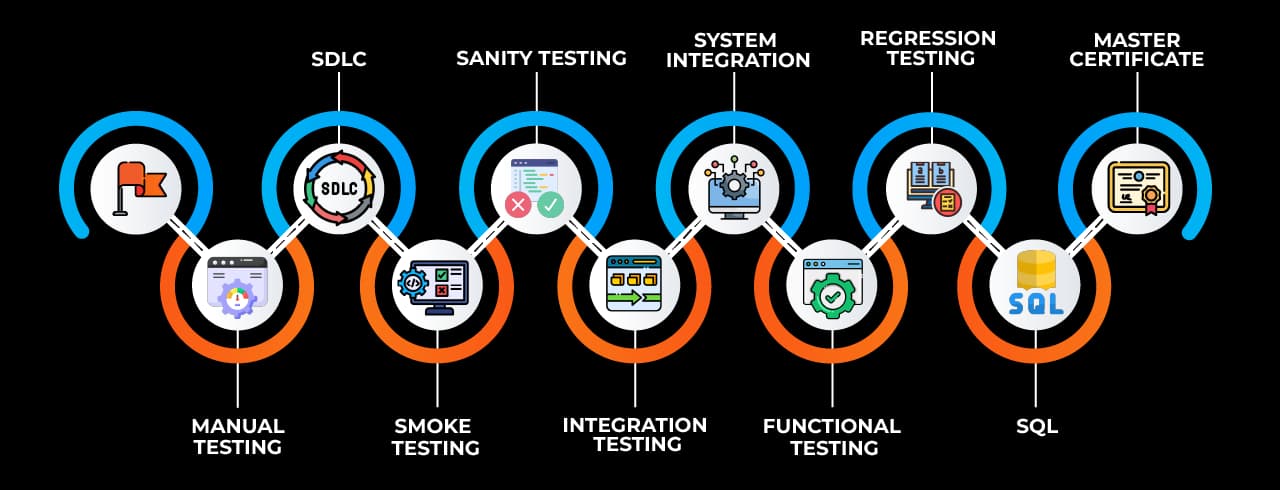
 Agile Testing Adapt testing strategies in Agile development environments.
 API Testing Validate APIs using tools like Postman or SoapUI.
 Automation TestingMaster tools like Selenium to automate test cases.
 Bug Reporting Identify, document, and report defects systematically.
 Cross-Browser Testing Test software across different browsers.
 Functional TestingVerify the software’s features against requirements.
 Integration Testing Test interactions between multiple modules.
 Load TestingTest the performance of software under heavy loads.
 Manual TestingLearn to execute test cases without automation tools.
 Mobile Testing Validate apps on Android and iOS platforms.
 Performance Testing Measure software speed, scalability, and stability.
 Regression TestingEnsure new updates don’t affect existing functionalities.
 Security Testing Identify vulnerabilities to protect against threats.
 Test Automation FrameworksLearn to build frameworks like Keyword or Hybrid.
 Test Plan Creation Develop strategic testing plans for projects.
 Unit Testing Test individual components of the application.
 User Acceptance Testing (UAT) Validate software readiness for end users.