Cyber Security Course in Akola

feature-iconA comprehensive cybersecurity strategy has numerous layers of protection.
feature-iconPrevention of cyber attacks is the primary goal of a Cyber expert.
feature-iconAn organization's people, processes, and technology must complement one another to effectively defend against cyber threats.
020-71172515

Start Today!

CONSULT WITH
OUR ADVISORS

  • Course & Curriculum Details
  • Flexible Learning Options
  • Affordable Learning
  • Enrollment Process
  • Career Guidance
  • Internship Opportunities
  • General Communication
  • Certification Benefits

Learning Curve for Cyber Security
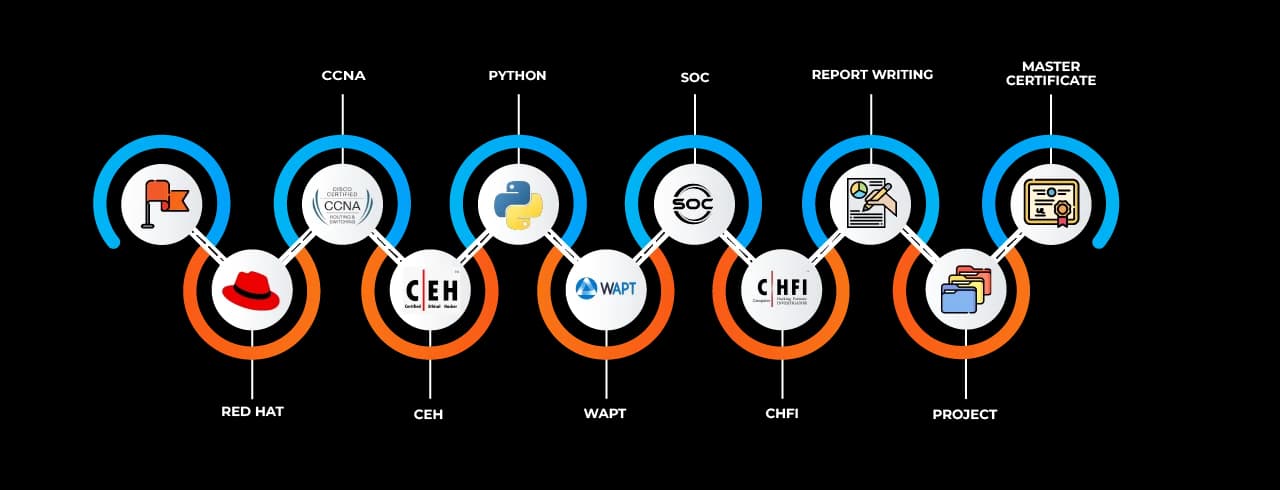
Learning curve for Cyber Security

Master In Cyber Security Course

OneCourseMultipleRoles

Empower your career with in-demand data skills and open doors to top-tier opportunities.

Cyber Security Analyst
Malware Analysis
information security
SOC
Risk Analyst
cyber forensics & DFIR
Threat Intelligence Analyst
Compliance and Risk Analyst
Cloud Security Specialist
Cyber Security Consultant
Incident Response Specialist

Skills & Tools You'll Learn -

Kali Linux iconKali LinuxA Debian-based penetration testing and ethical hacking operating system, pre-loaded with security tools.
Nmap (Network Mapper) iconNmap (Network Mapper)A powerful network scanning tool for discovering hosts and services.
Zenmap  iconZenmap A graphical front-end for Nmap that simplifies network scanning and analysis.
Wireshark  iconWireshark A network protocol analyzer used for packet sniffing and traffic monitoring.
Angry IP Scanner iconAngry IP ScannerA fast and lightweight tool for scanning IP addresses and ports.
NetworkMiner  iconNetworkMiner A network forensic analysis tool for extracting and analyzing packets.
Burp Suite iconBurp SuiteA web vulnerability scanner and penetration testing tool.
Nessus  iconNessus A vulnerability scanner that helps identify security issues in systems and networks.
Acunetix  iconAcunetix A web security scanner used to detect vulnerabilities like SQL injection and XSS.
Metasploit Framework iconMetasploit FrameworkA powerful exploitation framework for ethical hacking and penetration testing.
Social-Engineer Toolkit (SET) iconSocial-Engineer Toolkit (SET) A tool for simulating social engineering attacks and phishing campaigns.
Ettercap  iconEttercap A network security tool used for man-in-the-middle (MITM) attacks and traffic manipulation.
Hydra  iconHydra A fast brute-force password cracking tool for network authentication protocols.
Hashcat  iconHashcat A password recovery tool used for cracking hashes with GPU acceleration.
Wifite  iconWifite An automated wireless auditing tool for testing WiFi network security.
Wi-Fi Hacking Tools iconWi-Fi Hacking ToolsVarious tools in Kali Linux for capturing and cracking Wi-Fi passwords.
Mobile Hacking iconMobile HackingTechniques and tools used to test and exploit vulnerabilities in mobile devices.
FTK (Forensic Toolkit) iconFTK (Forensic Toolkit)A digital forensics tool for evidence collection and analysis
Recuva  iconRecuva A data recovery tool for restoring deleted files.
WinHex  iconWinHex A hex editor used for forensic investigations and data recovery.
Splunk  iconSplunk A security information and event management (SIEM) tool used for log analysis and threat detection.
Autopsy  iconAutopsy Perform digital forensics to recover and analyze deleted or hidden files.

Why Choose SevenMentor Cyber Security

Empowering Careers with Industry-Ready Skills.

Specialized Pocket Friendly Programs as per your requirements

Specialized Pocket Friendly Programs as per your requirements

Live Projects With Hands-on Experience

Live Projects With Hands-on Experience

Corporate Soft-skills & Personality Building Sessions

Corporate Soft-skills & Personality Building Sessions

Digital Online, Classroom, Hybrid Batches

Digital Online, Classroom, Hybrid Batches

Interview Calls Assistance & Mock Sessions

Interview Calls Assistance & Mock Sessions

1:1 Mentorship when required

1:1 Mentorship when required

Industry Experienced Trainers

Industry Experienced Trainers

Class Recordings for Missed Classes

Class Recordings for Missed Classes

1 Year FREE Repeat Option

1 Year FREE Repeat Option

Bonus Resources

Bonus Resources

Curriculum For Cyber Security

BATCH SCHEDULE

Cyber Security Course

Find Your Perfect Training Session

Jan 4 - Jan 10

2 sessions
04
Sun
Classroom/ Online
Weekend Batch
10
Sat
Classroom/ Online
Weekend Batch

Jan 11 - Jan 17

1 sessions
12
Mon
Classroom/ Online
Regular Batch

Jan 18 - Jan 24

1 sessions
19
Mon
Classroom/ Online
Regular Batch

Learning Comes Alive Through Hands-On PROJECTS!

Comprehensive Training Programs Designed to Elevate Your Career

DATA RECOVERY

DATA RECOVERY

MOBILE FORENSICS

MOBILE FORENSICS

Create a SOC environment

Create a SOC environment

Implement WEB application on SOC environment and monitor it & find a vulnerability on the website and report it

Implement WEB application on SOC environment and monitor it & find a vulnerability on the website and report it

No active project selected.

Transform Your Future with Elite Certification

Add Our Training Certificate In Your LinkedIn ProfileLinkedIn

Our industry-relevant certification equips you with essential skills required to succeed in a highly dynamic job market.

Join us and be part of over 50,000 successful certified graduates.

Student 1
Student 2
Student 3
Student 4
Student 5
Join 15,258 others learning today
Certificate Preview

KEY Features that Makes Us Better and Best FIT For You

Expert Trainers

Industry professionals with extensive experience to guide your learning journey.

Comprehensive Curriculum

In-depth courses designed to meet current industry standards and trends.

Hands-on Training

Real-world projects and practical sessions to enhance learning outcomes.

Flexible Schedules

Options for weekday, weekend, and online batches to suit your convenience.

Industry-Recognized Certifications

Globally accepted credentials to boost your career prospects.

State-of-the-Art Infrastructure

Modern facilities and tools for an engaging learning experience.

100% Placement Assistance

Dedicated support to help you secure your dream job.

Affordable Fees

Quality training at competitive prices with flexible payment options.

Lifetime Access to Learning Materials

Revisit course content anytime for continuous learning.

Personalized Attention

Small batch sizes for individualized mentoring and guidance.

Diverse Course Offerings

A wide range of programs in IT, business, design, and more.

Course Content

About Cyber Security

In an age where our personal lives, businesses, and global systems are deeply intertwined with digital technology, cyber security stands as a critical line of defense. The Cyber Security Course in Akola by SevenMentor Institute is crafted to introduce learners to the fundamentals of digital protection and equip them with the skills necessary to combat today’s evolving cyber threats. Whether it's protecting sensitive data or maintaining the reliability of digital infrastructures, this course lays a strong foundation in identifying and mitigating online risks through both theoretical knowledge and practical application.

As part of the training, learners explore the various types of cyber threats that pose serious risks to individuals and organizations alike. The curriculum covers key areas such as malware attacksphishing scamsransomwareSQL injections, and DDoS attacks. These threats are examined from both attacker and defender perspectives, enabling students to understand the methodologies behind each and implement effective countermeasures. With the inclusion of real-time simulations and case studies, this cyber security training in Akola ensures students are well-prepared to assess and respond to real-world security challenges with confidence.


Core Components of Cyber Security

  1. Network Security Fundamentals
    Network security focuses on safeguarding the confidentiality, integrity, and availability of networked systems. It begins with understanding protocols like TCP/IPHTTP/HTTPS, and DNS, along with their common vulnerabilities. Techniques such as packet filteringIntrusion Detection Systems (IDS), and Secure Socket Layer (SSL) are employed to protect data in transit. Tools like firewallsVPNs, and network segmentation help prevent threats including spoofingman-in-the-middle attacks, and DDoS attacks.
     
  2. Risk Assessment and Data Protection
    Effective risk management involves identifying vulnerabilities, evaluating threat impacts, and implementing mitigation strategies. This includes the use of cryptographic methods like symmetric and asymmetric encryptionhashing algorithms, and digital signatures. To ensure data protection, organizations also rely on secure communication protocolsaccess controls, and Data Loss Prevention (DLP) systems.
     
  3. Endpoint Security Measures
    Endpoints such as laptops, mobile devices, and servers are frequent targets of cyber attacks. Implementing anti-malware solutionshost-based firewalls, and patch management systems helps secure these devices. Monitoring tools and endpoint detection and response (EDR) platforms are essential in identifying and neutralizing threats at the device level.
     
  4. Application Security Practices
    Application security ensures that software is developed and maintained with security in mind. Techniques like secure codingcode review, and penetration testing help in identifying and eliminating software vulnerabilities. Tools such as Web Application Firewalls (WAFs) and runtime application self-protection (RASP) are commonly used to defend against attacks like SQL injection and cross-site scripting (XSS).
     
  5. Security Policies and Compliance
    Organizations rely on security policies and governance frameworks to create a culture of security awareness and accountability. This includes defining access control policiesincident response plans, and ensuring compliance with standards like ISO 27001GDPR, or HIPAA. These policies help maintain regulatory compliance and reduce organizational risk.
     
  6. Incident Response and Threat Intelligence
    Rapid detection and response to security breaches are critical to minimizing damage. A structured incident response plan enables teams to act quickly during a breach. Coupled with threat intelligence, which provides up-to-date insights on emerging threats, organizations can proactively strengthen their defenses and better prepare for future attacks.
     

Essential Cyber Security Tools Covered in Our Akola Training

The Cyber Security Course in Akola offered by SevenMentor equips students with hands-on experience in industry-standard tools that are vital for modern security professionals. One of the foundational tools taught is Wireshark, a network protocol analyzer that enables real-time monitoring and traffic analysis. Students use Wireshark to identify packet anomalies and detect suspicious activities within a network. Another critical tool is Nmap, which is widely used for network scanningport scanning, and security auditing. Through guided sessions, learners become proficient in mapping network structures and identifying open ports that may pose security risks.

Advanced modules of the course dive into Metasploit, an essential penetration testing framework that allows students to simulate real-world cyber attacks. Through structured lab exercises, learners use Metasploit to exploit vulnerabilities and assess network defenses, gaining deep insight into offensive security tactics. Similarly, Burp Suite is introduced as a comprehensive platform for web application security testing, enabling students to conduct both manual and automated vulnerability scans. These tools are crucial for identifying common web-based threats like SQL injection and cross-site scripting (XSS).

Further enhancing the practical experience, the course includes training on Kali Linux, a popular Linux distribution tailored for ethical hacking and digital forensics. Learners explore a wide range of tools preloaded in Kali, conducting attack simulations and testing system defenses in controlled environments. Additionally, the use of Snort, an open-source Intrusion Detection and Prevention System (IDS/IPS), helps students understand how to monitor real-time traffic and configure detection rules to prevent unauthorized access. To round out their toolset, learners also work with John the Ripper, a fast and efficient password cracking tool, gaining practical knowledge on how to perform password audits and assess password strength across various systems.

Thus, by mastering these industry-standard cyber security tools during our Best Cyber Security Course in Akola, learners gain practical skills essential for real-world threat detection and prevention. These tools not only build technical competence but also prepare students for dynamic roles in the cyber security industry.
 

Job Options For Cyber Security Professionals

The Cyber Security Course in Akola opens the door to a wide range of high-demand career opportunities in today’s digital landscape. Roles such as Security AnalystEthical HackerIT Auditor, and Penetration Tester are becoming increasingly critical as businesses work to secure their data and systems. SevenMentor's course offers hands-on training that prepares students for globally recognized certifications such as CEHCISA, and CISSP. With the rise in cyber threats, skilled professionals are in greater demand and are rewarded with faster career advancement, increased job security, and opportunities in diverse sectors like ITfinancehealthcare, and government.


Why SevenMentor Institute is the Best Choice for Cyber Security Training in Akola

SevenMentor Institute stands out as a leading provider of Cyber Security training in Akola, delivering practical skills for real-world cyber security applications. The course is taught by seasoned industry experts with in-depth knowledge, ensuring that students receive the most current insights. SevenMentor provides a comprehensive curriculum covering data protectionethical hacking, and network security fundamentals. Flexible learning options—both online and classroom—are designed to meet the needs of different types of learners. With hands-on projects, live case studies, and practical exposure, students become job-ready from day one. The course is offered at competitive prices, with EMI options available, making it accessible to all.
 

Future Is Here with Cyber Security Training in Akola

In summary, the Cyber Security Course in Akola at SevenMentor Institute combines expert-led training, practical experience, and strong career support to prepare students for success in the fast-growing cyber security field. With personalized mentorship, flexible learning schedules, and access to industry-recognized certifications, this course is the perfect pathway to launch a successful career in one of the most sought-after tech industries. Don’t wait—take the first step toward securing your future in cyber security today!
 

Online Course

SevenMentor Institute offers flexible and career-focused online IT courses that allow you to learn from the comfort of your home. Our programs cover key technologies like Java, Python, Cloud Computing, and Full Stack Development, and are delivered through live instructor-led sessions and recorded lectures. You’ll engage in real-time projects, receive expert guidance, and prepare for industry-recognized IT certifications. With flexible scheduling and comprehensive support, our online training platform is ideal for students, working professionals, and career switchers who want to enhance their skills and stay competitive in today’s tech-driven job market.
 

Corporate Training

SevenMentor Institute offers customized corporate Cyber Security training designed to meet the unique needs of your organization. Our employee upskilling solutions are tailored to enhance technical and soft skills across various domains like Cloud Computing, Networking, DevOps, and Project Management. Delivered through on-site or virtual sessions, our training ensures maximum flexibility and engagement. With a strong focus on industry-aligned curriculum, hands-on labs, and trainer-led workshops, we empower your workforce with the tools needed to improve productivity and stay ahead of technological advancements. Partner with us to transform your teams into high-performing assets through result-oriented corporate IT training.

Frequently Asked Questions

Everything you need to know about our revolutionary job platform

1

What is the highest-paid security job?

Ans:
Chief information security officers. The highest-paying security occupations are typically found in cybersecurity roles such as Chief Information Security Officers (CISOs), Cloud Security Engineers, and Security Architects.
2

Is a cyber security course easy to complete?

Ans:
Although degrees in cyber security are normally less difficult than those in research- or lab-intensive subjects such as physics and engineering, they are more difficult than non-research degrees such as those in humanities or business.
3

How to Become a Cybersecurity Engineer by 2025?

Ans:
Generally, a cybersecurity engineer must have the following qualifications: A degree in computer science, information technology, systems engineering, or a closely related subject. Two years of experience in cybersecurity-related roles such as incident detection, response, and forensics.
4

What credentials do I take to work in cybersecurity?

Ans:
The Level 3 Certificate in Cyber Security Practices is intended for individuals seeking entry-level Cyber Security positions. Alternatively, consider pursuing a Level 4 qualification or degree. The Level 3 Certificate in Cyber Security Practices is intended for individuals seeking entry-level Cyber Security positions.
5

What purpose does cyber security serve?

Ans:
Cybersecurity is the process by which individuals and organizations limit their vulnerability to cyberattacks. The primary goal of cyber security is to secure the devices we all use (smartphones, laptops, tablets, and computers) as well as the services we access, both online and at work, from theft or damage.
6

Where is cyber security most commonly used?

Ans:
Endpoint devices, such as PCs, smart devices, routers, networks, and the cloud, are the three main entities that must be safeguarded. Next-generation firewalls, Domain Name System (DNS) filtering, malware protection, antivirus software, and email security solutions are examples of common technologies used to safeguard these companies.
7

How is cyber security employed nowadays?

Ans:
Cybersecurity safeguards digital systems, networks, and data from unauthorized access, theft, or damage. It entails implementing a variety of methods and technologies.
8

What is a cyber security professional's career?

Ans:
Cybersecurity specialists serve as frontline warriors in the fight against cybercrime. To keep our data and systems secure, they construct defenses against attacks (such as firewalls), monitor for risks, and respond to breaches (such as data leaks).
9

Is cyber security a nine-to-five job?

Ans:
These employees are not necessarily on a 9-to-5 schedule. Cybersecurity specialists may be required to work extra hours to respond to security threats or track vulnerabilities discovered through testing or analytics. Professional training may also take place outside of regular working hours.
10

How does cyber security affect business?

Ans:
Safeguarding sensitive data One of the key reasons firms must invest in cybersecurity is to secure sensitive data. This includes client data, financial records, and confidential intellectual property.
11

What is the best industry for cyber security?

Ans:
Financial services are especially vulnerable because of the huge value of the financial data and transactions they handle on a daily basis. Patient data, which is both important and sensitive, poses enormous threats to the healthcare industry. To secure national security information, the government sectors require robust cybersecurity.
12

What are the Five C's of Cyber Security?

Ans:
What are the five C's of cyber security? - Creative Networks In an age where cyberattacks are growing more common and sophisticated, the 5 C's of Cybersecurity—Change, Compliance, Cost, Continuity, and Coverage—provide a complete framework for enterprises to defend their operations.
13

Is it possible for artificial intelligence to replace cybersecurity?

Ans:
The quick answer is that artificial intelligence is not likely to replace or take over cybersecurity positions. However, it will improve cybersecurity by introducing new tools, approaches, and frameworks.
14

Should I pursue AI or cybersecurity?

Ans:
Artificial intelligence is for those interested in robotics or computer-controlled robots. It's a field that has a lot to offer but also requires a lot from pupils.
15

What are the three major cybersecurity criteria?

Ans:
The relevance of the security model speaks for itself. Confidentiality, integrity, and availability are regarded as the three most critical notions in information security. The formulation of organizational security policies is guided by taking these three elements into account within the triad framework.

Explore Other Demanding Courses

No courses available for the selected domain.