Data Structures with C & C++ Classes in France

feature-iconData structures are used to keep and organize information.
feature-iconAn array is a type of data structure that may store several elements in a single variable.
feature-iconC++ also supports some other data structures, each of which is used to manage data in a unique way.

020-71173035

Start Today!

CONSULT WITH
OUR ADVISORS

  • Course & Curriculum Details
  • Flexible Learning Options
  • Affordable Learning
  • Enrollment Process
  • Career Guidance
  • Internship Opportunities
  • General Communication
  • Certification Benefits

Learning Curve for Data Structures with C & C++
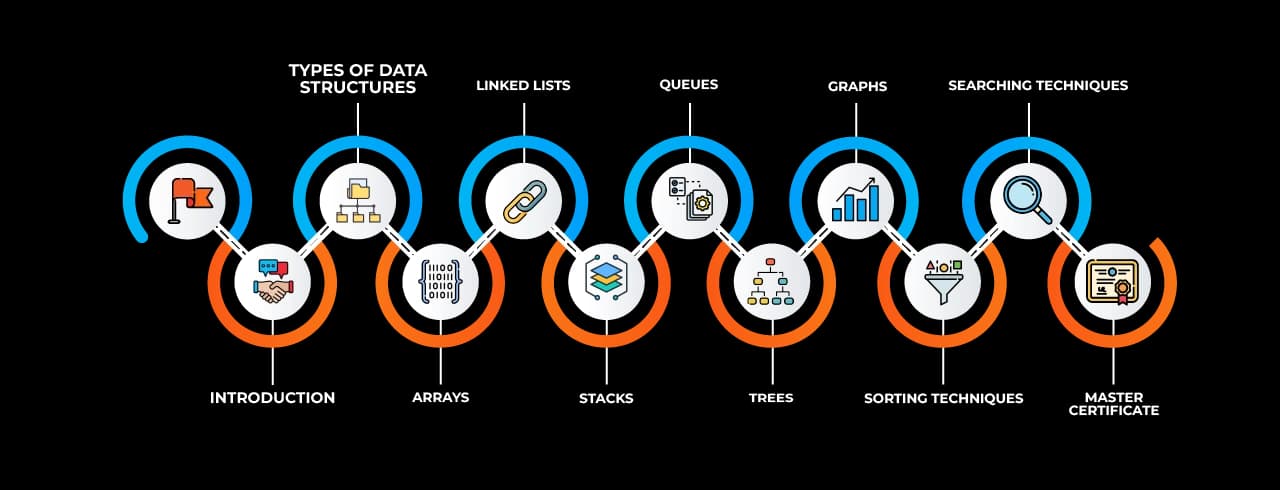
Learning curve for Data Structures with C & C++

Master In Data Structures with C & C++ Course

OneCourseMultipleRoles

Empower your career with in-demand data skills and open doors to top-tier opportunities.

Software Developer
Data Architect
Database Administrator (DBA)
Data Engineer
Data Scientist
Machine Learning Engineer
Business Intelligence Analyst
Data Analyst
Quantitative Analyst and Data Storyteller

Skills & Tools You'll Learn -

C iconCA procedural programming language for system and application development.
C++ iconC++An object-oriented programming language with features like classes and polymorphism.
Tools & Software iconTools & SoftwareIDEs and utilities for coding, debugging, and compiling C/C++ programs.
Creating Array iconCreating ArrayDeclaring and initializing a collection of elements of the same type.
Types of Array iconTypes of ArrayOne-dimensional, multi-dimensional, and dynamic arrays.
Operations on Array iconOperations on ArrayInsertion, deletion, traversal, searching, and sorting.
Creating Linked List iconCreating Linked List Defining nodes and linking them dynamically in memory.
Types of Linked List iconTypes of Linked ListSingly, doubly, and circular linked lists.
Operations on Linked List iconOperations on Linked ListInsertion, deletion, traversal, searching, and reversing.
Creating Stack iconCreating StackImplementing a LIFO data structure using arrays or linked lists.
Terms in Stack iconTerms in StackPush, pop, top, underflow, overflow.
Operations on Stack iconOperations on StackPush, pop, peek, and checking for empty/full conditions.
Creating Queue iconCreating QueueImplementing a FIFO data structure using arrays or linked lists.
Terms in Queue iconTerms in QueueFront, rear, enqueue, dequeue, overflow, underflow.
Creating Tree iconCreating TreeDefining a hierarchical structure with nodes and edges.
Types of Trees iconTypes of TreesBinary tree, BST, AVL tree, B-tree, etc.
Terms in Trees iconTerms in TreesRoot, parent, child, leaf, depth, height.
Operations on Trees iconOperations on TreesInsertion, deletion, traversal (inorder, preorder, postorder).
Creating Graph iconCreating GraphRepresenting networks using nodes and edges.
Types of Graphs iconTypes of GraphsDirected, undirected, weighted, unweighted.
Terms in Graphs iconTerms in GraphsVertex, edge, adjacency, degree, path.
Operations on Graphs iconOperations on Graphs BFS, DFS, adding/removing edges or vertices.
Searching Methods iconSearching MethodsLinear search, binary search, depth-first search, breadth-first search.
Sorting Methods iconSorting MethodsBubble sort, selection sort, insertion sort, merge sort, quick sort, heap sort.
Code Blocks iconCode BlocksA popular open-source IDE for C/C++ development.

Why Choose SevenMentor Data Structures with C & C++

Empowering Careers with Industry-Ready Skills.

Specialized Pocket Friendly Programs as per your requirements

Specialized Pocket Friendly Programs as per your requirements

Live Projects With Hands-on Experience

Live Projects With Hands-on Experience

Corporate Soft-skills & Personality Building Sessions

Corporate Soft-skills & Personality Building Sessions

Digital Online, Classroom, Hybrid Batches

Digital Online, Classroom, Hybrid Batches

Interview Calls Assistance & Mock Sessions

Interview Calls Assistance & Mock Sessions

1:1 Mentorship when required

1:1 Mentorship when required

Industry Experienced Trainers

Industry Experienced Trainers

Class Recordings for Missed Classes

Class Recordings for Missed Classes

1 Year FREE Repeat Option

1 Year FREE Repeat Option

Bonus Resources

Bonus Resources

Curriculum For Data Structures with C & C++

BATCH SCHEDULE

Data Structures with C & C++ Course

Find Your Perfect Training Session

Dec 28 - Jan 3

2 sessions
28
Sun
Classroom/ Online
Weekend Batch
03
Sat
Classroom/ Online
Weekend Batch

Jan 4 - Jan 10

1 sessions
05
Mon
Classroom/ OnlineToday
Regular Batch

Jan 11 - Jan 17

1 sessions
12
Mon
Classroom/ Online
Regular Batch

Learning Comes Alive Through Hands-On PROJECTS!

Comprehensive Training Programs Designed to Elevate Your Career

Phonebook

Phonebook

Bank management system

Bank management system

Plagiarism detection system

Plagiarism detection system

Crossword Puzzle

Crossword Puzzle

Library Management System

Library Management System

Real Estate Property Search

Real Estate Property Search

No active project selected.

Transform Your Future with Elite Certification

Add Our Training Certificate In Your LinkedIn ProfileLinkedIn

Our industry-relevant certification equips you with essential skills required to succeed in a highly dynamic job market.

Join us and be part of over 50,000 successful certified graduates.

Student 1
Student 2
Student 3
Student 4
Student 5
Join 15,258 others learning today
Certificate Preview

KEY Features that Makes Us Better and Best FIT For You

Expert Trainers

Industry professionals with extensive experience to guide your learning journey.

Comprehensive Curriculum

In-depth courses designed to meet current industry standards and trends.

Hands-on Training

Real-world projects and practical sessions to enhance learning outcomes.

Flexible Schedules

Options for weekday, weekend, and online batches to suit your convenience.

Industry-Recognized Certifications

Globally accepted credentials to boost your career prospects.

State-of-the-Art Infrastructure

Modern facilities and tools for an engaging learning experience.

100% Placement Assistance

Dedicated support to help you secure your dream job.

Affordable Fees

Quality training at competitive prices with flexible payment options.

Lifetime Access to Learning Materials

Revisit course content anytime for continuous learning.

Personalized Attention

Small batch sizes for individualized mentoring and guidance.

Diverse Course Offerings

A wide range of programs in IT, business, design, and more.

Course Content

About Data Structures with C & C++

Programmers and developers must have a solid foundation in computer science because the field of software engineering and development is still evolving quickly. Data structures, which dictate the effectiveness and scalability of software programs, are at the heart of this foundation. Professionals may create programs that are both functional and ideal in terms of time and space complexity by mastering data structures. Among the computer languages used to build data structures, C and C++ stand out due to their efficiency and fine-grained control over memory management. For this reason, students, working professionals, and aspiring developers are increasingly taking Data Structures with C & C++ Classes in France.
 

The Importance of Learning Data Structures

Because they specify how data is stored, retrieved, and altered, data structures are crucial. Programmers who don't understand data structures risk writing code that functions well but performs poorly in scenarios involving large numbers of variables. For creating high-performing applications, concepts like arrays, linked lists, stacks, queues, trees, graphs, and hash tables are essential.

In France, with the increasing demand for competent software engineers across industries such as banking, technology, healthcare, and logistics, expertise in data structures gives candidates a competitive edge. The Data Structures with C & C++ Courses in France are specifically designed to cover both theoretical concepts and practical implementation, ensuring learners can translate their knowledge into real-world applications.
 

Why Choose C & C++ for Data Structures

Because of their close connection to hardware and effective memory usage, C and C++ continue to be the most popular options for learning data structures. Learning how data structures operate internally is made much easier with C's low-level perspective on data management. More complex data structures and abstractions are made possible by C++'s extension of C with object-oriented programming features. By forcing students to comprehend memory allocation, pointers, and operation costs at a fine level, these languages help them get a deeper comprehension of data structure concepts.

By enrolling in SeenMentor’s Data Structures with C & C++ Training in France, learners gain exposure to implementing data structures from scratch, debugging complex memory issues, and optimizing code for performance, which are crucial skills in software development.
 

Curriculum of Data Structures with C & C++ Classes

The Data Structures with C & C++ Classes in France offered by SevenMentor follows a comprehensive curriculum that starts with the basics and gradually progresses toward advanced topics. Learners begin by understanding the characteristics of C and C++, syntax, and basic programming constructs. This is followed by an introduction to arrays, pointers, and dynamic memory allocation.

Then, using insertion, deletion, and traversal operations, students investigate linked lists, including single, double, and circular linked lists. The implementations of stack and queue follow, showing students how these linear data structures address practical issues like scheduling and parsing.

The program's most intricate section focusses on trees and graphs, including binary trees, binary search trees, heaps, and balanced trees like AVL and Red-Black Trees. Students also study graph representations, traversal algorithms including BFS and DFS, spanning trees, and shortest path algorithms. The training emphasises complexity analysis, including time and space trade-offs, to cultivate an analytical mindset.
 

Hands-On Learning Approach

An effective training program goes beyond theory by incorporating hands-on projects and exercises. The Data Structures with C & C++ Courses in France offered by SevenMentor emphasize practical assignments where students write code to implement and manipulate different data structures. Debugging, testing, and optimizing these implementations help reinforce the concepts learned.

Through lab sessions, learners gain confidence in identifying which data structures to use for a given problem and understand the implications of their choices. This experiential learning ensures that students can tackle complex programming challenges with clarity and confidence.
 

Career Opportunities After Completion

Mastering data structures opens the door to numerous career opportunities in France and beyond. Graduates of Data Structures with C & C++ Classes in France from SevenMentor  are well-prepared for roles such as software developer, systems programmer, application engineer, and algorithm specialist. The skills acquired are universally applicable, making candidates valuable assets for any organization seeking efficient and innovative software solutions.

Companies in sectors like e-commerce, banking, gaming, and artificial intelligence value professionals who can write optimized, scalable code. Thus, training in data structures with C and C++ provides a solid foundation for further learning in areas like competitive programming, system design, and advanced algorithm development.
 

About SevenMentor

When it comes to acquiring a high-quality education in data structures, choosing the right training institute is crucial. SevenMentor, the best training institute for Data Structures with C & C++ Training stands out in France for its experienced faculty, well-structured curriculum, and emphasis on practical learning.

At SevenMentor, students benefit from a blend of theoretical lectures, interactive sessions, and real-life projects. The instructors bring industry experience to the classroom, helping learners bridge the gap between academic knowledge and professional expectations. The institute also provides personalized mentorship, ensuring every student receives the attention they need to succeed.

The supportive learning environment at SevenMentor makes it an ideal place for both beginners and experienced programmers to deepen their understanding of data structures. Graduates from SevenMentor often highlight the institute’s commitment to excellence and its role in shaping their careers.
 

Learning Resources and Support

One of the strengths of the Data Structures with C & C++ Training in France at SevenMentor is the abundance of learning resources and support available to students. Alongside detailed lecture notes and reading materials, learners have access to video tutorials, coding exercises, and practice problems.

Instructors and teaching assistants are readily available to resolve doubts, review code, and guide students through challenging assignments. Regular assessments and feedback ensure that learners stay on track and continue to improve throughout the course.

Community engagement also plays a significant role, with students collaborating on projects, participating in coding competitions, and exchanging ideas, fostering a vibrant learning atmosphere.
 

Advanced Topics and Competitive Programming

For students interested in pushing their skills further, advanced topics like dynamic programming, greedy algorithms, and advanced graph algorithms are covered. Many learners who complete Data Structures with C & C++ Courses in France go on to participate in competitive programming contests, where their understanding of data structures and algorithms is put to the test.

Competitive programming not only sharpens problem-solving skills but also enhances a programmer’s ability to think under pressure and write efficient code, which are qualities highly sought after in the industry.
 

Benefits of Studying in France

France's robust technology industry, varied culture, and rich academic legacy make it a great place to learn. Modern classrooms, research tools, and networking chances with tech professionals are all advantages for students enrolled in Data Structures with C & C++ Classes in France.

Furthermore, there is a constant need for qualified software engineers because of France's emphasis on innovation and digital transformation. Taking one of these data structures courses can lead to internships and employment at some of the best companies in the nation.

The Data Structures with C & C++ Training in France equips students and professionals with the skills necessary to design and implement efficient algorithms and systems.

By choosing SevenMentor the best training institute for Data Structures with C & C++ Training, learners gain access to expert instruction, hands-on projects, and personalized support that prepare them for successful careers in technology. Whether you are a beginner looking to build a strong foundation or a professional seeking to enhance your skills, these classes in France offer a pathway to achieving your goals.


Online Data Structures with C & C++ Classes

SevenMentor offers comprehensive online Data Structures with C & C++ Courses in France that provide the same rigorous curriculum, delivered through virtual classrooms, recorded lectures, and interactive coding sessions. Students can learn at their own pace, revisit lessons, and participate in live doubt-clearing sessions from the comfort of their homes. 

The online format is ideal for working professionals or individuals with tight schedules, providing them with the freedom to balance learning with other commitments. SevenMentor’s online training ensures that learners still receive individualized attention and have access to mentors and peers through forums and discussion groups, maintaining a collaborative learning experience.


Corporate Data Structures with C & C++ Training

SevenMentor also offers customized corporate Data Structures with C & C++ Classes in France tailored to meet the specific needs of a company’s technical teams, focusing on the data structures and algorithms most relevant to their domain.

SevenMentor specializes in delivering on-site and virtual corporate training sessions that align with organizational goals. The training not only enhances employees’ technical competencies but also improves their problem-solving abilities and productivity, contributing to the company’s overall success. Corporate clients appreciate the flexibility, relevance, and measurable outcomes of SevenMentor’s programs, making it the preferred choice for professional development in data structures with C and C++.

Frequently Asked Questions

Everything you need to know about our revolutionary job platform

1

What is the eligibility to study data structures in C/C++?

Ans:
To study "Data Structures with C/C++", you need a solid foundation in either C or C++ programming languages, including basic concepts like variables, loops, conditional statements, functions, and ideally some understanding of pointers, as these are crucial for implementing data structures effectively in both languages.
2

What is the C and C++ data structure?

Ans:
Data structures are tools for storing and organising data. An array is a data structure that allows for the storage of several elements in a single variable. C++ also supports several other data structures, each of which is used to manage data in a different way
3

Is it tough to perform DSA?

Ans:
DSA may appear difficult at first, but with the appropriate technique and enough practice, it becomes far more manageable. The goal is to start with the fundamentals, practice consistently, and recognise common problem-solving patterns. What seems to be challenging will become easier and more natural with time.
4

Is it difficult to perform DSA in Python?

Ans:
Is DSA difficult to understand? DSA is a bit more difficult than learning the fundamentals of a programming language. With practice and determination, you can grasp the fundamental ideas of DSA.
5

Is DSA in C appropriate for placement?

Ans:
DSA is essential for obtaining a position in any product-based organisation. You will be hired if you have a strong understanding of DSA and have completed assignments. However, having 4-5 years of experience will improve your resume. In addition to DSA, you should understand the fundamentals of system design.
6

Can I learn DSA without first understanding C++?

Ans:
Is it possible to study DSA without understanding any programming languages? A: It's difficult. A basic familiarity of programming fundamentals is suggested.
7

Which came first: web development or DSA?

Ans:
So the proper approach is to devote time studying data structures first, then go on to web development, and then devote 5-10 hours a week to data structure practice. This will allow you to flourish in software development while also providing you with a solid foundation in data structures.
8

C or C++ are better for DSA?

Ans:
However, if you are learning C for the first time, I would recommend C++. C++ is what I use for all of my DSA interviews and coding challenges. I like to write and debug code in C++. I hope this clarifies things.
9

Should I perform DSA using Python or C++?

Ans:
Conclusion. Finally, the decision between DSA with C++ and Python is influenced by a variety of considerations, including performance constraints, code complexity, and the necessity for rapid prototyping. C++ is well-suited for performance-critical applications and scientific computing, but Python is popular for web development and machine learning.
10

Is it appropriate to learn DSA in C?

Ans:
The following are the reasons why the C language is ideal for learning data structures and algorithms: Deep learning: The C programming language demands the programmer to manually implement each feature, which aids in learning how data structures work at a fundamental level.
11

What are the advantages of a data structure in programming?

Ans:
Data structures are required for developing efficient algorithms. It facilitates reusability and abstraction. Using suitable data structures can help programmers save time while executing data operations including storage, retrieval, and processing. Manipulation of enormous volumes of data is simplified.
12

What is the importance of data structure in C?

Ans:
Data structures are important for two reasons: they make the code more efficient and easier to understand. In terms of efficiency, data structures assist the computer run the code faster by organising the data in an easy-to-process format.
13

What are the different applications of data structures?

Ans:
Data structures are useful in a variety of disciplines and are required for the development of efficient algorithms. Here are some important applications of data structures. Database Management Systems (DBMS) B-trees and hash tables are essential for indexing and organising database data.
14

What is the advantage of having structure in C++?

Ans:
One of the major advantages of a struct is that it allows us to transfer the complete structure to another function without having to pass each variable separately. We may also add members to the struct without having to rewrite all of the functions.
15

Is DSA important for job creation?

Ans:
DSA is essential for obtaining employment in any product-based organisation. You will be hired if you have strong DSA knowledge and have completed projects. However, having 4-5 years of experience would enhance your résumé. In addition to DSA, you should be familiar with the fundamentals of systems design.

Explore Other Demanding Courses

No courses available for the selected domain.