Data Structures with C & C++ Courses in UK

feature-iconData structures are used to keep and organize information.
feature-iconAn array is a type of data structure that may store several elements in a single variable.
feature-iconC++ also supports some other data structures, each of which is used to manage data in a unique way.

020-71173035

Start Today!

CONSULT WITH
OUR ADVISORS

  • Course & Curriculum Details
  • Flexible Learning Options
  • Affordable Learning
  • Enrollment Process
  • Career Guidance
  • Internship Opportunities
  • General Communication
  • Certification Benefits

Learning Curve for Data Structures with C & C++ Courses in UK
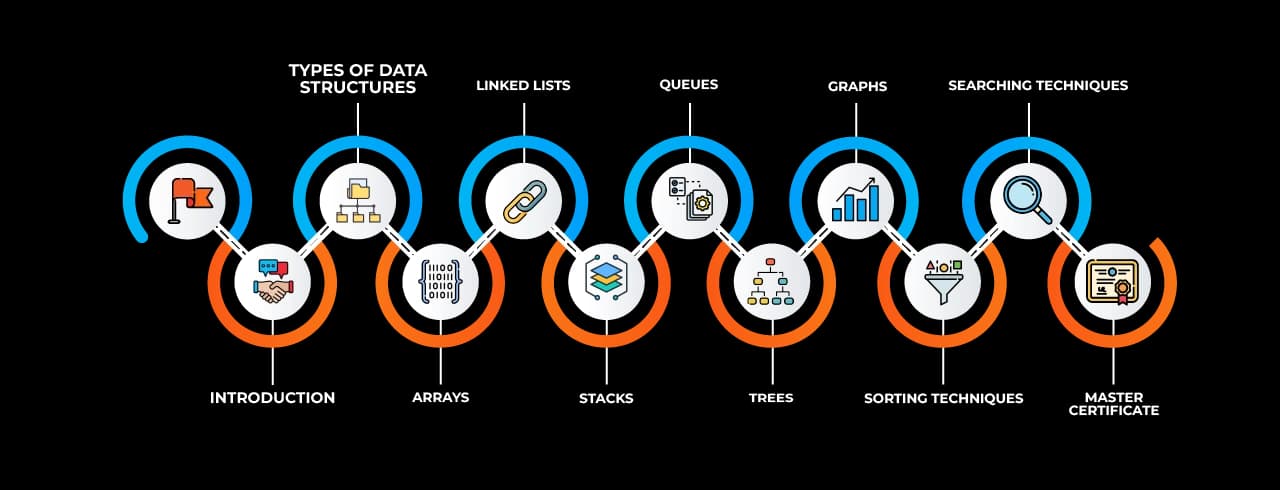
Learning curve for Data Structures with C & C++ Courses in UK

Master In Data Structures with C & C++ Courses in UK Course

OneCourseMultipleRoles

Empower your career with in-demand data skills and open doors to top-tier opportunities.

Software Developer
Data Architect
Database Administrator (DBA)
Data Engineer
Data Scientist
Machine Learning Engineer
Business Intelligence Analyst
Data Analyst
Quantitative Analyst and Data Storyteller

Skills & Tools You'll Learn -

C iconCA procedural programming language for system and application development.
C++ iconC++An object-oriented programming language with features like classes and polymorphism.
Tools & Software iconTools & SoftwareIDEs and utilities for coding, debugging, and compiling C/C++ programs.
Creating Array iconCreating ArrayDeclaring and initializing a collection of elements of the same type.
Types of Array iconTypes of ArrayOne-dimensional, multi-dimensional, and dynamic arrays.
Operations on Array iconOperations on ArrayInsertion, deletion, traversal, searching, and sorting.
Creating Linked List iconCreating Linked List Defining nodes and linking them dynamically in memory.
Types of Linked List iconTypes of Linked ListSingly, doubly, and circular linked lists.
Operations on Linked List iconOperations on Linked ListInsertion, deletion, traversal, searching, and reversing.
Creating Stack iconCreating StackImplementing a LIFO data structure using arrays or linked lists.
Terms in Stack iconTerms in StackPush, pop, top, underflow, overflow.
Operations on Stack iconOperations on StackPush, pop, peek, and checking for empty/full conditions.
Creating Queue iconCreating QueueImplementing a FIFO data structure using arrays or linked lists.
Terms in Queue iconTerms in QueueFront, rear, enqueue, dequeue, overflow, underflow.
Creating Tree iconCreating TreeDefining a hierarchical structure with nodes and edges.
Types of Trees iconTypes of TreesBinary tree, BST, AVL tree, B-tree, etc.
Terms in Trees iconTerms in TreesRoot, parent, child, leaf, depth, height.
Operations on Trees iconOperations on TreesInsertion, deletion, traversal (inorder, preorder, postorder).
Creating Graph iconCreating GraphRepresenting networks using nodes and edges.
Types of Graphs iconTypes of GraphsDirected, undirected, weighted, unweighted.
Terms in Graphs iconTerms in GraphsVertex, edge, adjacency, degree, path.
Operations on Graphs iconOperations on Graphs BFS, DFS, adding/removing edges or vertices.
Searching Methods iconSearching MethodsLinear search, binary search, depth-first search, breadth-first search.
Sorting Methods iconSorting MethodsBubble sort, selection sort, insertion sort, merge sort, quick sort, heap sort.
Code Blocks iconCode BlocksA popular open-source IDE for C/C++ development.

Why Choose SevenMentor Data Structures with C & C++ Courses in UK

Empowering Careers with Industry-Ready Skills.

Specialized Pocket Friendly Programs as per your requirements

Specialized Pocket Friendly Programs as per your requirements

Live Projects With Hands-on Experience

Live Projects With Hands-on Experience

Corporate Soft-skills & Personality Building Sessions

Corporate Soft-skills & Personality Building Sessions

Digital Online, Classroom, Hybrid Batches

Digital Online, Classroom, Hybrid Batches

Interview Calls Assistance & Mock Sessions

Interview Calls Assistance & Mock Sessions

1:1 Mentorship when required

1:1 Mentorship when required

Industry Experienced Trainers

Industry Experienced Trainers

Class Recordings for Missed Classes

Class Recordings for Missed Classes

1 Year FREE Repeat Option

1 Year FREE Repeat Option

Bonus Resources

Bonus Resources

Curriculum For Data Structures with C & C++ Courses in UK

BATCH SCHEDULE

Data Structures with C & C++ Courses in UK Course

Find Your Perfect Training Session

Dec 28 - Jan 3

2 sessions
28
Sun
Classroom/ Online
Weekend Batch
03
Sat
Classroom/ Online
Weekend Batch

Jan 4 - Jan 10

1 sessions
05
Mon
Classroom/ OnlineToday
Regular Batch

Jan 11 - Jan 17

1 sessions
12
Mon
Classroom/ Online
Regular Batch

Learning Comes Alive Through Hands-On PROJECTS!

Comprehensive Training Programs Designed to Elevate Your Career

Phonebook

Phonebook

Bank management system

Bank management system

Plagiarism detection system

Plagiarism detection system

Crossword Puzzle

Crossword Puzzle

Library Management System

Library Management System

Real Estate Property Search

Real Estate Property Search

No active project selected.

Transform Your Future with Elite Certification

Add Our Training Certificate In Your LinkedIn ProfileLinkedIn

Our industry-relevant certification equips you with essential skills required to succeed in a highly dynamic job market.

Join us and be part of over 50,000 successful certified graduates.

Student 1
Student 2
Student 3
Student 4
Student 5
Join 15,258 others learning today
Certificate Preview

KEY Features that Makes Us Better and Best FIT For You

Expert Trainers

Industry professionals with extensive experience to guide your learning journey.

Comprehensive Curriculum

In-depth courses designed to meet current industry standards and trends.

Hands-on Training

Real-world projects and practical sessions to enhance learning outcomes.

Flexible Schedules

Options for weekday, weekend, and online batches to suit your convenience.

Industry-Recognized Certifications

Globally accepted credentials to boost your career prospects.

State-of-the-Art Infrastructure

Modern facilities and tools for an engaging learning experience.

100% Placement Assistance

Dedicated support to help you secure your dream job.

Affordable Fees

Quality training at competitive prices with flexible payment options.

Lifetime Access to Learning Materials

Revisit course content anytime for continuous learning.

Personalized Attention

Small batch sizes for individualized mentoring and guidance.

Diverse Course Offerings

A wide range of programs in IT, business, design, and more.

Course Content

About Data Structures with C & C++

Data Structures form the backbone of computer science and software development. Efficient data organization, storage, and retrieval enable software systems to perform effectively. When paired with powerful programming languages like C and C++, data structures offer unmatched speed and control. That’s why Data Structures with C & C++ Classes in UK have become increasingly popular among students, software engineers, and professionals looking to enhance their coding capabilities.

These courses emphasise practical implementation in C and C++ in addition to providing in-depth theoretical understanding of arrays, linked lists, stacks, queues, trees, graphs, and hash tables. Both languages are essential for comprehending the inner workings of data structures because they offer a low-level understanding of memory and resource usage.

The technical aspects of Data Structures with C & C++ Courses in UK are covered in detail in this article, along with their advantages and an overview of the various training options, including corporate and online.


Why Learn Data Structures with C & C++?

The foundational languages in computer science education are C and C++. They enable programmers to apply effective algorithms, comprehend system-level behaviours, and directly manipulate memory. Acquiring knowledge of these languages' data structures gives students vital problem-solving abilities.

Unlike high-level languages that abstract memory management and data handling, C and C++ make it evident how operations like insertion, deletion, traversal, and searching truly work under the hood. SevenMentor’s Data Structures with C & C++ training in UK enables learners to write optimized code, minimize resource consumption, and develop scalable applications.

Whether you aspire to crack technical interviews at top tech companies or contribute to large-scale system development projects, mastering data structures with these languages will set you apart.


What You Will Learn in Data Structures with C & C++ Classes in UK

The curriculum of these classes offered by SevenMentor is comprehensive and carefully structured to help learners at all levels. Here are some technical concepts and implementations typically covered:


Arrays and Strings

Arrays are the simplest data structures and form the base for many complex structures. Classes begin with single and multidimensional arrays, operations like sorting and searching, and dynamic memory allocation. Strings, treated as arrays of characters, are explored for their manipulation functions and storage optimizations.


Linked Lists

Singly, doubly, and circular linked lists are introduced with C and C++ implementations. Students learn about pointer manipulation, dynamic node allocation, insertion and deletion at various positions, and memory deallocation strategies.


Stacks and Queues

These linear data structures and their applications are taught next. Students implement stacks using arrays and linked lists, explore postfix and prefix notations, and understand how stacks are used in recursion and backtracking algorithms.

Queues cover types like circular queues, priority queues, and dequeues. Real-world problems such as scheduling and buffering are also discussed.


Trees and Graphs

Hierarchical and non-linear structures such as binary trees, AVL trees, B-trees, and heaps are explored extensively. Traversal techniques like preorder, inorder, and postorder are implemented in C and C++. Graphs are studied using adjacency matrices and lists with depth-first and breadth-first search algorithms.


Hashing and Advanced Topics

Hash functions, collision resolution techniques, and open addressing are taught in-depth. Advanced concepts like tries, segment trees, and disjoint-set data structures are sometimes included in advanced modules.

The practical orientation of Data Structures with C & C++ Classes in UK ensures that you not only understand these concepts but also know how to apply them in real-world coding scenarios.


Advantages of Data Structures with C & C++ Courses in UK

One of the most significant advantages of these courses is that they balance theory with practical experience. Learners gain insight into both algorithmic design and system-level implementation. Some benefits include Strong understanding of memory management and pointer arithmetic, Ability to optimize code for time and space complexity, Enhanced problem-solving skills for competitive programming and interviews, Exposure to both procedural and object-oriented programming paradigms, and Ability to work on embedded systems and low-level hardware programming.

By completing Data Structures with C & C++ Courses in UK, learners position themselves for career opportunities in software development, game development, system programming, and research.


Learning Approach and Methodology

Classes offered by SevenMentor are structured to include lectures, hands-on coding labs, real-world project assignments, and assessments. The hands-on nature is crucial, as C and C++ require precision and attention to detail when working with pointers and dynamic memory.

Students often work on assignments that involve building their own implementations of libraries and data structures instead of relying on built-in ones. This experience builds confidence and clarity about how data structures operate internally.


About SevenMentor

When it comes to choosing a training provider, SevenMentor the best training institute for Data Structures with C & C++ Training stands out as a leader in the field. Their decades of experience in teaching computer science subjects, their highly qualified instructors, and a curriculum aligned with industry requirements make them the go-to choice for many aspiring professionals.

SevenMentor, the best training institute for Data Structures with C & C++ Training provides structured learning paths, one-to-one mentorship, doubt-clearing sessions, and robust placement support. Their focus on both conceptual clarity and practical mastery ensures learners are ready to take on real-world challenges confidently.


Real-World Applications

The skills learned in these classes are applicable in several fields Software development: writing efficient, scalable code, Game development: managing memory-intensive graphics and simulations, Operating systems: understanding kernel-level data management, Embedded systems: working with limited hardware resources, and Data-intensive research: building customized, high-performance data processing pipelines.

By applying the knowledge from Data Structures with C & C++ Classes in UK, learners can contribute to impactful, innovative projects across industries.

Data Structures are at the heart of efficient software systems, and mastering them using C and C++ gives learners unparalleled insight and ability. With structured classes, hands-on implementation, and expert guidance, learners can gain deep expertise and confidence. Whether you aim to ace technical interviews, improve coding efficiency, or understand the foundations of computer science more thoroughly, enrolling in these classes is a wise investment in your future.

Choosing SevenMentor the best training institute for Data Structures with C & C++ Training ensures you receive world-class instruction and career support. Their commitment to excellence has helped thousands of learners achieve their goals.


Online Data Structures with C & C++ Training

SevenMentor offers comprehensive online Data Structures with C & C++ Courses in UK that maintain the same level of rigor and hands-on experience as in-person classes. Students benefit from interactive live sessions, recorded lectures for later review, online coding exercises, and virtual labs that mimic real-world environments. 

Discussion forums and chat support allow learners to resolve doubts in real time. Many learners prefer online training for its flexibility, allowing them to balance learning with other commitments. The online Data Structures with C & C++ training in UK ensures that geographic boundaries do not limit your learning opportunities.


Corporate Data Structures with C & C++ Course

SevenMentor also offers customizable corporate Data Structures with C & C++ Classes in UK. Businesses often need their developers to write efficient code, optimize applications, and solve complex technical problems—skills that these classes provide.

Corporate training programs are tailored to the organization’s specific needs. Whether the focus is on algorithmic optimization, system programming, or preparing employees for advanced certifications, SevenMentor crafts customized sessions that deliver measurable results. SevenMentor the best training institute for Data Structures with C & C++ Training partners with organizations to deliver in-house or virtual corporate training programs, ensuring minimal disruption to workflows while maximizing learning outcomes.

Frequently Asked Questions

Everything you need to know about our revolutionary job platform

1

What is the eligibility to study data structures in C/C++?

Ans:
To study "Data Structures with C/C++", you need a solid foundation in either C or C++ programming languages, including basic concepts like variables, loops, conditional statements, functions, and ideally some understanding of pointers, as these are crucial for implementing data structures effectively in both languages.
2

What is the C and C++ data structure?

Ans:
Data structures are tools for storing and organising data. An array is a data structure that allows for the storage of several elements in a single variable. C++ also supports several other data structures, each of which is used to manage data in a different way
3

Is it tough to perform DSA?

Ans:
DSA may appear difficult at first, but with the appropriate technique and enough practice, it becomes far more manageable. The goal is to start with the fundamentals, practice consistently, and recognise common problem-solving patterns. What seems to be challenging will become easier and more natural with time.
4

Is it difficult to perform DSA in Python?

Ans:
Is DSA difficult to understand? DSA is a bit more difficult than learning the fundamentals of a programming language. With practice and determination, you can grasp the fundamental ideas of DSA.
5

Is DSA in C appropriate for placement?

Ans:
DSA is essential for obtaining a position in any product-based organisation. You will be hired if you have a strong understanding of DSA and have completed assignments. However, having 4-5 years of experience will improve your resume. In addition to DSA, you should understand the fundamentals of system design.
6

Can I learn DSA without first understanding C++?

Ans:
Is it possible to study DSA without understanding any programming languages? A: It's difficult. A basic familiarity of programming fundamentals is suggested.
7

Which came first: web development or DSA?

Ans:
So the proper approach is to devote time studying data structures first, then go on to web development, and then devote 5-10 hours a week to data structure practice. This will allow you to flourish in software development while also providing you with a solid foundation in data structures.
8

C or C++ are better for DSA?

Ans:
However, if you are learning C for the first time, I would recommend C++. C++ is what I use for all of my DSA interviews and coding challenges. I like to write and debug code in C++. I hope this clarifies things.
9

Should I perform DSA using Python or C++?

Ans:
Conclusion. Finally, the decision between DSA with C++ and Python is influenced by a variety of considerations, including performance constraints, code complexity, and the necessity for rapid prototyping. C++ is well-suited for performance-critical applications and scientific computing, but Python is popular for web development and machine learning.
10

Is it appropriate to learn DSA in C?

Ans:
The following are the reasons why the C language is ideal for learning data structures and algorithms: Deep learning: The C programming language demands the programmer to manually implement each feature, which aids in learning how data structures work at a fundamental level.
11

What are the advantages of a data structure in programming?

Ans:
Data structures are required for developing efficient algorithms. It facilitates reusability and abstraction. Using suitable data structures can help programmers save time while executing data operations including storage, retrieval, and processing. Manipulation of enormous volumes of data is simplified.
12

What is the importance of data structure in C?

Ans:
Data structures are important for two reasons: they make the code more efficient and easier to understand. In terms of efficiency, data structures assist the computer run the code faster by organising the data in an easy-to-process format.
13

What are the different applications of data structures?

Ans:
Data structures are useful in a variety of disciplines and are required for the development of efficient algorithms. Here are some important applications of data structures. Database Management Systems (DBMS) B-trees and hash tables are essential for indexing and organising database data.
14

What is the advantage of having structure in C++?

Ans:
One of the major advantages of a struct is that it allows us to transfer the complete structure to another function without having to pass each variable separately. We may also add members to the struct without having to rewrite all of the functions.
15

Is DSA important for job creation?

Ans:
DSA is essential for obtaining employment in any product-based organisation. You will be hired if you have strong DSA knowledge and have completed projects. However, having 4-5 years of experience would enhance your résumé. In addition to DSA, you should be familiar with the fundamentals of systems design.

Explore Other Demanding Courses

No courses available for the selected domain.