Data forms the foundation of all businesses in this age of digital and internet technology. Whether a small startup or a large international enterprise, successfully managing data is essential for success; this is where databases can be helpful. Having an understanding of the benefits and drawbacks of using a database enables both business and non-business users to make better decisions with regard to how they store, manage, and protect their data.
This comprehensive database guide will teach everything you need to know about databases. You'll learn what benefits databases provide, the limitations of databases, examples of databases in the real world, and how learning databases can advance your career.
What is a database?

A database is an ordered system of organized data that can be readily accessed, manipulated, and modified. It is usually managed by a database management system (DBMS), which facilitates the effective storing and handling of data.
Databases may include the following systems:
- Banking: a banking system to store details about customers
- E-commerce: an e-commerce platform to store product data
- Education: an educational system to track students' records Common
Types of Databases:
Why Databases Are Important in Today’s World
Databases may have both pros and cons; nevertheless, before discussing either, it is vital to understand their importance. In today's environment of large data sets,
Businesses need to use databases for the following:
- to save large quantities of information.
- Retrieve data quickly
- Maintain data integrity
- Support decision-making
Without databases, managing data manually would be inefficient and error-prone.
What Is a Database Management System (DBMS)?
A Database Management System (DBMS) is software that allows users, applications, and databases to interact with one another so that they can collect and analyze data.
Popular DBMS Examples
- MySQL
- Oracle Database
- Microsoft SQL Server
- PostgreSQL
A DBMS ensures that data is
- Organized
- Secure
- Easily accessible
- Efficiently managed
Why Do We Need a Database?
Understand why we need a database, and you will appreciate how important it is now for many applications.
1. Data Organization
Data: Without databases, managing large amounts of data is a chaotic mess. Using a database restructures data into a table format, which makes management much easier.
2. Quick Data Retrieval
Information databases allow information to be searched and filtered, allowing a quick access to retrieve data.
3. Data Security
Data that contains any confidential information, such as passwords and bank accounts, will be securely protected through access controls and encryption.
4. Data Consistency
Data databases provide a way to maintain the integrity of data by ensuring it remains accurate and consistent regardless of how many users or systems access the same data.
5. Multi-User Access
Multiple users can access and update data simultaneously without conflicts.
Types of Databases

There are different kinds of databases, which are designed for certain use cases.
1. Relational Databases.
These are the most commonly used databases where data is stored in tables.
Examples: MySQL, Oracle
Best for: Structured data
2. NoSQL Databases
Designed for unstructured or semi-structured data.
Examples: MongoDB, Cassandra
Best for: Big data and real-time applications
3. Hierarchical Databases
Data is organized in a tree-like structure.
Best for: Applications with parent-child relationships
4. Network Databases
Data is stored in a graph structure, allowing many-to-many relationships.
5. Cloud Databases
Hosted on cloud platforms for scalability and remote access.
Examples: Amazon Web Services RDS, Google Cloud SQL.
6. Object-Oriented Databases
Stores data as objects, which is a feature of many programming languages.
Explore Other Demanding Courses
No courses available for the selected domain.
What Is a Database? Types, Examples, Advantages, Disadvantages
A database is a tool for more than just storage; it is for effective management of data. Each type of database has its own set of strengths and limitations.
Example Scenario.
An e-commerce platform:
- Uses a relational database for transactions
- Uses a non-relational database for product recommendations.
This is an improvement in terms of performance and scalability.
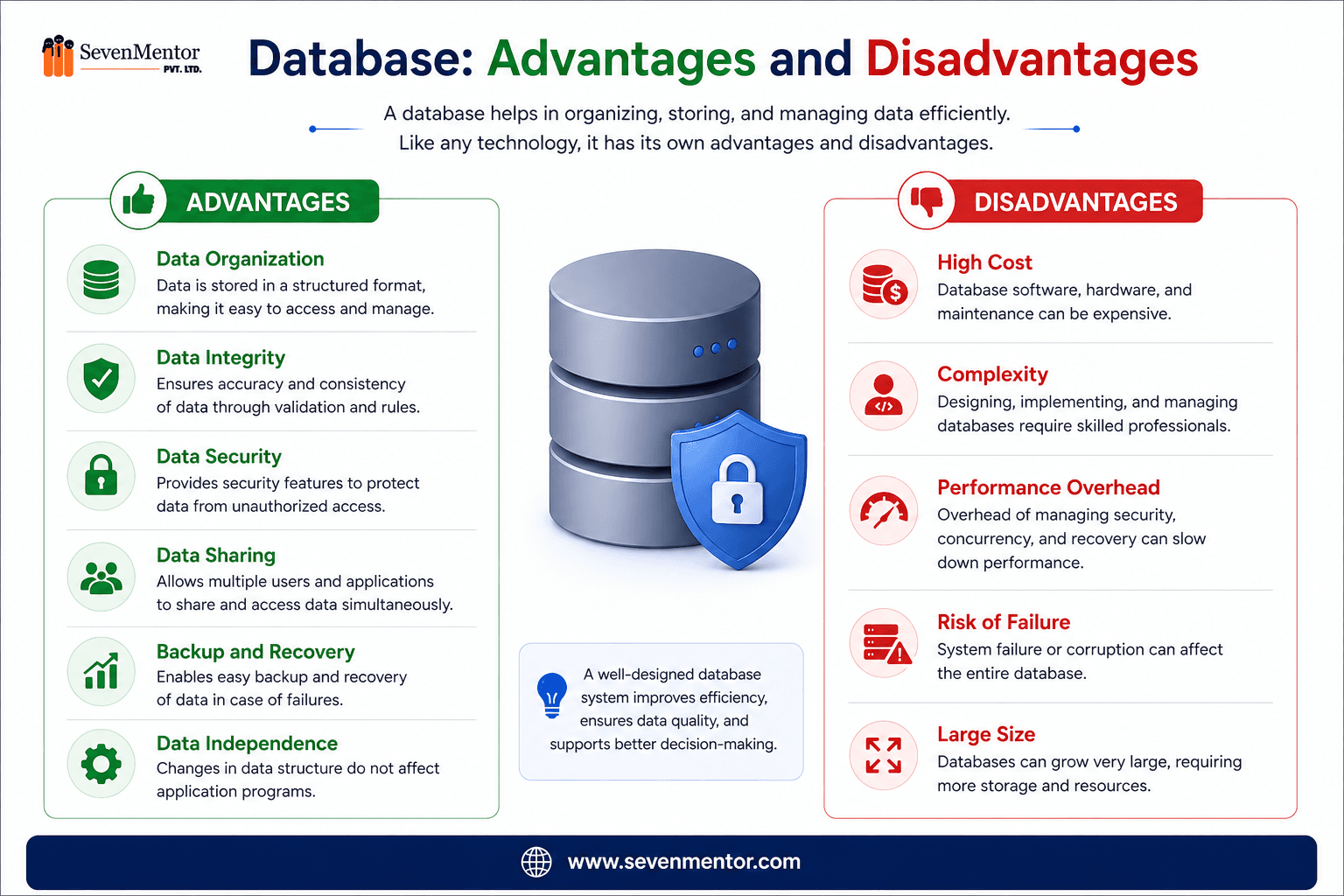
Advantages of Database Management System (DBMS)
Understanding the benefits of database management systems brings out the fact that businesses put great value in DBMS.
1. Data Integrity and Accuracy
DBMS, whose data is made to be consistent and accurate through constraints and validation rules.
2. Improved Data Security
Access control systems prevent unauthorized users from accessing sensitive data.
3. Data Redundancy Reduction
DBMS, which reduces data redundancy, thus saving storage space and improving efficiency.
4. Better Data Sharing
Multiple at the same time may work with the data, which in turn improves collaboration.
5. Backup and Recovery
Today’s DBMS systems provide for automatic backup and recovery, which in turn reduces data loss.
6. Data Independence
Applications can grow and change, which will not impact the database structure.
7. Efficient Query Processing
Using SQL to get at the data you want right away.
Importance of Mastering SQL Basics Before Diving into Databases
One of the often-ignored points is that which says to first learn the basics of SQL before jumping into databases.
What Is SQL?
SQL (Structured Query Language) is used to:.
- Insert data
- Retrieve data
- Update records
- Delete data
Why SQL Is Important
1. Foundation of Databases
SQL is at the core of most relational databases.
2. Better Data Handling
Understanding how SQL works will get you far in terms of performance and control of your data.
3. Career Opportunities
SQL skills are very much in demand for the following roles:.
- Data Analytics
- Database Administrator
- Software Developer
4. Improved Problem Solving
SQL is a tool that allows you to get out useful data from that into which you can put anything.
Example SQL Query
SELECT name, salary FROM employees WHERE salary > 50000;
This basic query is for employees who earn over a certain value.
Best Practices for Using Databases
- Normalize data to reduce redundancy
- Regularly back up data
- Implement strong security measures
- Optimize queries for performance
- Monitor database health
Conclusion
Understanding what a database is, which types there are, and which pros and cons come with database management systems puts you on the path to effective work in today’s digital world. While DBMS presents great tools for efficient data management, it also brings in issues of cost and complexity. Also, with proper knowledge in particular, a strong base in SQL, you may fully leverage databases. In short, databases are not only a tech tool; they are the foundation of modern apps and businesses.
FAQs
1. What is a database in simple terms?
A database is a structured collection of data that can be easily accessed, managed, and updated.
2. What are the advantages and disadvantages of database management systems?
Advantages: Data security, consistency, easy access
Disadvantages: Cost, complexity, maintenance
3. Why do we need a database?
We need databases to store, manage, and retrieve large amounts of data efficiently and securely.
4. What are the main types of databases?
The main types of databases include relational, NoSQL, hierarchical, network, cloud, and object-oriented databases.
5. Why is SQL important before learning databases?
The importance of mastering SQL basics before diving into databases lies in its ability to help you interact with and manage data effectively.
Related Links:
Java Design Patterns You Should Learn
Do visit our channel to know more: SevenMentor
SevenMentor
Expert trainer and consultant at SevenMentor with years of industry experience. Passionate about sharing knowledge and empowering the next generation of tech leaders.
Call the Trainer and Book your free demo Class..... Call now!!!
| SevenMentor Pvt Ltd.
© Copyright 2025 | SevenMentor Pvt Ltd.