What Does the Dot Net Full Stack Course at Sevenmentor Cover?
Our Dot Net Full Stack Course is designed with a single mantra—by the time you complete the course, you should be able to develop a full-fledged web application. Yes, that’s the mantra, and we start with that and design the course to achieve that. So, we start with a small example and then gradually keep on increasing the complexity of the examples. We start with a simple example of a button click and how it leads to a server response or a form submission and how the data in the form is sent to the server. As we progress through the examples and increase the complexity of the application we are working with, you will learn the entire .NET Full-stack development and the individual layers and their components and interactions.
This includes the C# programming language, ASP.NET Core web application development, and SQL Server data storage, as well as a front-end framework such as Angular or React for the client side of your application.
You will find out how each of the layers of .NET full-stack development interacts with each other. A click on the browser would result in a database query. It would then retrieve the data from the database and return it as a clean and usable response on screen.
What the course covers:
C# programming fundamentals and object-oriented concepts
- ASP.NET Core and MVC ASP.NET for server-side coding
- SQL Server for storing data as well as creating relationships between them and also stored procedures.
- Client-side development using HTML, CSS, JS and a front-end framework like Angular or React.
- Building complete, deployable full-stack projects
- API creation, consumption, and integration
- Debugging, testing, and real-world deployment practices
Our full stack .NET course is more than just learning .NET in a classroom. It is learning .NET the way it is used at workplaces around the world.
Why Should You Learn Dot Net Full-Stack Development Right Now?
With a Dot Net Full Stack Course in 2026, is it worth your while? .NET applications are widely used in finance, healthcare, logistics, insurance, and large enterprise systems. These industries do not require designers of websites or people who can write a backend endpoint. Instead, they require .NET full-stack developers who can understand the entire application, including user interaction and database work.
Why full stack .NET skills matter right now:
- High demand across enterprise software development and product companies.
- .NET's strength in secure, scalable application development
- Full-stack .NET developers have knowledge on how data flows in an application from user input over all layers of an application to a database and back on the screen as clean data.
- Ability to work with cross-functional teams of front-end, back-end and database developers.
- Valuable for companies maintaining large legacy .NET systems
- The skills learned as a full stack developer can also lead to strong career mobility to work as a junior developer and advance to architect-level roles within a short period of time.
Learning full stack is more than just checking off a list of resume skills. It changes the way you think about a problem—viewing the entire application rather than just the small part where you are contributing.
How Is the Dot Net Full Stack Course Structured at Sevenmentor?
Sevenmentor’s Dot Net Full Stack training program is structured in 5 phases in sequence so as to avoid an abrupt transition from one phase to another.
At first, the core of the C# programming language is to be learned in small console applications, in which variables, cycles, and conditions as well as the basics of the object-oriented programming are to be implemented. Also, first error handling is to be implemented. Afterwards, work with ASP.NET Core and MVC is to be learned. The students will get to know the controllers and the models as well as the views. The students also are going to learn how to work with forms and how to validate them as well as where the routing and the filters are to be applied for in the request processing. Then, we proceed to work with SQL Server and learn how to create joins and stored procedures and work with data using Entity Framework or ADO.NET. The fourth phase is dedicated to the front-end part, i.e., HTML5, CSS3, JS, and a front-end framework such as Bootstrap and either Angular or React, depending on the batch. In the final phase, we put everything we learned into practice in the projects, creating, for example, login systems, admin panels, dashboards, etc.
The five-phase structure:
- Phase 1: C# programming fundamentals and OOP basics
- Phase 2: ASP.NET Core / MVC — controllers, validations, CRUD, APIs
- Phase 3: SQL Server — queries, joins, stored procedures, Entity Framework and more other features to manage data in SQL Server database.
- Phase 4: Front-end development with HTML, CSS, JS, and Angular/React
- Phase 5: Full-stack projects—login systems, admin panels, and dashboards.
At the end of each phase the student will find small drills where he will be able to apply his recently acquired knowledge.
Is Online Dot Net Full Stack Training as Effective as Classroom Learning?
With modern technology it is possible to learn Dot Net Full Stack Development online, and that too effectively for most learners, especially working professionals. Sevenmentor’s Dot Net Full Stack Online Course on Dot Net Full Stack Development is being conducted in live, online, instructor-led sessions and not as pre-recorded videos on YouTube, etc. As students attend live sessions, they can ask for clarification and get their code reviewed and their doubts cleared on the spot.
Live class sessions can be recorded, but what matters is that the online learners can go back to the recording of the session as many times as they want. The same holds good for a concept like ASP.NET Core or SQL Server joins, which do not sink in the first instance but can be understood when revisited. As an online learner, if you are based out of the USA and your colleagues are based out of India, then the live sessions could coincide at most times. However, the recordings will remain, and you can watch it as many times as you want, especially when you are juggling between your work and the online course for Dot Net Full Stack.
What online learners get:
- Live, instructor-led classes — not static recordings
- Full access to session recordings for revision
- The same project files, assignments, and notes are given to online learners as are given to students in the classroom sessions of the Dot Net Full Stack course held by SevenMentor.
- Each small practice task (like a SQL exercise, a UI component, or even a full module) can be uploaded to a server for checking by the instructors and other students.
- Flexibility to structure learning around work schedules
- Direct doubt-solving with the trainer during live sessions
The same rhythm is maintained whether you are learning online or in a classroom. You learn a concept. You see an example of it. You implement a small part of it for your homework. You test it.
Does Sevenmentor Offer Corporate Dot Net Training for Teams?
A batch of training sessions for a team of developers who already work on a live .NET codebase and hence need training tailored to enhance their skills to work on their current projects without any interruption to work in progress. Sevenmentor’s Corporate Batches are designed for companies with existing .NET codebase(s) that are being developed / maintained / scaled and need the developers to be upskilled so as to tackle challenges faced by them in their current projects.
Trainers from Sevenmentor review a company’s existing stack of technologies, current projects the team is working on, and problems the team faces on a day-to-day basis. Stack analysis is carried out to develop the whole session plan for training as the trainer tries to solve the practical problems being faced by the team, like queries running slow, poorly written code, integration problems, and many others.
Corporates normally train on the following:
- Writing good and maintainable .NET code
- Speeding up backend development workflows
- API optimisation and integration improvements
- Improving SQL Server performance
- Building reusable components across projects
- Reducing time spent on debugging
- Structuring modules for long-term maintainability
Depending on the organization’s needs, we can conduct the training sessions on-site or online. Our training methodology differs significantly from that of typical courses conducted for employees in a room, who generally work on different projects/stacks. Our training is customized, post review of the exact stack that the team is working on and problems that they are facing on a day-to-day basis.
What Career Opportunities Open Up After a Dot Net Full Stack Course?
A Dot Net Full Stack Course, where does it lead? .NET is predominantly used to power enterprise and product software and, therefore, the jobs of a full stack. NET developers are plenty and steadily increasing across IT services firms, product companies, consulting shops, and large enterprises.
In the case of the Dot Net Full Stack Course, most of the students land a job as a Junior .NET Developer and then keep moving up to a Mid Level Developer role within a few months as they start to work on real-life projects and keep gaining experience.
Common roles after the course:
- Junior .NET Developer
- Full Stack .NET Developer
- ASP.NET Core Developer / MVC Developer
- Backend Developer
- API Developer
- SQL Developer
- Application Support Engineer
- Career path and salary structure:
Indian freshers are expected to make 3 LPA to 6 LPA. Experienced candidates (with few years of experience) are expected to make 6 LPA to 12 LPA. Long experienced candidates are expected to reach the level of Senior developer / Technical lead / Software architect / Product Engineer etc.
With a couple of years of work experience, one can expect to move up the ladder to earn between 6 and 12 LPA as a full stack .NET developer.
As one grows in experience, one can graduate to senior developer, technical lead, software architect, product engineer, and many more roles in the field.
As long as a lot of companies use .NET for secure, long-term, scalable applications, there will be a demand for full-stack developers and not just for developers that are working on a single layer of the stack.
How Does Sevenmentor Address Common Training Concerns in the Dot Net Full Stack Course?
People write a lot of reviews online where they compare various IT training companies, usually criticizing them for not delivering promises related to placements. However, at the same time, the learners complain of the inconsistent quality of trainers imparting the training, and it eventually reduces after they pay for the training course. We at SevenMentor have designed SevenMentor’s Dot Net Full Stack Course to combat these issues, and we put forth the facts the way they are rather than giving any defensive stand.
How the course is built to avoid common training pitfalls:
- Small batch sizes so doubts get answered individually, not lost in a crowd
- The same 5-phase structured course is taught in all batches—C# Programming, ASP.NET Core, SQL Server, Frontend Development, and the Full Stack Project.
- Recorded live sessions for the online learners. So even if they miss a class for whatever reason, they can always go back and learn whatever they had missed.
- Students attending online classes & students attending classroom training will have access to the same project files, same assignments, and same study notes.
- Each of the major topics is followed by a number of assignments, which help you to put to practical use the .NET skills that you have learned through the course.
We include corporate-style project simulations like Login System, Admin Panel, Dashboard, etc. as part of our .NET Full Stack Training to make you industry-ready for taking up a job as soon as you complete your course. These project simulations are more real-life projects rather than just for study purposes and help students in gaining expertise to design and develop full-stack applications on their own.
Trainers are available for debugging/code review/doubt clearing for all projects throughout the course.
Our aim is to provide the best .NET Full stack learning experience to our students and deliver on what we promise in the syllabus.
What Other Skills Can You Pair With a Dot Net Full Stack Course for a Stronger Career?
Is a Dot Net Full Stack Course enough on its own, or is it better to pair it up with other courses as well? For most of the students who are looking to get a job as a developer, .NET full-stack skills are more than enough to get them a decent job and help them get started with their development career. But if you want to grow faster in your job or get a better job of a specialized nature, then pairing up a .NET full stack course with a few other courses at Sevenmentor can make a huge difference and can make your profile look much better in the eyes of the employers, as they are not just looking for a developer who can write code but also someone who can understand data, deployment, and security related to the applications that he develops.
Courses that pair well with Dot Net Full Stack Development:
- Data Science – A course which enables you to create data-driven web applications on top of your .NET developed backend.
- Data Analytics – helps to analyze user behavior and application performance after the application has been deployed.
- Python – it is also used for the back-end of the web application and for the automation of the .NET systems.
- Cloud Computing – a way to deploy and scale. Net applications in production.
- Cyber Security – This will enable you to create secure web applications, which are a must requirement for large enterprise roles.
- SAP – This would be highly relevant for someone looking to develop solutions for large organizations / enterprises and develop solutions using SAP software.
- Generative AI & AI Course – Building Intelligent Features into Applications
- ChatGPT Course – for adding AI-powered chatbot integration to your projects
- DevOps – enables learning about continuous integration and continuous delivery/deployment of an application.
- Power BI – for building data visualization dashboards on top of application data
- Salesforce – useful for CRM-based web solutions in enterprise environments
- Java – For the developer who builds applications on multiple stacks and wishes to be a versatile developer who can deliver solutions using web applications for enterprises as well.
So, even adding one or two extra courses on top of the .NET Full Stack course that you have signed up for at Sevenmentor to develop into the ultimate developer can really add value to your .NET Full Stack profile that you will be presenting to recruiters.
Got Questions? Here Are Some FAQs
1. What is a Dot Net Full Stack Course?
A Dot Net Full Stack Course will help you to create full-fledged web applications using the back-end of Microsoft’s .NET framework and the front-end consisting of HTML, CSS, JavaScript and Angular or React. You’ll learn to create full stack for full application from client side to server side.
2. What topics are covered in a Dot Net Full Stack Course?
A Dot Net Full Stack Course would cover topics like C#, ASP.NET Core, Entity Framework, Web API, SQL Server and front end technologies like Angular or React for the client side. And using a version control system like Git for collaborative development. So basically a full stack web application development using the whole of .NET for the back end and front end as well.
3. Is prior programming knowledge required to join this course?
Major institutes in the market today are designed to teach Full Stack .NET from scratch. Hence, they start teaching students the fundamentals of C# followed by Object Oriented Programming (OOPs) concepts and later dive into advanced .NET technology stack.
4. What career opportunities are available after completing this course?
A graduate of Dot Net Full Stack Course will be able to work as .NET Developer, Full Stack Developer, Software Engineer, Backend Developer. As .NET is used by most of enterprises for developing scalable business applications in banking, health care, and corporate sectors.
5. How long does it take to complete a Dot Net Full Stack Course?
Duration of the Full Stack .Net Course is around 3 to 6 months. Duration of Full time course is less as compared to Part time or Weekend Course. Full time Course duration is around 3 to 4 months. And Part time or Weekend Course duration is around 4 to 6 months.
blog Links:
Anthropic AI Tool
What is Writesonic
What is Claude AI
AI Engineer Roadmap
What is JasperAI
What is Copy AI
Do visit our channel to know more: SevenMentor
 Become a Job-Ready Dot NET Full Stack Developer with Real-World Projects
 Transform Your Coding Skills with .NET Full Stack Training at SevenMentor Institute
 Build Scalable, High-Performance Applications with .NET Expertise
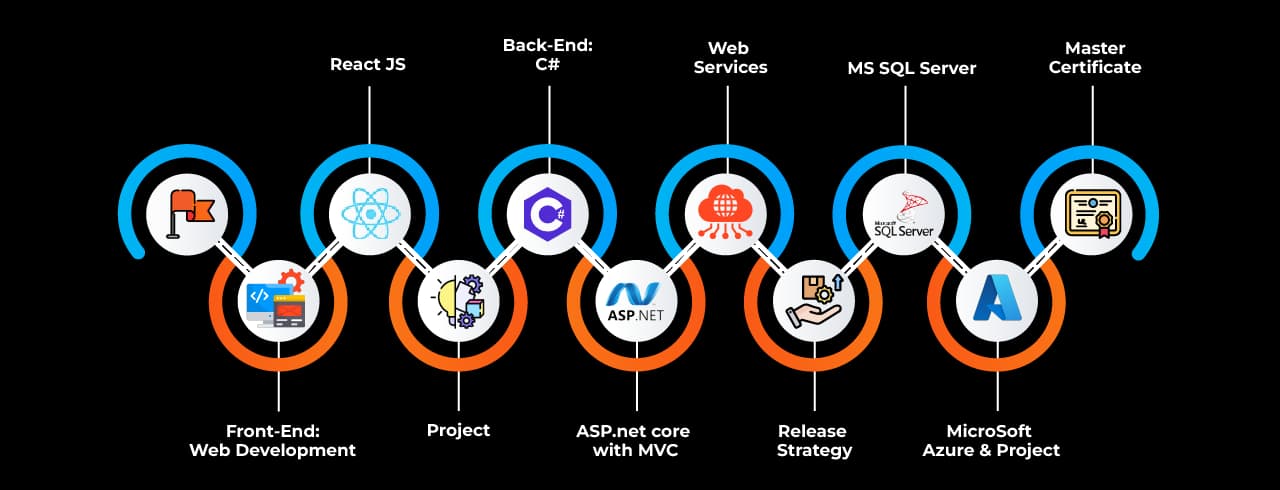
 React.jsDevelop dynamic and high-performance front-end applications using the React.js library
 C#Master C#, a powerful object-oriented language, for back-end development in the .NET ecosystem.
 ASP.NETBuild robust and scalable web applications using ASP.NET framework.
 ASP.NET Core with MVC Develop modern web applications using ASP.NET Core with MVC architecture for better maintainability.
 Web ServicesLearn how to create and consume RESTful and SOAP web services for seamless communication between applications.
 MS SQL ServerWork with MS SQL Server for efficient database management and querying.
 Microsoft Visual StudioUtilize Microsoft Visual Studio as a powerful IDE for .NET development.
 NuGet Package Manager Manage dependencies and libraries efficiently using NuGet in .NET projects.
 Entity FrameworkImplement ORM with Entity Framework for seamless database interaction in .NET applications.
 Postman Test and debug APIs efficiently using Postman for smooth integration.
 Toastr Implement Toastr for elegant and user-friendly notification pop-ups in web applications.
 Swagger Use Swagger to document, test, and manage APIs effortlessly.
 Architectures in .NET CoreUnderstand various software architectures in .NET Core for scalable and maintainable applications.
 Blazor Develop interactive web applications using Blazor with C# instead of JavaScript.
 Architectures in Web ServicesLearn different architectural patterns for designing efficient web services.
 Microsoft AzureExplore cloud computing with Microsoft Azure for hosting, deploying, and managing applications.
 JavaScript Add interactivity and dynamic behavior to web applications using JavaScript programming.
 HTML & HTML5Learn the fundamentals of web page structure and the advanced capabilities of HTML5 for modern web development.
 CSS3Style and enhance web pages with CSS3, including responsive design, animations, and flexible layouts.
 Bootstrap Utilize Bootstrap to build mobile-first, responsive websites with pre-designed components and a grid system.