What is the Financial Analyst Course at SevenMentor and How Does It Work?
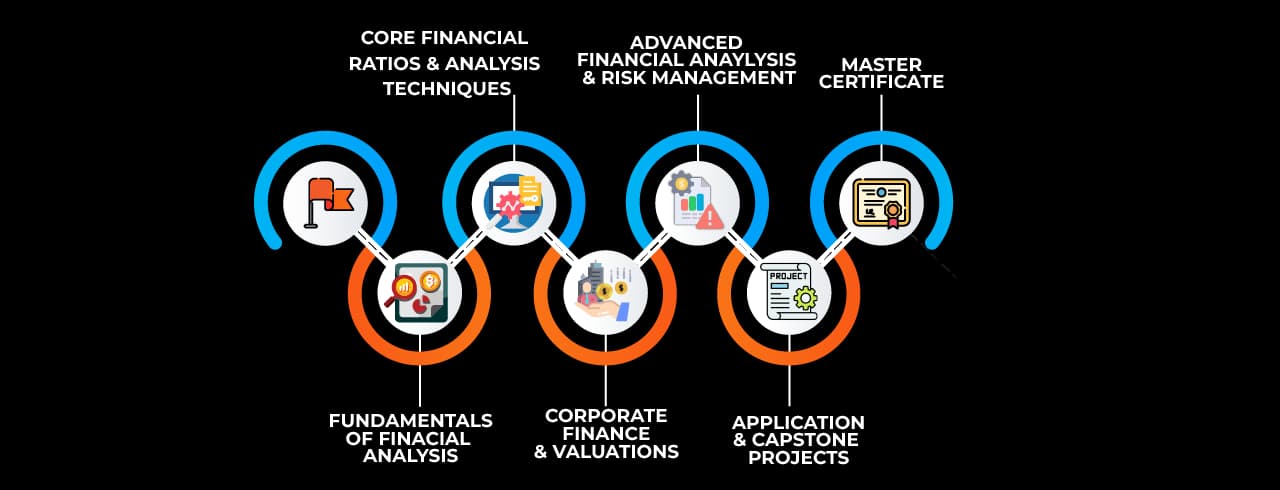
The financial analyst course offered by SevenMentor is structured, keeping in mind practical application of finance rather than theoretical knowledge. Most of the courses are designed to deal with problems faced by finance teams of organizations on a day-to-day basis. For example, how monthly reports can be generated on time, why and how corporate budgets go haywire, and why a balance sheet doesn’t match even when all numbers are correct. Once the student masters these basic concepts, s/he is able to study the more advanced financial concepts and the tools to manage them.
After a good grasp of the various practical concepts is gained, the course proceeds to delve into the more intricate mechanics of the financial world and also the software used to manage it. The financial analyst course makes effective use of authentic corporate data, and it is analyzed in the same manner as one would be done by working with files found in an office. The data analyzed in the course of study includes the following: analyzing sales targets, a detailed cost breakdown of various expenses, a cash-flow statement, and creating a budget from scratch and analyzing it to arrive at a conclusion.
- Practical Case Studies: We use actual data from industries such as manufacturing, banking, IT, and logistics.
- Step-by-Step Curriculum: Start from learning basic data interpretation and gradually move on to learn advanced valuation models.
- Data Cleaning Mastery: Learn to remove erroneous information from data and thereby avoid reporting errors that affect top management’s decision-making.
- Our approach to small batch learning, where you will have ample opportunity for asking & clarifying any doubt in a cohort of students and faculty, runs in very small batches—so to say, it’s just the right size to facilitate the best of all-round learning via interactions.
Why is Enrolling in a Financial Analyst Program Crucial for Your Career Growth?
The skills to conduct a financial analysis are no longer limited to the accounts department. An ever-increasing number of companies from different industries are using their financial information to measure their operating expenses and to secure their profit margins. They are also using this information to decide on capital expenditure and to test the viability of their business decisions over the long term. All of this requires financial intelligence, and anyone who possesses these skills will be an extremely valuable asset to any company. They will be able to secure rewarding and challenging employment within a number of different industries.
True financial intelligence is based on more than just filling in numbers in spreadsheets or creating presentations. A financial analyst is a. a corporate navigator who recognizes even the smallest market trends, b. able to evaluate risks of all financial instruments, c. able to make his organization competitive in times of economic changes, and d. with increasing data centralization in corporate decision-making processes, opens up new fields of application for such special expertise.
- Widespread Industry Demand: Financial analysis skills are currently in high demand in banking, consulting, IT, and manufacturing as well as many other sectors, including startup companies.
- Strategic Visibility: Get from being a back-office executor to being a contributor to the top management’s planning and decision-making process.
- Versatile Professional Roles: He or she can qualify for various positions in areas of operations, of management information systems (MIS), and of corporate consulting.
- Risk Mitigation Expertise: Identify and manage any hidden vulnerabilities to your operation and recognize anomalies in your company’s financial data before they can cause any damage.
- Long-Term Job Security: The analysis functions form the core of a company’s reporting and planning. Therefore, positions in financial analysis are always future-proof.
What Core Technical Skills Will You Master in This Financial Modeling Training?
Our financial modeling training has been designed with the objective of helping you to develop your technical skills in financial modeling in a structured fashion. Thus, in our training programs, you will go from financial literacy to corporate forecasting, i.e., from being able to read a financial model to being able to forecast revenues and expenses of a corporation, using financial statements (i.e., income statements, balance sheets, and cash flow summaries). Our financial modeling training is very practical in the sense that every learning module is linked to a real-life workplace assignment, which means that you will be able to apply immediately the financial modeling skills that you have learned in your workplace.
You will then learn to put all your new knowledge into practice as you learn to master all of the key tools and utilities that are found within the finance function. all delivered through the medium of Microsoft Excel. You will be able to learn to build performance ratios that track and report on key measures and KPIs dynamically, as well as providing senior managers with a comprehensive and easy-to-use summary of all key financial data.
- Decluttering & Structuring Financial Statements (Income Statement, Balance Sheet & Cash Flow Cash Summary): Read between the financial lines to extract value from large financial datasets of Corporations.
- Advanced Cash Flow Analysis: Break down the mechanics of financial statements to track a company’s liquidity and forecast future cash requirements.
- Trend Forecasting Methods: Use historical data in order to develop trend models for future periods (e.g., future quarters) to forecast performance.
- Ratio and Performance Tracking: Using key efficiency, liquidity, and profitability ratios to audit the performance of companies.
- Valuation Model Construction: Construct preliminary corporate valuation models in order to price assets and projects.
- Managerial Reporting: Learn how to package up information from your financial models in highly readable reports that upper management can quickly scan to make important business decisions.
How Does the Online Financial Analyst Course Deliver Flexibility Without Compromising Quality?
SevenMentor's online financial analyst training is designed to reach students with maximum flexibility in their schedules while not compromising on the interactive nature of the live classes of a physical training center. This is perfect for a full-time working professional, or college student, or even a job seeker who has a job already and is unable to commute on a daily basis to a physical location. Our online program does not rely on pre-recorded videos like, say, a static accounting for financial analysis online training, and is delivered through fully interactive live sessions with experienced trainers from the finance industry through live streaming and two-way audio and video and live text communication, thus enabling students to ask questions, participate in discussions, and even get instant screen-sharing assistance, all while the trainer is walking the learners through their spreadsheets to fix any errors or even re-work a financial model.
The SevenMentor Financial Analyst Course has digital assets to support its students in times of need. All live sessions are recorded in high quality and uploaded to the course's Learning Management System (LMS) for reference.
- Live Interactive Classrooms: Experts interact with students over real time audio, video, and text.
- Screen Sharing for live troubleshooting: Trainers can jump onto your computer and guide you through your spreadsheets and other tools to solve any errors or modeling issues in real time.
- On-Demand Recording Vault: All sessions are recorded and provided in high-quality HD videos in the online learning platform for students to refer to later as and when required.
- Modular Skill Assignments: We provide learners with short practical tasks at the end of each module to validate their understanding of the skill.
- Personal Finance Projects: Students work on independent project case studies that will form part of their robust, personalized professional portfolio of work.
- Dedicated Outside-Class Support: SevenMentor has scheduled daily doubt-clearing sessions to provide additional support outside of the class hours for any issues arising with the worksheets.
What Makes Our Corporate Financial Analyst Training the Ideal Solution for Corporate Teams?
This is a B2B financial analyst training offered by SevenMentor for corporate purposes. The financial analyst training program is especially designed to combat reporting delays, inaccurate data, and analysis holds in the corporate departments. The programs can be targeted at the Management Information Systems (MIS) team, the finance department, and other operational data teams within the organizations and help them to get skilled up for producing reports on a regular basis.
Our approach to delivering corporate financial analyst training is hyper-focused on the goals of the company. Rather than teaching employees to implement hypothetical scenarios with fictional data, SevenMentor will train employees using your company’s data in the formats that your team currently uses to perform their work. By taking a no-nonsense, results-driven approach to training financial analysts, the skills learned in training are immediately implemented at work to automate repetitive work, to reduce manual errors in reporting data, and to increase the frequency and quality of analysis. The end result is a team of very productive financial analysts.
- Tailored Company-Data Curriculums: Train your staff on your company’s data. Use your company’s file formats, financial reports, and business models. Reporting Bottleneck Elimination: Preparing monthly and quarterly financial reports on time is a huge help for your corporation's management. Our analyst training course helps eliminate reporting bottlenecks and greatly reduce hours of grueling, tedious work spent in spreadsheets.
- Monthly/Quarterly Financial Reporting: Reporting out the financial data on time and in a correct format every month and quarter without wasting hours of work to prepare.
- Custom Automated Templates: Learn to create custom automated templates that will aid in creating standard and automated reports that can be reused by other team members and management.
- Advanced File Scrubbing Techniques - Equip your workforce to clean and reconcile huge unorganized raw data into information to support financial analysis.
- Flexible Corporate Scheduling: Scheduling our training program around your work hours at peak time in the office, and we also conduct a weekend special training program as well as fast-track boot camp programs for corporate clients.
- Post-Training Performance Metrics: Measuring improvement in skill sets of employees through evaluation sheets & revising classes after the course.
What is the Financial Analyst Career Path and Salary Growth Potential After Graduation?
The Financial Analyst Career Path. A modern business is not possible to run without an analytical mind who is able to interpret numbers reliably. Financial analysts are in demand in every department and at every level within an organization. The 360 Financial Analyst Program is a comprehensive program designed for the ambitious and keen-minded individual to qualify as a financial analyst and move into various roles in various corporations around the world. After 1-2 years as a financial analyst, you would begin to validate data for accuracy and completeness, prepare and manage on a daily or monthly basis reports relating to the operations of a company, and provide basic information to upper management for use in forecasting. In 2-3 years, as a matured junior financial analyst, you would move on to planning for cash flows, determine product costs, and develop models to make accurate forecasts and predictions.
Compensation in this domain increases dramatically with skill, as financial analysts in India are remunerated anywhere between 3 LPA and 5 LPA for entry-level roles, followed by roles such as cash-flow planning, product costing, and predictive models, worth 6 LPA to 9 LPA and upwards for senior specialists, including corporate planning leads.
- Diverse Job Placements: This course will enable you to apply for various job openings immediately after the course, such as Financial Analyst, Junior Analyst, Equity Research Intern, and jobs for a Business Analyst - Level-1.
- In-Demand Core Roles: Step into key operational roles of MIS executive, budgeting assistant & reporting analyst positions.
- Clear Hierarchy: Get promoted from Junior Tracking Executor to Senior Analyst to Finance Manager or Business Planning Lead.
- Cross-Industry Versatility: Financial analysts can find jobs in a large array of industries such as consulting, banks, IT companies, manufacturing units, and logistics units, among many others.
- Rigorous Interview Preparation: Create a portfolio, help enhance your resume, and practice real-life mock interviews in order to get promoted in your current job or land a new financial analyst job.
Why Does SevenMentor’s Structured Approach Guarantee a Premium Learning Experience?
At SevenMentor, we have designed a financial analyst training program to mitigate typical operational frictions in professional training and placement anxieties. Here at SevenMentor, our commitment to total operational transparency, a stringent selection process for our trainers, and above all a student-centric career development roadmap assure you that your investment in us translates into real growth of your career. Our transparent approach to our program and its operational structures ensures that from the very day of your enrollment to the day you receive an offer letter from corporate, you are assured of a top-notch education that is structured, consistent, and quality-rich.
SevenMentor is committed to delivering a learning experience that is protected by a set of institutional commitments. We guarantee your learning format at the time of signing up for the program. If you sign up for offline classes, you can rest assured that you shall learn in a physical classroom only and NOT be shifted to an online learning format in the middle of the program.
- We have Elite Trainers: All our financial analyst training program content is delivered by highly experienced financial experts, who are certified in their respective fields. Our trainers go through a student-driven quality audit on an ongoing basis so that we can ensure that the best knowledge is imparted to our students in the most detailed and methodical manner possible.
- 100% Transparent Fee Structure: We follow a zero-hidden-fee policy. There are no hidden charges after the placement post the official offer letter.
- 100% Verified Job Profiles - SevenMentor’s Corporate Placement Cell pre-screen verifies job profiles of organizations posted on SevenMentor portal to ensure that interview job descriptions are perfectly aligned to learner’s field of study and no projects are assigned to learners to work as unpaid interns or in deceptive bait positions.
- Student-First Placement Rights: Even after a student gets placed at a company, they have the right to reject the offer if it includes any unfair corporate bonds or altered salary package. All the interview drives conducted by SevenMentor are never stopped for any student.
- Prompt Digital Certification: SevenMentor issues digital Course completion certificate instantly after successful evaluation of Learner’s last project in a course that he/she has completed.
How Does Integrating Advanced Tech Stack Tools Elevate Your Financial Analysis Output?
In today’s corporate world, a financial professional is not just confined to number crunching and Excel work. A modern financial professional requires being equipped with tools of a large digital ecosystem. Our program provides a learner with tools of cross-functional technologies that a corporate financial manager uses on a daily basis to manage capital, measure and control risk, and automate day-to-day operations. The tools and knowledge that a financial professional acquires in the program help him or her to develop financial architectures that are secure, scalable, and intelligent and help a CEO or CFO to make strategic and tactical decisions in an organization.
We cover how these state-of-the-art technologies can be used to enhance or even entirely change how you can do your financial reporting and predictive work in your corporate finance job:
- Data Science & Analytics: Build web applications that harness data and analyze user behavior to better measure the performance of portfolios and company operations in real time.
- Python & Java Ecosystems: The majority of the back-end financial applications are written in Python, which we combine with Java for developing web applications of an enterprise scale.
- Cloud Computing & DevOps: Learn how to deploy financial web applications in the cloud, run them on very large numbers of servers, and be very secure. You will learn about continuous integration and deployment (DevOps) so that you can deploy updates to your application’s code and deploy them instantly.
- Cyber Security Frameworks: Implement a variety of security measures to protect financial data as well as web applications from cyber threats to protect corporate assets. We provide our students with training in enterprise solutions such as SAP Accounting and finance solutions and the Salesforce CRM platform, including the integration of these solutions with financial models.
- Generative AI & ChatGPT Integration: Build smart corporate applications and integrate AI-powered chatbots into your work in order to automatically handle common data requests and customer interactions.
- Power BI Visualizations: Create Power BI dashboards that enable senior management to efficiently analyze large amounts of complex financial information in a visually understandable format and thereby easily recognize trends and make appropriate financial decisions.
Got Questions? Here Are Some FAQs
1. What is a Financial Analyst Course?
A Financial Analyst Course is meant to teach people who are interested in finance how to gather relevant data, produce reports on it, to check investments, support in the business’ decisions and more. You will also learn about financial modeling, budgeting and even market analysis.
2. Who can enroll in a Financial Analyst Course?
Financial Analyst Course is intended for all individuals interested in Finance: recent graduates, working professionals, students of Commerce, students of other disciplines looking for career in Financial Analysis and Investment Management.
3. What skills will I learn in a Financial Analyst Course?
This Financial Analyst Course includes skills like financial modeling, data analysis, forecasting, a variety of valuation techniques, working with Excel to create financial reports and managing risk, and more. These are skills required to be successful in a wide array of financial analysis and investment management roles.
4. What are the career opportunities after completing a Financial Analyst Course?
Upon completion of the course participants can get employed as Financial Analysts, Investment Analysts, Budget Analysts, Equity Research Analysts or even Finance Executives in various sectors.
5. Is a Financial Analyst Course suitable for beginners?
Yes, most of the Financial Analyst Courses are developed for beginners, focusing on the basic concepts of finance to advanced topics gradually, hence are suitable for the learners who don’t have any prior experience or knowledge of finance.
Blog Links:
Anthropic AI Tool
What is Writesonic
What is Claude AI
AI Engineer Roadmap
What is JasperAI
 Immersive Learning With Real-World Finance Tools
 In-Demand Skills For A High-Growth Finance Career
 Expert-Led Training With Flexible Learning Paths
 Advanced ExcelMaster pivot tables, financial models, macros, and dashboards — the backbone of every analyst’s toolkit.
 Google SheetsCollaborate in real-time and streamline financial reporting with cloud-based spreadsheets.
 Power BITurn raw financial data into interactive dashboards and actionable insights with Microsoft’s BI tool.
 TableauCreate visually stunning reports and data visualizations to simplify complex financial trends.
 SQLQuery, manage, and extract large datasets to support data-driven financial decision-making.
 PythonAutomate workflows, build models, and apply programming for modern financial analytics.
 NumPyPerform fast, efficient numerical computations for large-scale financial datasets.
 PandasHandle, clean, and analyze structured financial data with ease and precision.
 MatplotlibVisualize data trends and financial models with clear, professional charts.
 Financial CalculatorsQuickly solve valuations, ROI, interest, and investment-related problems with accuracy.
 BloombergGet hands-on with Bloomberg Terminal — the global standard for real-time financial data & research.