What is a front-end development course, and why should you enroll?
We at SevenMentor offer a quality front-end development course to learn to build websites and apps that have only the user interface or the front end. This is as opposed to a full-stack developer program where a student is inundated with code and theory to build the back end of a website too. Our structured front-end developer course uses a progressive learning approach to teaching the practical examples of how to develop a front end, starting with the small things like changing the color of a button on click and then scaling text in a webpage dynamically. Eventually the student will be able to learn to build complex applications in a real-world setting.
Enrolling in a front-end developer course will help a student understand the connection between the code written and the user interface created. Learning HTML, CSS, and JavaScript as well as most of the UI libraries for the web enables you to create the front-end of websites and applications, bringing design to life. In other words, you can turn design into reality.
- Approach to Learning Fundamental Concepts in Web Development: HTML5 & CSS3 and fundamental concepts in JavaScript to develop interactive web pages for real-world situations after initial learning stages.
- Dynamic Interaction: Learn how to use loops, variables, and event listeners in JavaScript to create interactive websites.
- Modern Frameworks: Get ahead in learning a robust React.js course or Angular fundamentals course based on your batch.
- Real-Time Data Integration: Connect your web application to external APIs and learn to parse JSON data from there.
- Industry Ready to Work: Ability to develop small, responsive web pages and to showcase the work in front of potential employers by the means of a portfolio.
Why Are Front End Developer Skills Highly Demanded in the Job Market?
Front-end development skills are in huge demand across various industries such as IT services, e-commerce, finance, education, and travel as more and more businesses move online. They rely heavily on user experience to retain their customers. Online as well as classroom training helps you to get into this industry where you can immediately see the results of your work and also measure them.
With the massive amount of browsing happening on mobile, much of which is on very small screens, businesses are scrambling to hire someone to write compatible front end code, all clean and structured, with proper use of version control. With a front-end developer certification, you will show potential employers that you have a good grasp of the inner workings of a web page and have hands-on experience making a web page’s mobile pages render properly.
- Immediate Visual Impact: Front-end changes can be put into effect immediately, allowing users to experience the changes to a website’s functionality and usability, resulting in an immediate increase in conversions.
- The Responsive Imperative: There is very high demand for people who can deliver flawless user experiences that work perfectly on mobile, tablet, and desktop viewport sizes.
- Framework Scalability: Even with the rapid evolution of the JavaScript space with new frameworks, knowing the basics of front-end development will help you adapt easily to any new framework.
- A Diverse Career Ecosystem: With the skills that you can quickly master, you will be equally attractive to a large number of companies, either as a stable full-time employee or as a lucrative freelancer.
- Rapid Prototyping: People often want to test out new features and to be able to test out a new interactive component very quickly and be able to test it out in real-time in a real environment, which front-end developers are very good at.
What are the benefits of joining SevenMentor’s front-end development training program?
Front End Development Training by SevenMentor is one of the best. Unlike the classes where most of the time is spent going through the slides, the training is completely practical in nature. The trainers simulate real-world scenarios like developing the navigation header, debugging the layout to fix the layout collapse, configuring the component states, etc. Small batches of students are made so that each and every student is provided the required mentorship. The students are provided the screen sharing support, help in clearing their doubts, etc. all the time outside the class time.
In addition to gaining competence in front-end development, our front-end development classes (as well as online, for instance) offer their students access to a comprehensive web development course environment. This enables them to gain round-the-clock assistance from the experienced team of gurus and mentors in addition to a collaborative community of students going through the same learning environment as them. Hence, whether a student is struggling with complex JavaScript logic, for instance, or having trouble shooting a CSS flexbox layout, he or she would never feel lost for help with his or her learning.
- Project-Driven Curriculum: We work on short daily assignments instead of abstract theory to build confidence step by step.
- Live Interactive Classrooms: Our live online sessions have features like screen sharing, where our trainers and experts can review code written by students in real time, and students can get feedback from their peers instantly.
- Comprehensive Career Support: We can assist in updating your resume and setting up a portfolio and then do an intensive study on interview techniques to prepare you for job interviews.
- Flexible Learning Delivery: Our sessions are recorded & can be played back at students’ convenience.
- Get learners ready to deal with real-world data streams after they complete our course on Seamless API Focus. The key task here for our learners would be to render information in real time on their screen.
What important topics are covered in this front-end development syllabus?
Our Front End Course Syllabus for absolute beginners goes step-by-step through building up the necessary knowledge in a logical order, first creating a solid foundation in building semantic, structured HTML and the basics of CSS for building out pages in proper layout, then moving on to more advanced styling techniques for creating a visually rich website. Then we take a deep dive into the programming basics for the JavaScript Developer Training program, where students learn how to write functional and clean code that can interact with a Document Object Model (DOM) and handle events that occur from user interactions in the browser.
We kickstart automation using the Front End Course of Studies by imparting training in Bootstrap UI training. This will assist candidates in developing UI/UX design with much ease and increase their efficiency in developing rapid, responsive web design. This approach to learning web development also includes in-depth coverage of the basic to advanced features of the latest UI libraries and frameworks such as React JS/Angular. It includes how to create UI components, understanding of props, state management, and client-side routing, among others.
- HTML5 & CSS3 Basics: A Comprehensive Coverage of Page Architecture, Layouts, Typography, Grids, and Basic Structuring of Content Using Only CSS.
- JavaScript Programming: Study the core of any programmer—variables, arrays, loops (simple and complex), functions, and also synchronous and asynchronous behavior.
- DOM & Browser Integration: Students will use the completed HTML pages as a testbed for interacting with the live page elements, simulating click actions, and dynamically changing styles. Students will also track user input.
- API & Data Processing: Connect your front-end applications to live back-end servers and manipulate incoming JSON data streams.
- Modern UI Frameworks: Learners will be able to develop single-page applications by creating and using components, understanding the properties, states, and props of components, and also client-side routing in modern front-end development using either React.js or Angular.
How Does SevenMentor Conduct Online Frontend Development Classes?
Our online front-end development classes are created to emulate a physical classroom environment, with our online programs engineered from the ground up to teach students, remote learners, and working professionals alike to learn front-end development online. Our classes are held live by senior trainers with fixed time slots, thus not causing any trouble for students with fixed schedules of work or study. These live classes are extremely interactive, with all sessions being held with students and trainers working on their active code editors.
All our live sessions are very interactive, and our trainers can actually log in to students’ computers and help debug code or even fix up a distorted web page structure in a matter of seconds. These sessions are also recorded and uploaded on the student learning portal for the student to refer back to. That helps especially with harder topics like JavaScript or CSS animations where students can rewatch and see small details in videos.
- Interactive Live Labs: All learning is done in LIVE interaction with senior trainers on a real-time basis and NOT in isolation by going through video lectures.
- Live Coding with the Team: Continuous feedback from fellow students. Learn from, and work with, other aspiring web developers in a virtual, shared learning environment. Collaborate on coding projects, peer review each other’s code, help each other through, and learn from each other’s challenges and triumphs.
- The Program is Flexible: Our program is designed for students to be able to continue to work at their current job, continue to go to school, or study from home and complete daily assignments while attending live classes with other students.
- Same Curriculum Value: The online front-end development program we offer follows the same curriculum that is followed by the offline batches of the program. The online students also work on the same projects, complete the same assignments, go through the same interview preparation notes and study materials, etc. as the students in the offline batches.
- On-Demand Coding Support: We are available for doubt clearing outside of class hours to help you complete your assignments.
What Corporate Front End Training Solutions Do We Offer for Enterprise Teams?
SevenMentor, a premier training institute, offers specialized corporate front-end development training programs for engineering teams and internal dashboard developers of enterprises. The training syllabus is mapped after a thorough evaluation of the existing engineering pipeline of the organization, current component architecture, and front-end pain points. All the training programs are designed as completely customized courses. Course content is customized to address specific user interface (UI) problems of enterprises and help developers to write cleaner code and remove technical debt from existing applications.
Our corporate bootcamps are designed to get your developers to work quickly and with high performance on technical front-end issues. They will learn how to set up an optimized UI workflow to develop faster and with fewer bugs. Also they will learn how to set up a component-driven architecture, which can be used in all applications within your company. In addition, they will learn how to handle APIs in a more optimal way. How to fetch, cache, and render data from your internal microservices.
- Optimized UI Workflows: Our training program helps engineers build optimized user interfaces. Quick UI Development—Build user interfaces fast and efficiently, with no bugs.
- Create Components: Build UI components and apply a component-based architecture for scalable, maintainable, and consistent web applications.
- Efficient API Handling: Learn to fetch, cache, and render information from microservices in your backend from your frontend.
- Flexible Delivery: We can deliver our corporate front-end development training at your office or as a live and interactive corporate virtual bootcamp.
- Project Directly Related to Your Work: The lab exercises you will complete will be directly related to your work at your company using the exact same technical stack that you use to complete your daily work. The result will be to improve your work immediately.
How does SevenMentor ensure transparency and integrity in our front-end developer program?
Our institution is constantly updating the methodologies of training by the feedback provided by the industry, and this helps us to create trust and the best training for the students. There are many problems the student faces when he/she joins the training hub, which are the following: (1) the quality of instructors can’t be predicted, (2) the training center may charge for the career development of the student after selection. (3) the mode of training can be switched to digital mode in the middle of the course, and the student is forced to adapt to the new mode. All these pain points are addressed at SevenMentor Institute while designing the course for front-end development.
Our aim is to educate students. That is why we outline all the details of our coding system from the very start. The learning process and all the guidelines of the best engineering mentors are clearly set out so that our students can focus on the very first day of the course, focus on what’s most important—learning to program.
- Senior Experienced Instructors: All our instructors are verified, senior-level (min. 10-15 yrs) engineering experts with loads of real-time experience. All of them can teach advanced JavaScript topics, including pattern design and architecture for real-world applications. They are not slide readers.
- Transparent Placement Regulations: No hidden post-selection fees. Here at SevenMentor, all of the front-end developer training tracking and placement criteria, including the verification fees that we charge, are clearly detailed out for you in our formal onboarding checklist, which is provided for you prior to your onboarding as part of our training program.
- Rigorous Job Verification: We have a dedicated cell to verify who the corporate hiring partner is, and we shield students from deceptive descriptions of jobs to be offered and ensure all interview notifications relate to core development jobs to be filled.
- Unwavering Batch Commitments: While we hold physical classes for our students, we adhere to our commitments and never abruptly switch to online training in the middle of a batch.
Which Complementary Technologies Can You Learn Alongside Frontend Development?
Being proficient in UI design is just the beginning. The modern tech ecosystem requires developers to cross-train in other related domains in order to have a holistic perspective of how web platforms work today. Our front-end development course is a fantastic starting point for you to discover and learn other technical areas. For instance, learning how front-end code interacts with cloud servers, databases, automation tools, etc. will make you a more valuable engineer in teams.
Whether you wish to create interactive dashboards, to secure your users’ data, or to even tap into the vast expanse of machine learning (ML), SevenMentor’s environment is your launching pad to explore further. By marrying your primary skill, i.e., user experience and styling of UI, with the Data, cloud, or Backend (server) logic, you’re a powerhouse in making, enhancing or managing websites and/or web applications and therefore command the higher package in the global market as opposed to the junior, who would have confined himself / herself only to laying out pages.
- Data Science & Analytics: Learn to build data-driven web applications by mastering data science and closely analyze user behavior and frontend site performance by learning data analytics.
- Backend & Enterprise Powerhouse: Python and Java are two of the most powerful backend languages for developing high-performance web applications and also very powerful for developing enterprise-level web applications.
- Cloud & Operations Architecture: Build out to run your projects in production with the cloud computing courses and learn DevOps practices and methods to implement your work with continuous integration and continuous delivery (CI/CD) with automated workflows and deployment.
- Next-Gen Artificial Intelligence: Build intelligent interfaces for your web projects with our Generative AI & AI Course or learn to integrate ChatGPT into your web application with the ChatGPT Course.
- Corporate & Dashboard Ecosystems: Build business intelligence assets (e.g., Power BI data visualization dashboards) and develop custom corporate-level web applications using applications such as Salesforce (custom CRM-based web applications) and SAP (large-scale enterprise software).
- Enterprise-Grade Infrastructure Security: Learn how to ensure the security of web applications by embedding comprehensive cybersecurity solutions within the web application code to protect against the latest and emerging threats and vulnerabilities.
Got Questions? Here Are Some FAQs
FAQ 1: What is a Front End Development Course?
A front-end development course is a course of study that teaches you how to create the front end, or client-side, of websites. This could be a simple website or a very complex and dynamic application that users can interact with. The course teaches you how to create the user interface and user experience of web applications using HTML, CSS, and JavaScript, as well as frameworks such as React to build more complex client-side applications.
FAQ 2: Who should join a Front End Development Course?
The front-end development training is very suitable for beginners, students, working professionals, freelancers, and other web development professionals who wish to improve their skills in front-end development or to start a career in this area.
FAQ 3: What skills will I learn in a Front End Development Course?
Students will learn to develop front end of websites using following technologies- HTML, CSS, JavaScript, Responsive Web Design, Bootstrap, React, Git and many more advanced features and best practices to develop a website.
FAQ 4: What are the career opportunities after completing a Front End Development Course?
Upon completion of this Front End Development Course candidates can look to apply for roles of Front End Developer, Web Developer, UI Developer, JavaScript Developer. In addition candidates can also look to work as a freelance web designer. These roles can be found within a wide variety of industries.
FAQ 5: Is prior programming experience required to learn Front End Development?
No prior programming experience is needed to learn Front End Development as most of the courses start from scratch and cover all the necessary information step by step.
Related Links:
Anthropic AI Tool
What is Writesonic
What is Claude AI
AI Engineer Roadmap
What is JasperAI
What is Copy AI
Do visit our channel to know more: SevenMentor
 Front-end development is the process of designing a website's user interface (UI).
  It involves designing visual elements like buttons, images, and text.
 Front-end development focuses on creating a visually appealing and user-friendly UX.
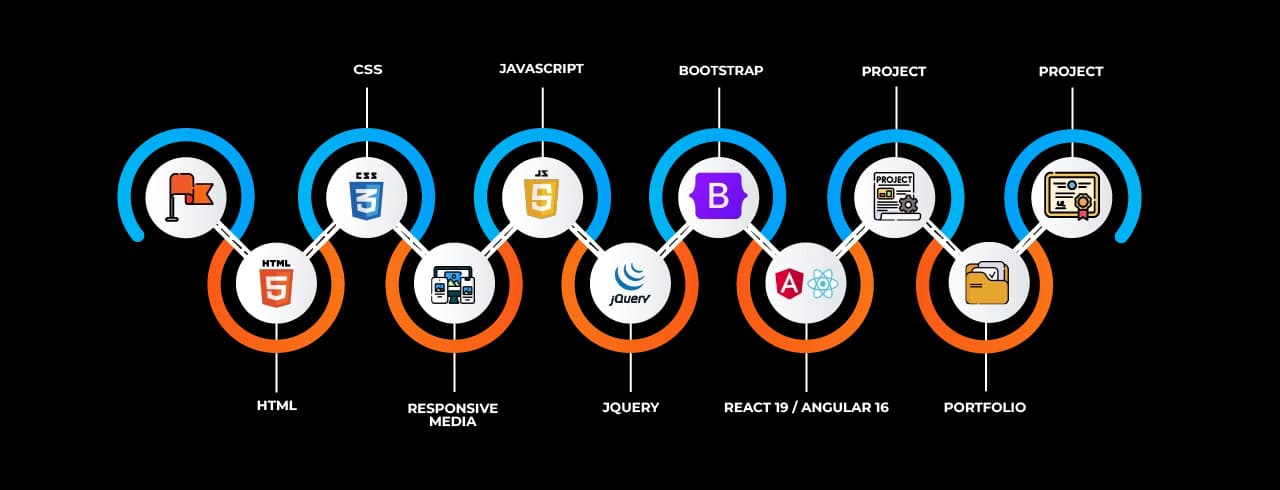
 CSS3Style websites with CSS3, including layouts, animations, and responsive design for an enhanced user
  React.jsDevelop dynamic and high-performance front-end applications using the React.js library
 JavaScript Add interactivity and dynamic behavior to web applications using JavaScript programming.
 HTML & HTML5Learn the fundamentals of web page structure and the advanced capabilities of HTML5 for modern web development.
 AngularBuild dynamic and scalable web applications with Angular, utilizing TypeScript and two-way data binding.
 Designing for responsiveness Learn how webpages look and function on different devices.
  Version control Use Git to organise and track changes to code.
  Testing and debuggingEnsure that webpages function error-free.
 Communication Work with the design and back-end teams.
  Accessibility Ensure that websites perform properly on mobile smartphones and other regularly used devices.