What Is the Full Stack Java Course at Sevenmentor?
The Full Stack Java Course at Sevenmentor is a complete course for full-stack Java development where you will learn how to create complete real-time applications using Java on the back end and the latest web technologies on the front end. Rather than starting with a lot of theory first, we start with very simple examples of how a web page interacts with a Java backend server, how a request is processed within the server, and how data is transferred to and from a database within a browser.
The course is a step-by-step learning process from HTML & CSS to JavaScript, Java and then to Spring Boot, Hibernate, and finally databases. All the examples provided in the course are practical in nature and are being used in industries.
- This full-stack Java development program is for:
- Beginners with no prior coding background
- Learners with basic programming knowledge looking to specialize
- Professionals seeking a career change from non-technical fields.
- Java programmers looking to become front-end developers.
After completing this course, you will be able to create a front-end interface and then link it to the back-end created using the the Java programming language. You will be able to develop Spring Boot APIs and manage databases as well as deploy the project in a testing/production environment.
Sevenmentor follows a steady learning pace and implementing approach and thus helps to equip every learner, irrespective of prior knowledge, to become a reliable full-stack Java developer.
Why Do Companies Need Full Stack Java Developers?
Companies today need developers who can take care of the front-end as well as the back-end without having to pass their job to another team. Therefore, there is an increasing need for full-stack Java development skills. A full stack developer can make interfaces and code the back end using Java. He can then connect this to a database and deploy the application.
Due to Java’s reliability in projects on an enterprise level and its ability to be scaled and maintained, full-stack Java development is being demanded on a large scale. The areas in which Java is primarily used include large corporations and banking and finance institutions, as well as other large companies that require high-level business solutions to be processed. Consequently, companies will be able to maintain their apps for years without the loss of any functions, provided that the coding is done and maintained in the proper way.
Here is the reason why these skills are important today:
- Java is widely used by enterprises in financial applications, banks, and large businesses.
- • The Spring Boot framework recently simplified the development process for Java back-end development, making the need for competent developers even higher.
- Most companies try to finish projects as fast as possible and work in a way to prevent as many dependencies as possible between team members.
- A full-stack developer is very valuable to a company/project, as they can work on the back-end and the front-end of a web application.
- Java's ecosystem stays relevant even as frameworks evolve
All sectors like banking, finance, insurance, e-commerce, IT services, etc. are looking for professionals who can manage the entire development process by themselves and manage it properly. They want people who can write good-quality Java code and, at the same time, also design good UI for the front end. A full-stack Java classes is thus a very practical and career-oriented course to learn. All the skills that you acquire, like writing good-quality code, handling APIs, database management, etc., will never go out of fashion and will always be required regardless of whatever new tools or frameworks get introduced in the market.
What Makes Sevenmentor's Full Stack Java Course Different?
Sevenmentor’s Full Stack Java Development training approach is more practical-based instead of just attending lectures. Participants would write code, test it, debug it, and make it error-free by repeating the process to get better results and real understanding of what they have learned in their training sessions. Participants would learn to create REST APIs using Spring Boot, manage entities using Hibernate, perform form validation while taking input, and many more features while connecting front-end pages to the database.
We keep the batch sizes small so we can give every student lots of individual attention. They can write their own code, test it, and then intentionally break it—all with our full support. And then, they can fix it. That is how one can learn to do things properly and not just read about them. The sessions are all focused on making sure that the student learns how to do things, and the focus is on practical aspects of the training. By the end of the module, there are short and focused exercises that are required to be done by the students in order to reinforce the concepts that were covered in the training.
Key advantages of learning at Sevenmentor include:
- Small batch sizes for direct trainer interaction
- Spring Boot, Hibernate, and Java Fundamentals practical training sessions.
- Real project-based exercises instead of isolated theory
- We provide support outside of class hours for learners to get answers to their doubts and to help them in debugging their programs.
- Guidance on Git, resume building, and interview preparation
- Calm, focused, and systematic learning environment.
The training at Sevenmentor is not restricted to the completion of various modules, and hence, we train our students in such a manner so that when they complete the Full Stack Java Certification course, they have worked on a live project and can explain what they have done in the project during interviews. Whether you are a fresher or have experience in software development in some other technology, this is not a matter of concern for us. Our training methodology helps you to acquire skills of Java full stack slowly and steadily in a very practical manner.
What Will You Learn in the Full Stack Java Course?
Our Full Stack Java training at Sevenmentor follows a layer-by-layer approach, starting with the front end through to creating the Java back end, databases, and deployment of the application. Each topic of learning is reinforced by related work so that by the time you get to do your projects, all the relevant material will have already been learned, making it easier to apply.
Our course will take you through the tools and workflow of a typical full-stack Java development team. It goes through the various modules in a connected order mirroring a typical project, and you learn to write a form, create a database, add business logic, and finally deploy a full application at the end of it all.
Here's what the course covers:
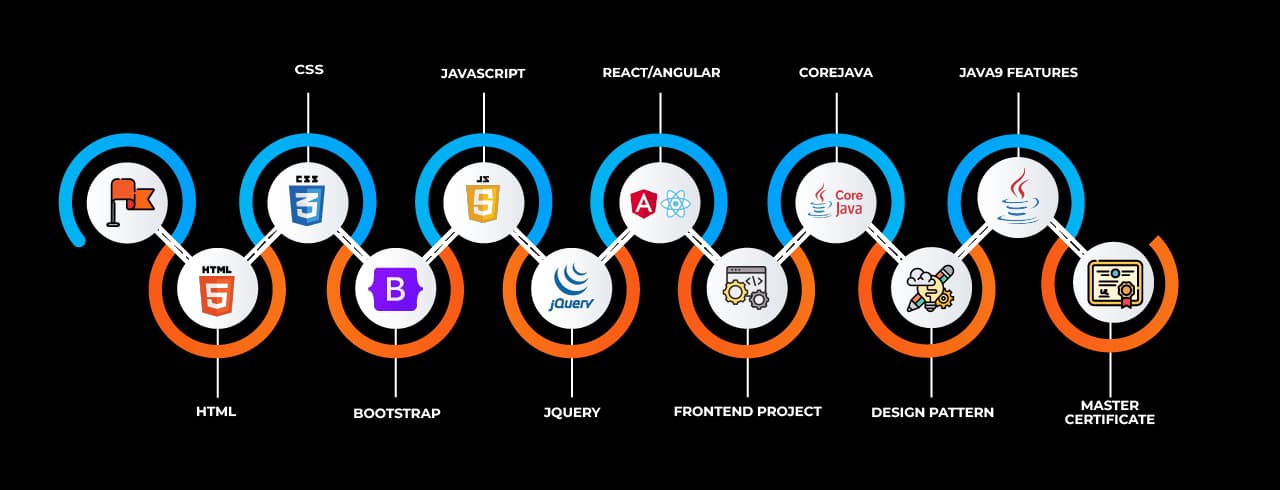
- Page structure and styling with HTML and CSS
- JavaScript fundamentals and DOM handling
- Core Java concepts and object-oriented programming
- Back-end development using Spring Boot
- Database management with Hibernate and SQL
- Building and consuming REST APIs
- Authentication and session handling
- Version control using Git
- Testing, debugging, and deployment practices
- End-to-end project building using real workflows
Each module is supplemented with a number of short practical tasks. Adding a new Java class, adding a new API endpoint to an existing project, Styling a section of a HTML page, connecting a new table in a database to an existing application etc. Instead of learning to use individual tools in full-stack Java development, the students will learn to put everything together to develop a single working application using HTML, CSS, and JavaScript in conjunction with Java back-end programming systems.
What Are the Career Opportunities After This Course?
All these things are important but the most important is that this course gives you lots of opportunities of different careers.And that’s because there are many companies who need developers who can do the front end of a website and the Java-based back end. And a lot of these companies are based in the financial districts of major cities. So there are a lot of big companies in banking and finance and retail and healthcare and IT services that are looking for full-stack Java developers.
The developer starts off with developing and debugging apps for other developers. With time, he/she gets sufficient knowledge and responsibility, such as managing APIs, managing databases, and ultimately managing an entire module alone.
Common roles after this course include:
- Full Stack Java Developer
- Java Developer
- Back End Developer (Java/Spring Boot)
- Front End Developer
- Software Developer (Entry Level)
- Application Support Engineer
- Web Developer
After a few years of hands-on experience of having built large systems and projects, a developer can be promoted to a senior developer role or take up roles like a technical lead or even a module lead, where they would be responsible for larger systems and also train/mentor other developers.
With just a few years of experience and having worked on a number of projects, a person should be able to secure a salary between 6 LPA and 10 LPA post a full-stack Java certification. This will depend upon cities such as Delhi, Gurgaon, Noida, Mumbai, Pune, Hyderabad, Bangalore, and others along with organization sizes ranging from startups to small, medium, and large companies and multinational companies. Provided that one has a strong portfolio and keeps oneself updated with the latest technology, one should be able to grow fast in one’s career path.
Java is used in most of the large-scale enterprise software applications. Hence, the demand for skilled full-stack Java developers will never come down. Thus, Full Stack Java is a stable and long-term specialization area for learning and growing.
Can You Learn Full Stack Java Development Online?
Yes, Sevenmentor’s Full Stack Java course is also available in the online version too. And many students opt for this mode of study, as it is flexible enough for any student with work, study, or other obligations.
Even in online format, the learners will work with the same project files, exercises, and real-life examples as we do in our classroom batches of the Full Stack Java Development course. There is no compromise on depth or quality of training for full-stack Java development.
Here's what the online format includes:
- Live instructor-led sessions, not pre-recorded content
- Screen sharing for real-time debugging support
- Ability to ask the trainer to repeat or clarify concepts
- Practice of topics such as Spring Boot and Hibernate through exercises during sessions.
- Recorded sessions available for revisiting missed classes
- Same project structure and exercises as offline batches
The live online format of Sevenmentor's Full Stack Java Course is designed to suit working professionals and students as well as freshers, as the sessions are held at fixed timings and one can join from anywhere in the world while continuing to work on studies simultaneously. This method of learning also best suits a novice to revisit the video, if required, to recall a concept discussed in a session.
Whether you opt for online training or classroom training, our primary intention remains the same, i.e., to impart practical full stack Java developer training using a hands-on approach & not just to display videos & earn money.
How Does Sevenmentor Ensure a Transparent Full Stack Java Learning Experience?
Sevenmentor knows how important it is to establish trust with customers while providing them best Full Stack Java Course with quality training, so we focus on the key areas which are of utmost importance to a student looking to join a course: the communication that the student receives prior to joining a course and the quality of batches that are being provided to the student after he/she has joined the course, and lastly, the placements support that the student receives after completion of the course.
Every aspect of the course is designed with the aim to keep the learners updated about the happenings around them. Sevenmentor thus ensures that learners are kept posted about the development taking place around them from the very first day of the course till the day of certification.
Here's how Sevenmentor keeps the learning experience dependable:
- Clear batch Timings are communicated in advance and followed exactly (no changes at the last moment)
- All trainers at Sevenmentor specialize in training students in areas of Spring Boot, Hibernate, etc., with high-quality knowledge. And they maintain the same high quality of training throughout all the sessions, i.e., all the batches of students.
- Doubt-clearing sessions outside of class timings to clear any query or doubt that the students have in their minds related to the course.
- Students are provided with the accurate information regarding the placements, such as resume making, mock interviews, and referrals to job openings. No incorrect information is provided to the students in order to make any false promises.
- All classes are recorded so that you never have to worry about missing a session as well as being able to go back and learn from it whenever you want.
- A well-structured syllabus, which is followed throughout the course by both online and offline batches.
- Direct access to the trainers. Our trainers make sure that the batch size is such that every student in the class gets individual attention throughout the course period.
This is the main reason why a large number of full-stack Java developer aspirants join Sevenmentor for their full-stack Java course. Not because of the curriculum, but because of the accountable experience that they gain during their training period. At Sevenmentor, it is our motto to make our learners experts in the field of Full Stack Java and, in turn, to make them industry-ready. This is possible only when our learners gain an ample amount of experience during their training period. The experience that they gain is not only from the curriculum but also from the projects that they complete during their training period. The learners will have a thorough knowledge of what they went through during their full stack Java certification training period.
Which Skills Complement Your Full Stack Java Course at Sevenmentor?
The Full Stack Java Course on SevenMentor will enable you to learn the core development skills of a full-stack Java developer. However, if one wants to increase his/her career prospects, then an IA modern full stack and a few other technologies are used in conjunction with the abovementioned course. A modern full-stack Java Developer is expected to have knowledge of few other domains, such as data handling, cloud deployment, etc. But in reality, the projects that a developer gets to work on are not limited to the above skills of a full-stack Java developer. Thus, to make a developer well-rounded and to increase his/her career prospects, it is better to learn a few other courses that are offered by Sevenmentor.
Here are the additional skills that are used in conjunction with Full Stack Java Development in a variety of projects and applications:
Data Science - This course helps one to develop web applications that are data-driven with intelligent real-time data.
Data Analytics – Analyze user behavior and the performance of an application.
Python is the most popular language used for backend development along with Java.
Cloud Computing—A must-have skill to deploy & scale your application.
Cybersecurity – Most important to safeguard web application against threats.
SAP – Valuable for building enterprise-level business solutions
Generative AI & AI Course – Generative AI and AI Course to create intelligent applications using AI.
ChatGPT Course – Building AI-Powered Chatbots for your Web Platforms
DevOps – Supports continuous integration and deployment workflows
Power BI – for the data visualization and creating of dashboards.
Salesforce – Useful for CRM-based web solutions
Java – Remains foundational for enterprise-grade web applications
Adding one or two such courses to your Full Stack Java Certification can open up doors to higher-paying specialized roles. Sevenmentor helps you to gain such additional skills on top of your Java skills and become a versatile, future-ready technology professional. He or she can get the best of jobs in the industry.
Got Questions? Here Are Some FAQs
1. What is a Full Stack Java Course?
A Full Stack Java Course is a form of education that helps students to create full-fledged web applications. The core part of the application will be written in Java and the front-end will be built up using HTML, CSS and JavaScript. Alongside these basics, a Full Stack Java Course will also cover frameworks like Spring Boot and Hibernate as well as REST APIs for the integration of the single parts.
2. How long does it take to learn Full Stack Java Development?
The duration of a Full Stack Java course can vary between 4 to 8 months. The duration is influenced by the type of program (full-time / part-time) and the type of program (simplistic / in-depth with many frameworks and many projects).
3. Do I need to know core Java before starting this course?
A Full Stack Java course will help students with basic knowledge of Java fundamentals (like OOP concepts, Java syntax, data structures etc) grow into advanced Java developers who know to develop complete web applications using Java for back-end and front-end technologies like HTML, CSS and JavaScript etc. There are many Full Stack Java courses available that start from basics and teach basic Java concepts and then move on to advanced Java frameworks and help students in developing real-world projects.
4. What is the scope and salary for a Full Stack Java Developer?
The demand for Full Stack Java Developers in IT companies and startups is very high since Java is one of the most widely used languages in enterprise. Also, salaries for developers in this position are very high and they tend to increase as they gain experience.
5. What topics are covered in a Full Stack Java Course?
The typical curriculum of such courses cover the Core Java such as OOPs concepts, basic Java syntax and data structures. However, majority of the courses are designed from ground up and start teaching Core Java and then gradually move on to advance topics such as the Spring Framework, Spring Boot, Hibernate and RESTfulfilling the requirements of the back end of web application. A Full Stack Java Course covers the entire gamut of knowledge that is required to develop and deploy a complete web application. It focuses on teaching the students the skills required to create a web application using Java in the back end and utilizing HTML, CSS and JavaScript for the front end. The programs also cover REST APIs and database management systems such as MySQL and MongoDB in the course of completing the projects that are developed in real time.
blog Links:
Anthropic AI Tool
What is Writesonic
What is Claude AI
AI Engineer Roadmap
What is JasperAI
What is Copy AI
Do visit our channel to know more: SevenMentor
 A Java full-stack developer uses the Java programming language that interacts with the front-end and the back-end functions.
 Java Full Stack Development encompasses both the front-end (client-side) and back-end (server-side) components of a web application.
  Its done utilising the Java programming language and front-end technologies such as HTML, CSS, JavaScript, and frameworks.
 ContainmentA relationship where one class contains an object of another class (HAS-A relationship).
 PolymorphismAbility of an object to take multiple forms via method overloading and overriding.
 Abstract ClassA class that cannot be instantiated and may contain abstract methods.
 AnnotationsMetadata used to provide instructions to the compiler or runtime.
 EnumA special Java type representing a fixed set of constants.
 InheritanceMaster object-oriented programming (OOP) concepts to build modular and reusable code.
 Interface IDoc: An IDoc (Intermediate Document) is a standard data format used in SAP to exchange information between different systems.
 Swing A Java library for building desktop applications with rich UI components.
 Object-Oriented Programming (OOP)Programming approach based on classes and objects.
 Introduction to Java Learn Java basics and how it powers enterprise applications.
 Java Language Fundamentals Core syntax, datatypes, and control structures in Java.
 Functional-style ProgrammingUse lambdas and streams for cleaner, concise code.
 Utility ClassesJava’s built-in helper classes like Math, Arrays, and Collections.
 Exception HandlingManage runtime errors using try-catch blocks.
 GUI with AWT & SwingBuild desktop interfaces using Java’s GUI toolkits.
 MultithreadingRun multiple threads to improve performance and responsiveness.
 Lambda / Stream APIFunctional programming tools for efficient data processing.
 Collection FrameworkJava structures like List, Set, Map for data management.
 Generics Enable type safety in collections and methods.
 File I/O & Object SerializationRead/write files and save Java objects.
 Networking Build apps that communicate over the internet.
 Unit Testing Verify code reliability using testing frameworks.
 Introduction to SQLLearn to query and manage databases.
 JDBC Connect Java apps with databases using Java Database Connectivity.
 Maven / XMLBuild automation and project configuration tools.