Java Course

feature-iconJava is a programming language and computing platform used to build programs.
feature-iconIt is an object-oriented language, which is founded on the idea of classes and objects.
feature-iconTo generate flexible and reusable code, it employs fundamental concepts such as classes, objects

020-71173071

Start Today!

CONSULT WITH
OUR ADVISORS

  • Course & Curriculum Details
  • Flexible Learning Options
  • Affordable Learning
  • Enrollment Process
  • Career Guidance
  • Internship Opportunities
  • General Communication
  • Certification Benefits

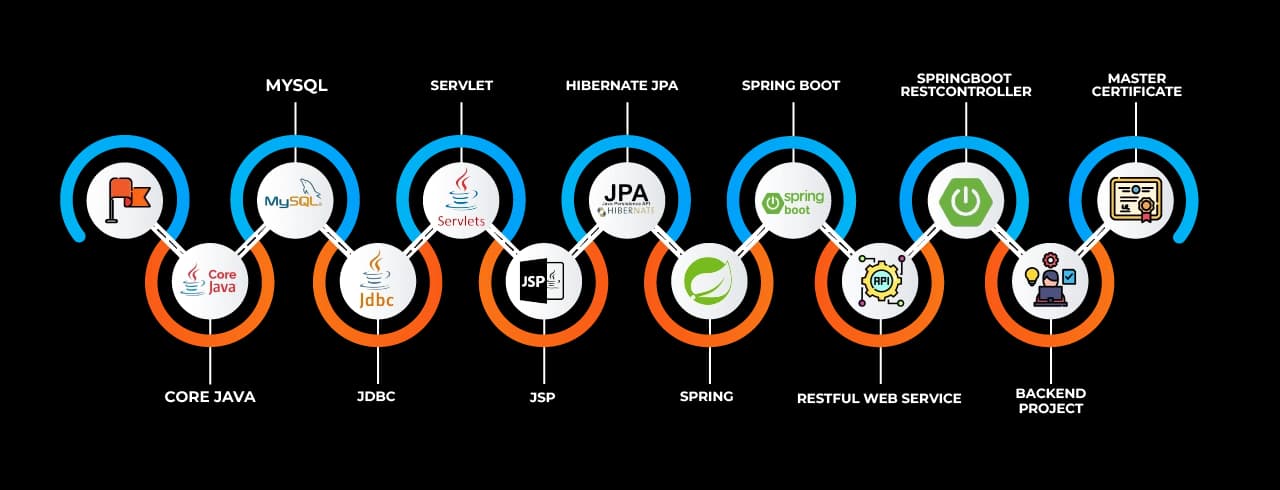
Learning Curve for Java
Learning curve for Java

Master In Java Course

OneCourseMultipleRoles

Empower your career with in-demand data skills and open doors to top-tier opportunities.

Junior Java Developer
Senior Java Developer
Java Software Engineer
Back-end Developer
Java Test Engineer
Java Full stack Developer
Java Micro services Developer
Full Stack Developer
Java Web Developer
Java Architect

Skills & Tools You'll Learn -

Object-Oriented Programming (OOP) iconObject-Oriented Programming (OOP)A programming paradigm based on objects and classes.
Introduction to Java iconIntroduction to JavaOverview of Java's history, features, and applications.
Java Language Fundamentals iconJava Language FundamentalsCore concepts like variables, data types, operators, and control flow.
Containment iconContainmentA relationship where one class contains an object of another class (HAS-A relationship).
Polymorphism iconPolymorphismAbility of an object to take multiple forms via method overloading and overriding.
Abstract Class iconAbstract ClassA class that cannot be instantiated and may contain abstract methods.
Annotations iconAnnotationsMetadata used to provide instructions to the compiler or runtime.
Enum iconEnumA special Java type representing a fixed set of constants.
Inheritance iconInheritanceMaster object-oriented programming (OOP) concepts to build modular and reusable code.
Interface  iconInterface IDoc: An IDoc (Intermediate Document) is a standard data format used in SAP to exchange information between different systems.

Why Choose SevenMentor Java

Empowering Careers with Industry-Ready Skills.

Specialized Pocket Friendly Programs as per your requirements

Specialized Pocket Friendly Programs as per your requirements

Live Projects With Hands-on Experience

Live Projects With Hands-on Experience

Corporate Soft-skills & Personality Building Sessions

Corporate Soft-skills & Personality Building Sessions

Digital Online, Classroom, Hybrid Batches

Digital Online, Classroom, Hybrid Batches

Interview Calls Assistance & Mock Sessions

Interview Calls Assistance & Mock Sessions

1:1 Mentorship when required

1:1 Mentorship when required

Industry Experienced Trainers

Industry Experienced Trainers

Class Recordings for Missed Classes

Class Recordings for Missed Classes

1 Year FREE Repeat Option

1 Year FREE Repeat Option

Bonus Resources

Bonus Resources

Curriculum For Java

BATCH SCHEDULE

Java Course

Find Your Perfect Training Session

Jan 4 - Jan 10

2 sessions
04
Sun
Classroom/ Online
Weekend Batch
10
Sat
Classroom/ Online
Weekend Batch

Jan 11 - Jan 17

1 sessions
12
Mon
Classroom/ Online
Regular Batch

Jan 18 - Jan 24

1 sessions
19
Mon
Classroom/ Online
Regular Batch

Learning Comes Alive Through Hands-On PROJECTS!

Comprehensive Training Programs Designed to Elevate Your Career

Inventory Management System

Inventory Management System

Online Learning Platform

Online Learning Platform

Healthcare Management System

Healthcare Management System

Job Portal System

Job Portal System

Book Management System

Book Management System

No active project selected.

Transform Your Future with Elite Certification

Add Our Training Certificate In Your LinkedIn ProfileLinkedIn

Our industry-relevant certification equips you with essential skills required to succeed in a highly dynamic job market.

Join us and be part of over 50,000 successful certified graduates.

Student 1
Student 2
Student 3
Student 4
Student 5
Join 15,258 others learning today
Certificate Preview

KEY Features that Makes Us Better and Best FIT For You

Expert Trainers

Industry professionals with extensive experience to guide your learning journey.

Comprehensive Curriculum

In-depth courses designed to meet current industry standards and trends.

Hands-on Training

Real-world projects and practical sessions to enhance learning outcomes.

Flexible Schedules

Options for weekday, weekend, and online batches to suit your convenience.

Industry-Recognized Certifications

Globally accepted credentials to boost your career prospects.

State-of-the-Art Infrastructure

Modern facilities and tools for an engaging learning experience.

100% Placement Assistance

Dedicated support to help you secure your dream job.

Affordable Fees

Quality training at competitive prices with flexible payment options.

Lifetime Access to Learning Materials

Revisit course content anytime for continuous learning.

Personalized Attention

Small batch sizes for individualized mentoring and guidance.

Diverse Course Offerings

A wide range of programs in IT, business, design, and more.

Course Content

About Java Course

The Java Course at SevenMentor is built for learners who want to understand how real software behaves not just memorize syntax.

Training starts with the fundamentals — variables flow control and basic logic — and slowly moves toward building programs that actually solve day-to-day problems.

Instead of rushing through topics the course takes a step-by-step approach: first you write small snippets then functions then you start connecting ideas until things feel natural.


As the sessions progress students start working on Java OOP file handling JDBC exception management and later frameworks like Spring or basic servlet programming.

Most people who finish the course say it feels hands-on because they spend more time writing and fixing code than listening to long lectures.
 

Java is used in banking automation tools enterprise systems Android development and countless backend services.

So throughout the course learners interact with examples from multiple domains — e-commerce finance retail and small business applications.
 

Depending on the batch the training usually spans around 2 to 3 months.

By the end students feel confident writing Java programs from scratch and understanding how real projects are structured.
 

What Benefits Do You Get From Taking the Java Course?

Joining the Java Training at SevenMentor gives learners more than just coding knowledge — it builds discipline and logical thinking which is essential for any developer role.
 

After a few weeks our students start to learn the difference between Java education:

Writing of the codes can be less about remembering syntax and mostly an understanding about why a program works and how to write it properly.

Reading of existing code normally feels easier that is because our trainers teach how to break a problem into smaller parts.

Debugging becomes less stressful since learners get used to tracing errors and handling exceptions properly.

Java doesn’t feel intimidating anymore — it becomes a tool to create things.

One common feedback from past students is how much confidence they gain when they’re able to explain their code in interviews or show small projects they built during training.

The course also improves communication skills — because explaining a logic flow or a bug is part of real IT culture not just a classroom exercise.
 

Technical Learning and Tools Covered in the Java Course

The Java Course at SevenMentor focuses on writing programs from day one.

Instead of stretching theory for weeks learners get into coding tasks early touching real Java files IDEs and common utilities.

Students will cover:

Core Java fundamentals — variables loops arrays methods

Object-Oriented Concepts are taught such as inheritance polymorphism and abstraction along with encapsulation

Collections Framework — ArrayList HashMap Iterator sets

Exception handling

File and input/output operations

JDBC — connecting Java with databases

Multi-threading basics

Intro to Servlets & JSP (for web concepts)

Spring basics (for modern frameworks)

Students also practice using:

Eclipse  and IntelliJ & IDEA

MySQL for database tasks

Maven basics in later sessions

Git fundamentals for versioning
 

Projects come from regular business use cases 

Billing systems 

login modules 

mini e-commerce flows 

analytics-style programs.
 

By the time the course finishes learners know how to convert a simple idea into a Java application and how to structure their projects properly.


Why Choose SevenMentor for Java Training?

What sets SevenMentor apart is the practical mentor-style teaching approach.

The trainers have worked on real Java projects — so they explain things beyond the textbook. Small tips shortcuts and coding habits that developers actually use become part of the training.

A few reasons students often choose SevenMentor:

Classes are available in both offline and online modes

Weekday and weekend batches give flexibility

Learning is paced so both beginners and working professionals can follow

Trainers review your logic and suggest improvements

Projects are small but meaningful helping learners build a portfolio

Resume assistance and interview preparation sessions are part of the process

The environment feels approachable not rushed or overcrowded

Students frequently mention that the real value of the course is the confidence they gain in writing and explaining Java code — not just completing a syllabus.


Career Directions After Completing the Java Course

Learning Java opens doors to various paths in software development.

Once learners complete the course they commonly move into roles such as:

Java Developer — building backend modules and APIs

Software Developer — working on end-to-end applications

Backend Engineer — handling server-side login

Automation Developer — writing test scripts in Java-based frameworks

Android Developer (optional path) — using Java in mobile apps

Junior programmer and application support engineers are responsible. 

Industries such as finance insurance and SaaS along with logistics are what IT services rely heavily on Java systems for.
 

Salary Expectations:

Freshers: ₹3.5 – 5 LPA on average

With automation or Spring exposure: ₹6 – 10 LPA

Experienced Java developers: ₹12 – 18 LPA or higher depending on company and skill depth

Employers primarily care about how clearly you explain your logic not how many keywords you’ve memorized.

That is why the course keeps the learning highly practical.
 

Overview of the SevenMentor Java Training

Students often say what our learning experience at Sevenmentor feels and be part of a small development team rather than a traditional classroom student at any other course.

Batch sizes for our Java Training are kept so small that our trainers can observe each student’s code and guide them personally.

What the training emphasizes:

Real-world coding assignments

Clean coding habits

Working with IDEs the way professionals do

Understanding project structure

Reading error logs and debugging

Following a simple version of the SDLC

The datasets programs and exercises used in class are based on actual business logic not generic examples copied from textbooks.


The institute also assists learners with:

Interview prep

Practice tests

Resume polishing

Portfolio-building using small Java projects

Different learning modes — classroom online hybrid — are available and students pick whichever fits their schedule.


Can I Take an Online Java Course?
 

Yes. Many learners pick the online Java training because they need flexibility for work college or personal schedules.

The online mode includes:

Live mentor-led sessions (not recorded lectures)

Interactive coding practice

Screen-sharing support for debugging

Real assignments and project building

Doubt-solving sessions in every class

Evening and weekend timing options

Students who take the online course often mention that it feels almost like learning in-person just without the travel time.
 

Is Corporate Java Training Available?
 

Yes SevenMentor provides customized corporate Java training for companies looking to upgrade their development teams or onboard fresh engineers.

The corporate program typically includes:

Tailored modules based on organizational requirements

Live coding demos with industry examples

Exercises based on the company’s workflow

Group assignments for team-based learning

Clean code and best practices training

Optional automation or Spring Boot modules

Corporate batches are conducted on-site or online depending on the company’s preference.

This training helps teams improve coding standards reduce errors and build more reliable applications.

Frequently Asked Questions

Everything you need to know about our revolutionary job platform

1

What is the significance of the Java skill?

Ans:
Java is a valuable programming talent since it is widely used, adaptable, and simple to master. It is used to construct a wide range of software, including mobile apps, online applications, and big data applications.
2

How does Java apply in real life?

Ans:
Because Java is simple, resilient, and platform neutral, it may be used to produce a wide range of development projects. Java can be used in game development, cloud computing, artificial intelligence, deep learning, the Internet of Things, and big data.
3

What is the main application of Java?

Ans:
Java is a popular programming language for creating web applications. It has been a popular choice among developers for nearly two decades, and millions of Java programs are still in use today.
4

Is studying Java still worthwhile in 2025?

Ans:
AI Overview+3 Yes, learning Java in 2025 is worthwhile since it remains a popular programming language with a promising future.
5

Is Java required for a placement?

Ans:
To prepare for coding interviews and technical tests, you should be familiar with programming concepts, algorithms, data structures, and problem-solving abilities. You should also be fluent in at least one programming language, such as Java, Python, or C++.
6

What is the definition of specialization in Java?

Ans:
Specialisation is the process of making a new class that inherits from an existing one. The new class, also known as a subclass, inherits the parent class's properties and methods but has the ability to create new ones or override existing ones.
7

What exactly are the four varieties of Java?

Ans:
The Java programming language runs on four different platforms: Java Platform, Standard Edition (Java SE), Enterprise Edition (Java EE), and Micro Edition (Java ME).
8

What exactly is oops in Java?

Ans:
OOP is an acronym for Object-Oriented Programming. Procedural programming involves writing procedures or methods that conduct data operations, whereas object-oriented programming entails constructing objects that include both data and methods.
9

Is a Java profession a wise choice?

Ans:
Yes, a career in Java is seen as a solid choice due to its extensive use in the industry, high demand for Java developers, potential for high income, and the opportunity to discover numerous work possibilities across multiple sectors, making it a steady and viable career path.
10

Do corporations prefer Java or Python?

Ans:
Python is fast and efficient. Learning Python leads to faster development times and lesser lines of code. Many programmers favour Python over other programming languages due to its simplicity, which allows for faster and more effective prototyping and testing of systems.
11

Is Java a suitable placement option?

Ans:
If you're interested in fields like healthcare, software development, or web development, studying Java could be beneficial. Java is a safe and portable language suitable for beginners. It has a big ecosystem and a vibrant community, making it easy to find resources and work possibilities.
12

Can I find work after completing Java?

Ans:
Depending on the sort of business and the work involved, a freshly graduated Java programmer is typically hired as a Junior Programmer, Junior Software Developer, or Junior Software Engineer.
13

What about Java's future?

Ans:
Java Programming’s Future Java's future in 2025 lies in its integration with cutting-edge technologies like machine learning and cloud computing.
14

How do I get a Java position?

Ans:
The indexOf() function returns the location of the first occurrence of the provided character(s) in a string. Tip: The lastIndexOf method returns the position of the final occurrence of provided character(s) in a string.
15

What are some of the advantages of Java?

Ans:
Java was created to be simple to use, which makes it easier to write, compile, debug, and learn than other programming languages. Java has an object-oriented design. This enables the creation of modular programs and reuse code.

Explore Other Demanding Courses

No courses available for the selected domain.