Java Full Stack Course in India

feature-iconA Java full-stack developer uses the Java programming language that interacts with the front-end and the back-end functions.
feature-iconJava Full Stack Development encompasses both the front-end (client-side) and back-end (server-side) components of a web application.
feature-iconIts done utilising the Java programming language and front-end technologies such as HTML, CSS, JavaScript, and frameworks.

020-71173035

Start Today!

CONSULT WITH
OUR ADVISORS

  • Course & Curriculum Details
  • Flexible Learning Options
  • Affordable Learning
  • Enrollment Process
  • Career Guidance
  • Internship Opportunities
  • General Communication
  • Certification Benefits

Learning Curve for Java Full Stack in India
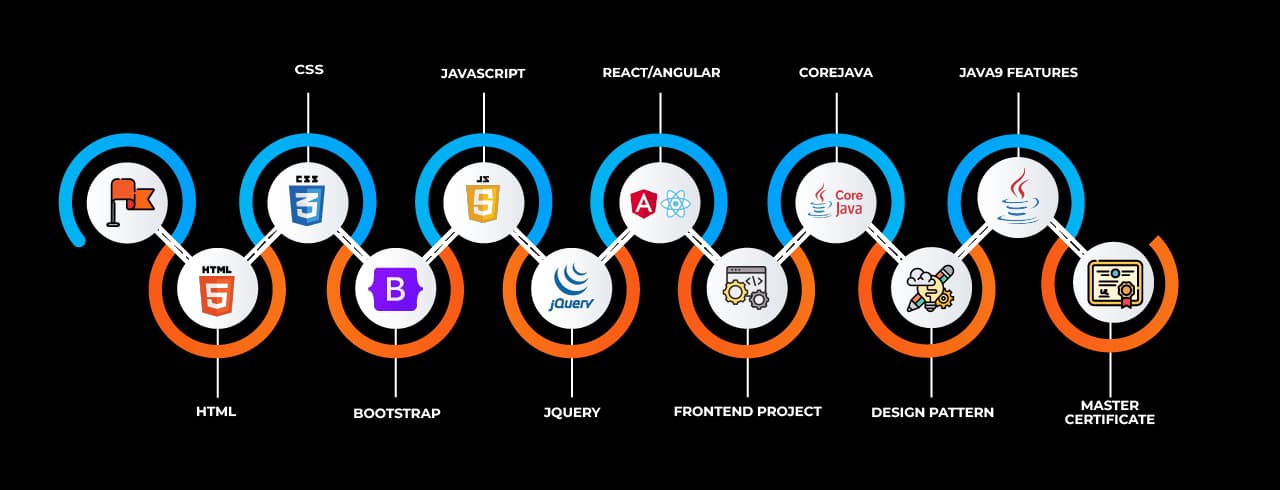
Learning curve for Java Full Stack in India

Master In Java Full Stack in India Course

OneCourseMultipleRoles

Empower your career with in-demand data skills and open doors to top-tier opportunities.

Junior Java Developer
Java Full Stack Developer
Trainee-FSD Java
Java Developer
Adv Java Developer
Senior Java Developer
Tech Lead
Sr. Tech Lead
Technical Manager

Skills & Tools You'll Learn -

Unit Testing  iconUnit Testing Test individual components of the application.
XML Handling iconXML HandlingWork with XML data formats using SQL functions and queries.
CSS3 iconCSS3Style websites with CSS3, including layouts, animations, and responsive design for an enhanced user
JavaScript  iconJavaScript Gain proficiency in JavaScript to add interactivity and dynamic behavior to web applications.
React.js iconReact.jsDevelop dynamic and high-performance front-end applications using the React.js library
Object-Oriented Programming (OOP) iconObject-Oriented Programming (OOP)A programming paradigm based on objects and classes.
Containment iconContainmentA relationship where one class contains an object of another class (HAS-A relationship).
Polymorphism iconPolymorphismAbility of an object to take multiple forms via method overloading and overriding.
Abstract Class iconAbstract ClassA class that cannot be instantiated and may contain abstract methods.
Enum iconEnumA special Java type representing a fixed set of constants.
Lambda Functions iconLambda FunctionsUse Python’s lambda functions for concise, anonymous function expressions in programming
Inheritance iconInheritanceMaster object-oriented programming (OOP) concepts to build modular and reusable code.
Exceptions iconExceptionsLearn to handle files and manage errors with exception handling techniques in Python.
Bootstrap  iconBootstrap Utilize Bootstrap to build mobile-first, responsive websites with pre-designed components and a grid system.
Angular iconAngularBuild dynamic and scalable web applications with Angular, utilizing TypeScript and two-way data binding.
Interface  iconInterface IDoc: An IDoc (Intermediate Document) is a standard data format used in SAP to exchange information between different systems.
React Hooks iconReact HooksSpecial functions like useState and useEffect that enable state and lifecycle management in React.
Maven  iconMaven A build automation tool primarily used for Java projects, managing dependencies and builds.
Core Java iconCore Java The fundamental part of Java programming, covering OOPs concepts, collections, and multithreading.
Spring Boot iconSpring Boot A framework that simplifies Spring application development with auto-configuration and embedded serve
Graphical User Interface (GUI) iconGraphical User Interface (GUI)Explore SAP GUI types (Windows and Java) and their role in user interaction.
SQL  iconSQL A database language for querying and managing structured data.
Swing  iconSwing A Java library for building desktop applications with rich UI components.
Object Serialization  iconObject Serialization Converting Java objects into a format for storage or transfer.
Collection Framework  iconCollection Framework Java’s built-in data structures like List, Set, and Map.
Functional-Style Programming iconFunctional-Style ProgrammingWriting concise, expressive Java code using lambda expressions.

Why Choose SevenMentor Java Full Stack in India

Empowering Careers with Industry-Ready Skills.

Specialized Pocket Friendly Programs as per your requirements

Specialized Pocket Friendly Programs as per your requirements

Live Projects With Hands-on Experience

Live Projects With Hands-on Experience

Corporate Soft-skills & Personality Building Sessions

Corporate Soft-skills & Personality Building Sessions

Digital Online, Classroom, Hybrid Batches

Digital Online, Classroom, Hybrid Batches

Interview Calls Assistance & Mock Sessions

Interview Calls Assistance & Mock Sessions

1:1 Mentorship when required

1:1 Mentorship when required

Industry Experienced Trainers

Industry Experienced Trainers

Class Recordings for Missed Classes

Class Recordings for Missed Classes

1 Year FREE Repeat Option

1 Year FREE Repeat Option

Bonus Resources

Bonus Resources

Curriculum For Java Full Stack in India

BATCH SCHEDULE

Java Full Stack in India Course

Find Your Perfect Training Session

Jan 4 - Jan 10

2 sessions
04
Sun
Classroom/ Online
Weekend Batch
10
Sat
Classroom/ Online
Weekend Batch

Jan 11 - Jan 17

1 sessions
12
Mon
Classroom/ Online
Regular Batch

Jan 18 - Jan 24

1 sessions
19
Mon
Classroom/ Online
Regular Batch

Learning Comes Alive Through Hands-On PROJECTS!

Comprehensive Training Programs Designed to Elevate Your Career

BudgetFlow App

BudgetFlow App

 PetPal App

PetPal App

TravelMate (Travel Planning Platform)

TravelMate (Travel Planning Platform)

GreenThumb (Gardening and Plant Care App)

GreenThumb (Gardening and Plant Care App)

 Personal Fitness Tracking App

Personal Fitness Tracking App

No active project selected.

Transform Your Future with Elite Certification

Add Our Training Certificate In Your LinkedIn ProfileLinkedIn

Our industry-relevant certification equips you with essential skills required to succeed in a highly dynamic job market.

Join us and be part of over 50,000 successful certified graduates.

Student 1
Student 2
Student 3
Student 4
Student 5
Join 15,258 others learning today
Certificate Preview

KEY Features that Makes Us Better and Best FIT For You

Expert Trainers

Industry professionals with extensive experience to guide your learning journey.

Comprehensive Curriculum

In-depth courses designed to meet current industry standards and trends.

Hands-on Training

Real-world projects and practical sessions to enhance learning outcomes.

Flexible Schedules

Options for weekday, weekend, and online batches to suit your convenience.

Industry-Recognized Certifications

Globally accepted credentials to boost your career prospects.

State-of-the-Art Infrastructure

Modern facilities and tools for an engaging learning experience.

100% Placement Assistance

Dedicated support to help you secure your dream job.

Affordable Fees

Quality training at competitive prices with flexible payment options.

Lifetime Access to Learning Materials

Revisit course content anytime for continuous learning.

Personalized Attention

Small batch sizes for individualized mentoring and guidance.

Diverse Course Offerings

A wide range of programs in IT, business, design, and more.

Course Content

About Java Full Stack

The rapid advancement of web and enterprise application development has driven a massive demand for full-stack developers with versatile skill sets. Java, being one of the most stable and widely adopted programming languages, continues to dominate the enterprise software landscape. With the rising emphasis on responsive frontend and scalable backend, the role of a Java Full Stack Developer has become central to modern software development projects. Java Full Stack Classes in India are tailored to bridge the skills gap by offering in-depth training on both client-side and server-side development using Java technologies. These programs empower learners with the ability to manage end-to-end development tasks, making them invaluable assets in any software team.


The Scope of Java Full Stack Development

Java Full Stack development requires expertise in front-end, back-end, database, and DevOps technologies. A developer is required to work with frontend technologies like HTML, CSS, JavaScript, and React/Angular, as well as backend technologies like Java, Spring Boot, and Hibernate. Additionally, hands-on experience with databases such as MySQL and MongoDB, as well as deployment tools like Jenkins, Docker, and Kubernetes, is required. As the demand for digital solutions grows, organisations throughout India are investing in qualified experts who can oversee the whole software development lifecycle.

The core advantage of being a Java Full Stack developer lies in the ability to build complete applications independently. These professionals are not only technically sound but are also equipped to understand project requirements from UI to API design, database schema to DevOps automation. This full-spectrum capability significantly reduces project turnaround time and dependency overheads, making Java Full Stack developers a priority hire.


Curriculum Structure and Technical Proficiency

Java Full Stack training in India at SevenMentor is structured to offer learners a comprehensive roadmap into the world of full stack development using Java technologies. The course starts with the fundamentals of programming logic using Java SE (Standard Edition), which includes core concepts like object-oriented programming, multithreading, exception handling, file I/O, and data structures. This strong base ensures that learners have a solid understanding before moving into complex enterprise-level solutions.

On the front end, students learn HTML5, CSS3, and JavaScript, followed by current frameworks like as React or Angular. The emphasis is on creating dynamic, interactive, and responsive user interfaces that improve user experience across several devices. For server-side development, the curriculum introduces Java EE components such as Servlets and JSP, but the emphasis quickly shifts to Spring Framework and Spring Boot, which are industry-standard frameworks for building RESTful APIs, implementing security, and managing microservices-based architecture.

The backend portion is also tightly integrated with databases, offering hands-on experience with both relational databases like MySQL and NoSQL databases like MongoDB. Hibernate ORM is used to simplify data persistence logic. Along with this, learners are trained on version control using Git, containerization using Docker, and CI/CD pipelines using Jenkins to simulate a real-world agile environment.


Hands-On Experience and Capstone Projects

One of the distinguishing features of Java Full Stack courses in India is the focus on real-world applications. Learners are assigned projects that mirror actual software development life cycles, allowing them to apply their theoretical knowledge into building complete applications. These projects range from e-commerce platforms and content management systems to enterprise resource planning and social media tools.

Capstone projects are executed in agile sprints, where students collaborate in teams, emulate developer roles, and follow proper SDLC protocols including requirement gathering, designing, coding, testing, and deployment. This exposure not only builds confidence but also prepares learners to transition seamlessly into professional development roles post-certification.

Assignments include integration of third-party APIs, session management using Spring Security, state management using Redux, and deployment on platforms like Heroku, AWS, or Google Cloud. The goal is to simulate challenges faced in production-grade applications and equip learners to tackle them effectively.


Demand for Java Full Stack Developers in India

India has emerged as a global software development hub, with thousands of IT firms offering services across the world. The digital transformation of traditional industries, the boom in e-commerce, and the growing adoption of cloud-native applications have led to a surge in demand for full stack developers. Java remains a preferred language for building scalable, secure, and maintainable systems in sectors like banking, healthcare, education, logistics, and government.

Employers are specifically looking for candidates who can contribute across layers of software architecture. Companies appreciate the flexibility that Java Full Stack developers bring to the table, allowing them to reduce team sizes while enhancing productivity. With job titles such as Software Engineer – Full Stack Java, Backend Developer with Frontend Exposure, and Java Microservices Developer, the market offers a wide range of career pathways.

The average starting salary for a Java Full Stack Developer in India ranges between ₹5 to ₹9 LPA, with mid-level developers earning between ₹12 to ₹20 LPA depending on their expertise, project portfolio, and location. Cities like Bangalore, Pune, Hyderabad, and Gurgaon offer a plethora of job opportunities for certified professionals.


Career Paths and Opportunities

After completing Java Full Stack training in India at SevenMentor, students can pursue several promising career roles. Entry-level developers typically begin as Full Stack Interns or Junior Developers, where they get to work under the mentorship of senior architects. As their skills mature, they progress to roles like Software Engineer, System Analyst, and eventually Full Stack Architect.

Those inclined towards leadership may take up roles such as Technical Lead, Engineering Manager, or Product Owner in agile environments. Moreover, experienced developers with strong communication skills often transition into DevOps engineering, solution architecture, or cloud infrastructure roles.

Freelancing is another lucrative career path, especially for developers who prefer flexible schedules. Many startups and global businesses outsource full stack projects to Indian developers, offering competitive hourly rates for those with verified portfolios.


Why Choose SevenMentor?

SevenMentor, the best training institute for Java Full Stack Training offers meticulously curated courses aligned with the current trends and technologies demanded by the industry. Their Java Full Stack program is led by experienced trainers with real-world development exposure, ensuring students learn through a blend of theory, practice, and project-based assessments.

The institute is known for its commitment to quality training, extensive placement support, and state-of-the-art infrastructure. Courses are updated regularly to include emerging practices in microservices, containerization, CI/CD, and testing automation, providing learners a future-proof skill set.

Moreover, the institute fosters an interactive learning culture where students are encouraged to collaborate, innovate, and seek feedback continuously. Regular assessments, hackathons, coding challenges, and group discussions ensure knowledge retention and application readiness.

With multiple batches and flexible timings, SevenMentor ensures that both working professionals and fresh graduates can participate in their intensive training modules without compromising on their existing responsibilities.

Mastering full-stack development with Java is an excellent decision for those aiming to build a long-term career in software engineering. The ability to create scalable backend logic, design user-friendly interfaces, and implement secure database integrations makes Java Full Stack Developers indispensable in modern IT projects. Enrolling in Java Full Stack Classes in India provides learners with the structured pathway and mentorship needed to excel in the field.


Online Java Full Stack Training

SevenMentor also offers online Java Full Stack Training in India. The online program mirrors the offline curriculum and offers live interactive classes, downloadable materials, coding labs, and virtual project reviews. It is particularly beneficial for working professionals and students from remote areas who may not be able to access classroom training.

Live coding sessions, breakout rooms for team collaborations, and online forums allow participants to stay engaged and receive instant feedback. These online classes are often recorded for later access, enabling learners to revise at their own pace. The online learning model has proven to be equally effective and is backed by dedicated placement cells that assist with resume building, interview prep, and job referrals.


Corporate Java Full Stack Course

SevenMentor offers a customized corporate Java Full Stack Course in India. This training can be delivered on-site or online, based on the client’s preference. It is tailored to the organization’s tech stack, project requirements, and employee learning levels. SevenMentor's corporate training module emphasizes hands-on learning and project-based workshops, ensuring that the employees can apply their learning directly to ongoing and future projects. With experienced corporate trainers and post-training support, organizations can achieve higher productivity, better code quality, and faster project delivery timelines.

SevenMentor, the best training institute for Java Full Stack Training, has successfully partnered with various IT and non-IT companies across India to conduct effective employee development programs. Whether it’s transitioning legacy systems, introducing microservices, or modernizing the frontend—corporate teams trained in Java Full Stack are well-equipped to handle the transformation.

Frequently Asked Questions

Everything you need to know about our revolutionary job platform

1

Are Java Full Stack Developers in high demand?

Ans:
Organisations across sectors are looking for experts that can contribute to both client-side and server-side programming, therefore Java Full Stack Developers are in high demand. This high demand creates a wealth of career opportunities and competitive pay for skilled individuals.
2

Which company is ideal for a Java full stack developer?

Ans:
Java full-stack developers can expect to make a solid living in India. Here are some of the top organisations in India that are recruiting Java full-stack developers: TCS, Infosys, Wipro, Mindtree, Tech Mahindra, Cognisant Technology, IBM, and Accenture are among the companies involved.
3

What are the prerequisites for the Fullstack Java course?

Ans:
To be eligible for a Java Full Stack development course, you must normally have a high school diploma or equivalent, as well as a fundamental grasp of computers and, in many cases, some familiarity with programming concepts such as HTML, CSS, and possibly JavaScript.
4

Is full-stack Java a viable career option?

Ans:
Versatility and Flexibility. The full stack Java developers can transition smoothly between front-end and back-end development, making them valuable assets to any project. This adaptability not only boosts your skill set but also provides doors to different work prospects in the information technology industry.
5

What is a Java full stack developer's technology stack?

Ans:
In short, a Java full stack developer must be proficient in both front-end technologies (such as HTML, CSS, JavaScript, and WebSocket) and back-end skills.
6

What exactly is the backend of a Java complete stack? What exactly is Full Stack Development?

Ans:
A full stack developer develops both the front and back ends of a web application. The front end is in charge of the website's visual appearance and feel, whereas the back end is in charge of the site's backend logic and infrastructure.
7

What capabilities does a Java full stack expert have?

Ans:
Advanced Java Developer Tools expertise includes Eclipse IDE, Maven, and others. A skilled Java developer should be familiar with all of the Java programming tools. Eclipse, Maven, Git, or Jenkins are all options. These tools assist us in a variety of tasks such as developing code, managing dependencies, and tracking code modifications.
8

What exactly is Java full stack skills?

Ans:
A Java full-stack developer is skilled in a wide range of coding areas and often works on both the front and back ends of an application or software. They have database experience and even design expertise to create a positive user experience.
9

What are the advantages of running Java full stack?

Ans:
Versatility and Flexibility. One of the key benefits of pursuing a career in Java Full Stack Development is its flexibility. The full stack Java developers can transition smoothly between front-end and back-end development, making them valuable assets to any project.
10

What is the point of complete stack?

Ans:
Use basic design principles to convey ideas, information, products, and services on the internet. Use basic programming techniques to build websites. Manage website projects effectively with the resources at your disposal. Communicate, manage services, and present effectively.
11

Is it easy to learn the Java complete stack?

Ans:
Because of its vast scope, full stack development can be difficult to learn. It entails understanding both front-end and back-end technologies, which requires proficiency in a variety of programming languages, frameworks, and tools.
12

Is full-stack Java a viable career option?

Ans:
Versatility and Flexibility. The full stack Java developers can transition smoothly between front-end and back-end development, making them valuable assets to any project. This versatility not only broadens your skill set, but it also opens the door to a variety of professional options in the IT business.
13

What use does the Java complete stack serve?

Ans:
A full-stack Java developer is in charge of writing back-end code and software systems, as well as designing the front-end of software or websites in Java. Full-stack Java engineers frequently lead teams developing software, websites, or applications.
14

Which business is better for full-stack development?

Ans:
Radiansys Inc. is one of India's top full-stack web development firms, offering on-site, near-shore, and offshore services. Its core clients include Fortune 500 corporations, small and medium-sized enterprises, and startups in the United States. The company creates and implements one-of-a-kind software solutions to assist clients in achieving their goals.
15

Is Java appropriate for the complete stack?

Ans:
One of the key benefits of pursuing a career in Java Full Stack Development is its flexibility. Full Stack Developers who are fluent in Java can transition easily between front-end and back-end programming, making them invaluable assets to any project.

Explore Other Demanding Courses

No courses available for the selected domain.