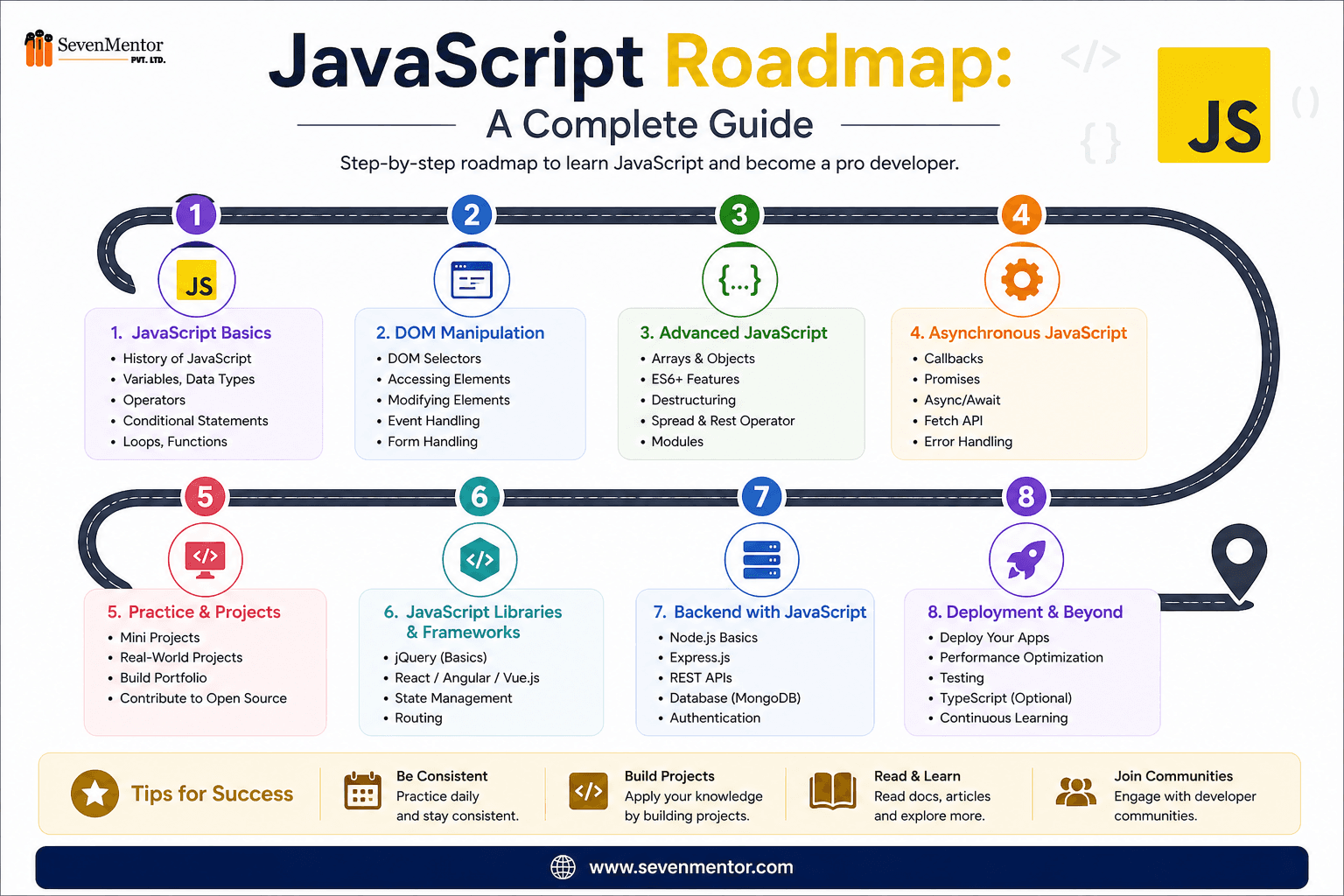
Introduction
If you wish to develop a successful career in web development, get into a structured JavaScript plan, which is one of the best decisions you can make. What you may not know is that JavaScript is not just a programming language but the structure that holds together modern web applications, which include interactive websites and very complex full-stack systems. Whether you are a total beginner or an advanced user looking to improve your skills, this JavaScript roadmap for beginners and advanced users will have what you need to know, in what order to learn it, and how to put it to use. In this guide, we will go into each stage in detail, which will make it easy for you to navigate your journey to becoming a great JavaScript developer.
Why Learn JavaScript in 2026?

Before we get into the roadmap, it’s also very important that you understand why JavaScript is still at the top of the list as a must-have skill:.
- It is the number one language for web development.
- For frontend, backend, and full-stack development.
- Huge demand for JavaScript developers globally
- Strong ecosystem of tools, which includes React, Angular, and Node.js.
- Continuous expansion of AI, Web3, and cloud applications.
In other words, with JavaScript you open up to many career options.
Career Opportunities After Following the JavaScript Roadmap
After completing this JavaScript roadmap, you can apply for:
- Frontend Developer
- Backend Developer
- Full Stack Developer
- Web Developer
- Software Engineer
The demand for skilled JavaScript developers is consistently high.
JavaScript Roadmap: Step-by-Step Guide
Step 1: Learn the Basics of JavaScript
The first step in the JavaScript roadmap is building a strong foundation.
Core Concepts You Must Learn
- Variables (let, const, var)
- Data types (string, number, boolean, object)
- Operators and expressions
- Conditional statements (if, else)
- Loops (for, while)
- Functions and scope
Example
function greet(name) {
return "Hello " + name;
}
console.log(greet("John"));
Understanding these basics ensures you can write and understand simple programs confidently.
Step 2: Master DOM Manipulation
Once you have the basics down, in the second stage of the Roadmap to Learn JavaScript For beginners, we look at which elements of the page JavaScript can interact with.
What is DOM?
DOM (Document Object Model) allows JavaScript to manipulate HTML and CSS.
Key Topics
- Selecting elements (getElementById, querySelector)
- Event handling (click, submit)
- Changing content dynamically
- Styling elements
Example
document. getElementById("btn"). addEventListener("click", function() {
alert("Button clicked!");
});
This is where JavaScript becomes powerful and interactive.
Step 3: Understand ES6+ Features
Modern JavaScript has adopted features from ES6 and beyond that are a must-have in any JavaScript developer's roadmap.
Important ES6 Features
- Arrow functions
- Template literals
- Destructuring
- Spread and rest operators
- Modules (import/export)
- Promises and async/await
Example
const add = (a, b) => a + b;
console.log(add(2, 3));
Learning these improves code readability and efficiency.
Step 4: Learn Asynchronous JavaScript
In practical settings, which is what we see in the real world, handling of asynchronous processes is key.
Topics to Cover
- Callbacks
- Promises
- Async/Await
- Fetch API
- Error handling
Example
async function fetchData() {
const response = await fetch("https://api.example.com");
const data = await response.json();
console.log(data);
}
This step is essential for working with APIs and dynamic data.
Step 5: Version Control with Git & GitHub
In 2026, no step-by-step guide to learning JavaScript is complete without version control.
Why Learn Git?
- Trace code changes.
- Collaborate with teams
- Build your portfolio
Key Commands
- git init
- git add
- git commit
- git push
GitHub also helps showcase your projects to recruiters.
Step 6: Learn Frontend Frameworks
After learning the basics of JavaScript, try out frameworks.
Popular Frameworks
Why Frameworks?
For one, they simplify the development process and also help in the creation of large-scale applications
Focus Areas
- Components
- State management
- Routing
- API integration
Step 7: Backend Development with JavaScript
JavaScript has gone beyond the front end.
Learn Node.js
Node.js also includes client-side execution.
Key Topics
- Express.js framework.
- REST APIs
- Authentication
- Database integration
Example
const express = require('express');
const app = express();
app.get('/', (req, res) => {
res.send('Hello World');
});
app.listen(3000);
This step makes you a full-stack developer.
Explore Other Demanding Courses
No courses available for the selected domain.
Step 8: Work with Databases
To create real applications, databases are used.
Types of Databases
- SQL (MySQL, PostgreSQL)
- NoSQL (MongoDB)
Skills to Learn
- CRUD operations
- Database design
- Connecting with Node.js
Step 9: Build Real Projects
The key to the JavaScript roadmap is working on projects.
Project Ideas
- To-do app
- Weather app
- E-commerce website
- Chat application
Why Projects Matter
They show off your skills and build confidence.
Step 10: Learn Advanced Concepts
To become a pro, dive deeper.
Advanced Topics
- Closures
- Event loop
- Hoisting
- Prototypes
- Design patterns
These concepts are often asked about in interviews.
Step 11: Explore Testing & Performance Optimization
Professional developers should focus on code quality.
Testing Tools
- Jest
- Mocha
Optimization Techniques
- Code splitting
- Lazy loading
- Minification
Step 12: Stay Updated with Trends in 2026
Technology evolves rapidly, and staying updated is key.
Latest Trends
- AI integration with JavaScript
- Serverless architecture
- Web3 and blockchain apps
- Progressive Web Apps (PWAs)
Why Follow a Structured JavaScript Roadmap?
The following is a structured roadmap to learn JavaScript for beginners, which saves time and avoids confusion. Instead of jumping around randomly between topics, you build skills step by step.
It also ensures:
- Better understanding
- Strong fundamentals
- Faster job readiness
Conclusion
The JavaScript Roadmap: Step by Step to Master JavaScript in 2026 is your roadmap to success as a developer. We take you from the basics through to advanced topics, which all play a key role in developing your skills. If you work through the JavaScript developer plan: From Novice to Pro in 2024 (revised for 2026): With care and diligence, you will be well on your way to building real-world apps and landing that great tech job. For those who want structure in their learning, access to expert mentors, and practical training, we recommend enrolling in a professional JavaScript or full-stack development course.
Frequently Asked Questions (FAQs):
1. How long does it take to learn JavaScript in 2026?
It typically takes 3–6 months to learn the basics and 6–12 months to become job-ready, depending on your consistency and practice.
2. Is JavaScript enough to get a job?
Yes, JavaScript is highly in demand. However, combining it with frameworks and backend skills increases your chances significantly.
3. What should I learn before JavaScript?
Basic HTML and CSS are recommended before starting the JavaScript Roadmap.
4. Which framework is best after JavaScript?
React.js is the most popular choice, but Angular and Vue are also excellent depending on your goals.
5. Can I learn JavaScript without coding experience?
Absolutely. The Roadmap to Learn JavaScript for Beginners is designed for complete beginners, and with consistent effort, anyone can master it.
Related Links:
Java Design Patterns You Should Learn
Do visit our channel to know more: SevenMentor
SevenMentor
Expert trainer and consultant at SevenMentor with years of industry experience. Passionate about sharing knowledge and empowering the next generation of tech leaders.
Call the Trainer and Book your free demo Class..... Call now!!!
| SevenMentor Pvt Ltd.
© Copyright 2025 | SevenMentor Pvt Ltd.