MEAN Stack Development: What Is It and Why You Must Consider Learning It?
Web applications are generally structured in a linear fashion. Beginning from your login page to your database, where your information is stored in records, there is generally one application that’s been built out to handle everything for you. Building web applications such as these requires learning a particular technology stack. For this course, we’ll be learning the MEAN stack technology. This is what makes learning MEAN Stack so practical for new web developers as well as for those who are already into web development and looking for a change.
In the previous article, we explained the MEAN stack. Today we are going to talk about the MEAN Stack, a powerful technology stack made up of 4 main technologies: MongoDB, Express.js, Angular, and Node.js. What’s best about the MEAN Stack is that you can use only one language for everything: JavaScript.
Here’s why learning a MEAN stack course is best right now:
- One language (JavaScript) across the entire application
- High demand from startups and MNCs building web-based products
- Faster development cycles compared to mixed-stack projects
- Strong community support and constant updates to tools
- It can also be used for freelance work, product companies, service-based IT firms, etc.
- A solid foundation for real-time apps, dashboards & e-commerce platforms.
Whether you’re looking to get a job, start a freelance career or create your own product/idea, learning the 4 MEAN Stack components will enable you to build complete functional applications as opposed to just learning parts of building an application.
What Will You Learn in the MEAN Stack Course at Sevenmentor?
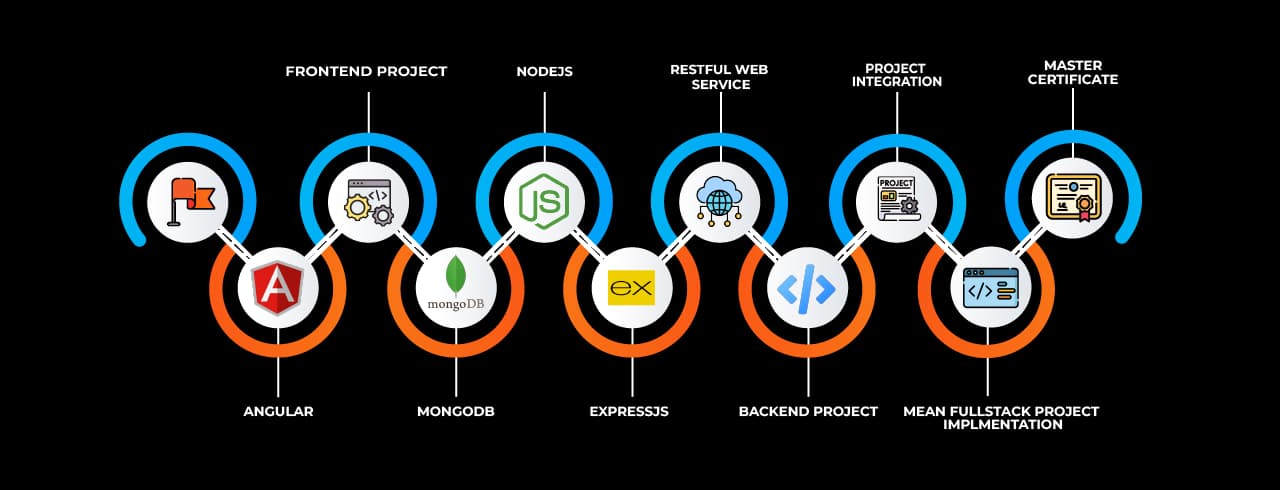
Sevenmentor’s MEAN Stack training is structured to establish understanding of each component of the MEAN Stack in sequential order, enabling students to develop an application comprised of a front end, back end, and database in the end. Instead of beginning to work on large projects immediately, students learn how the web works first, followed by an in-depth tutorial of each technology used in the MEAN stack.
The training is based on “doing” rather than just reading theory about implementing it in future projects. I can start to apply what I learn in this course to future projects quickly, instead of wasting time in a classroom listening to a long lecture on theory and then hopefully applying what I learned. For example, you click a button and then analyze the implemented logic. After that, you fill out a form and then analyze the implemented logic again.
Some of the main points of this course are the following:
- HTML, CSS, and basic JavaScript functionality, as well as how to manipulate the DOM and handle events.
- Angular - components, forms, routing, dynamic UI.
- API development of the whole application with the help of Node.js and Express.js.
- Data storage, updates, and retrieval by means of MongoDB.
- Authentication and session handling for secure applications
- Connect all four layers to 1 full-stack project.
At the end of the MEAN Stack development course you will have made your way through the theory of all four layers and will have put them into practice for your full-stack project. This means that in addition to the theory, you will have created screens, connected them to your own API, and stored the data of your application in a database. This is exactly what potential employers are looking for from a MEAN Stack certification course.
Why Choose Sevenmentor for MEAN Stack Training?
The numerous offers for MEAN stack training courses can make a big decision very difficult. Why should one book a training course instead of others? The main goal of Sevenmentor’s MEAN Stack training course is to focus on practical knowledge, imparted through means of tutorial sessions, and impart adequate knowledge so that candidates can apply the knowledge in real-life scenarios. Sevenmentor does not focus on just imparting theoretical knowledge. Hence, all the sessions are conducted keeping in mind the practical implementations. Moreover, adequate individual attention is provided to all the candidates, as a limited number of candidates are made to sit in a single session of the MEAN Stack training course.
The examples of projects that the trainers create are all practical in nature and are similar to the work that a fresher will get to do in any company. It is not just a theoretical session where only textbook examples are shown to students.
Here’s how Sevenmentor is different from other MEAN Stack training institutes.
- Small batch sizes for more individual attention
- Practical tasks after every topic — routing, APIs, database queries, UI logic.
- Support outside class hours for debugging and project reviews.
- Work on real projects such as building dashboards, authentication systems, and admin panels for your portfolio.
- Write a cover letter & improve your resume & practice for MEAN stack developer job interviews after the course is over.
- Portfolio guidance to implement projects into your resume while you complete the course.
Learn how to apply for a job as a MEAN Stack developer after the course. Get confident to apply and get selected for a job in a few days after the course. We also help you to get placed in top companies by preparing you to speak about your projects in interviews.
What Career Opportunities Open Up After a MEAN Stack Course?
MEAN Stack is one of the most popular courses among learners, as the range of possible jobs is huge and is focused on web development, covering the front-end, back-end, and database parts.MEAN Stack students are not limited to just one job description. They can function as full-stack developers, front-end developers or even back-end developers as long as they wish.
The training is for e-commerce, fintech, healthcare, logistics and ed-tech companies who need web applications to be built and maintained.
Companies from a range of industries, including e-commerce, fintech, healthcare, logistics, and ed-tech, require web applications to be developed and maintained. So even though the range of roles available to graduates of a MEAN Stack course is extensive, there is a steady demand for qualified web developers with expertise in the full MEAN Stack development workflow.
Graduates of the MEAN Stack program will be ready to step into the following positions:
- MEAN Stack Developer in product or service-based companies
- Front End Angular Developer
- Back End Node.js/Express Developer
- Full Stack JavaScript Developer
- Freelance web developer building client projects independently
- Developer for a startup company that is capable of building web applications very fast.
All of the MEAN Stack applications are written in JavaScript, which provides the learner with the ability to quickly and easily adapt to applications like React, Vue, and serverless architectures. The end result is that the learner receives a powerful foundation to start their web development career that will not leave them stranded after the completion of a single course.
Why Enroll in the Online MEAN Stack Course at Sevenmentor?
If attending in-person classes doesn’t suit you, then why compromise on the learning experience? SevenMentor's Online MEAN Stack course also comes with a hands-on approach. In this mode of learning, student can participate in live sessions of classes, can see screen of trainer, can do debugging in real time etc. Thus, it is not just watching pre-recorded videos and then hoping that things will fall into places.
This format of learning is especially beneficial to the working professionals, who have very less time to learn new things and students, who like to go back to the demo anytime they want.
The benefits of the online MEAN Stack training are as follows:
- Live interactive classes with real-time doubt resolution
- Full recorded sessions to revisit anytime
- Project files and structured assignments
- Practice sets after every major topic
- Complete portfolio-building guidance
- The same depth of content as classroom batches
Many of our students who took up our online MEAN stack certification program have got placed in good MNCs.The sessions will be very practical and follow the goals that the students pursue with their projects. This also means that whether the sessions are held in a classroom or as part of an online MEAN stack training course, after finishing the course, you will be able to immediately start building, debugging and deploying your full-stack web application.
How Does Sevenmentor Support Corporate MEAN Stack Training?
Sevenmentor also trains individuals and helps a company to upskill their development team with corporate MEAN Stack training. The trainer first understands the existing tech stack of a company and the problems that a company is facing, and then only the trainer creates an environment of training and makes a syllabus for the training.
Therefore, the way that training is delivered is tailored towards solving real problems for real projects. This means that rather than delivery of generic examples, the trainers are delivering sessions of practical use to the day jobs of the attendees.
Corporate sessions typically focus on:
- Writing cleaner, more maintainable APIs
- Speeding up UI development using Angular
- Improving overall application performance
- Structuring code for easier scaling
- Reducing recurring bug cycles
- Building reusable components across projects
Students work on exercises related to their current projects or work at companies. We offer on-site or online training to corporate clients. That way the development teams can put their newly acquired skills into practice No time is wasted on abstract examples. The most practical MEAN stack training is delivered to aid development teams in closing skill gaps without being removed from work for lengthy, irrelevant theory-based courses.
How Does Sevenmentor Address Common Training Concerns in the MEAN Stack Course?
Choosing the right training institute is a big decision. It is normal to have many doubts in your mind before joining a course like MEAN Stack training in Mumbai. The batch size, the kind of placement support that the students receive, and the way the classes are conducted are just a few of the things that one would like to know before enrolling in a course. At Sevenmentor, we design our courses in such a way so that our students know what to expect from the very first day of the course.
Here’s how Sevenmentor ensures a fixed structure of the course for the MEAN stack training program.
- Our training program runs with a fixed number of students in each batch, kept small on purpose to provide the best possible assistance to every student, regardless of the batch.
- All session schedules are clearly laid out at the commencement of the batch and Sevenmentor ensures that all sessions are held on time. The timings are strictly followed, and any variations are notified in advance.
- Doubt-clearing sessions outside of classes are held to ensure that students are able to progress at their own pace without any hiccups in their learning.
- Structured placement assistance—The training program includes mock interviews, resume development & portfolio creation as a part of the course. It is not something that is done as an after-thought.
- Work on Real Projects: In order to reinforce learning, we work on real projects throughout the MEAN Stack training course. So, you would be able to see how well you are doing and learn accordingly.
- All sessions conducted by trainers (not pre-recorded) to keep it interactive.
- A fixed online or offline format that you can choose beforehand and that we maintain throughout the training.
What Other Skills Complement a MEAN Stack Developer's Career?
The MEAN Stack Training Course will equip you and give you a good base for full-stack web development. However, many a student also wants to learn additional skills in order to be prepared for the job market. Because most of today’s applications are not standalone applications but are connected to data warehouses, cloud servers, AI applications, or other enterprise systems, it is very helpful to know what kind of additional skills there are and how you can plan your learning in the best way.
Here are some skills that work well with the MEAN Stack development training:
Data Science - As you already know, most of the applications are data-driven, so learning Data Science with the MEAN stack helps you to develop web applications that go beyond basic CRUD operations.
Data Analytics – to be able to better understand the behavior of users of your web applications and also that of your own developed web applications.
Python – As a popular alternative for a backend to Node.js, learning Python can be really beneficial for a MEAN stack developer.
Cloud Computing - Needed for deploying your applications in the cloud and scaling them up or down as necessary.
Cyber Security – useful for a developer to understand and to work with in order to secure his/her web applications from vulnerabilities etc.
SAP – useful for enterprise solution development.
Generative AI & AI Course—learn to create intelligent web applications with a lot of features.
ChatGPT Course—This will help you create and integrate chatbots to your applications.
DevOps – helps to implement continuous integration and release of your web applications.
Power BI adds data visualization and also the development of dashboards to your current skills.
Salesforce – valuable for building CRM-based web solutions
Java – useful for developing large-scale web applications for the enterprise.
You don’t have to learn all of these at the same time. Many of our learners first start with the MEAN Stack certification course and then add 1 or 2 of the above depending on how their career grows. Whether you are interested in a data-intensive role, cloud role, or an enterprise-based role, we can help you to achieve your goals.
Got Questions? Here Are Some FAQs
1. What is a MEAN Stack Course?
The MEAN Stack course is a hands-on and project oriented training that teaches students how to build a full web application using MongoDB, Express.js, Angular and Node.js. The student starts from the basics of the database and the server part of the web application. Once he masters these topics, he proceeds to the dynamic front-end of the web application. By the end of the student can develop a full web application using only one programming language i.e. JavaScript and the four components of the MEAN stack.
2. How long does it take to learn MEAN Stack?
It may take different periods of time for different learners to learn MEAN stack. However, generally speaking, it takes three to six months to learn MEAN stack development. However, this really depends upon prior experience of the student with programming languages. Since there are various types of courses, such as full-time bootcamps as well as part-time self-learners, the time required to learn also varies.
3. Do I need to know JavaScript before starting a MEAN Stack Course?
Most MEAN Stack Courses start from the beginning of learning JavaScript and then continue with learning Angular, Node.js and MongoDB. So it is not a problem that you have no prior experience with JavaScript before enrolling for a course.
4. What career opportunities are available after completing a MEAN Stack Course?
By learning MEAN Stack, students will be ready to apply themselves in industries such as software development and take up roles such as a MEAN Stack Developer, Full Stack Developer, Front-End Developer or Back-End Developer. The strong growth of JavaScript-based technology stacks are taken up by most startups, especially startups, IT companies and product-based organizations across the globe.
5. What is the difference between MEAN Stack and MERN Stack?
The main difference between MEAN and MERN is the front-end framework used. MEAN Stack uses Angular while MERN Stack uses React. So the difference really comes down to whether you prefer to specialize in Angular or React, or if you are looking for a job and are unsure which has the most demand in the job market.
Related Links:
Anthropic AI Tool
What is Writesonic
What is Claude AI
AI Engineer Roadmap
What is JasperAI
What is Copy AI
Do visit our channel to know more: SevenMentor
 Master full-stack development with SevenMentor’s MEAN Stack course and build dynamic web applications.
 To become a developer who is ready for work, acquire hands-on experience in MongoDB, Express.js, Angular, and Node.js.
  Develop real-world projects, improve your coding skills, and begin your web development career.
 AngularBuild dynamic and scalable web applications with Angular, utilizing TypeScript and two-way data binding.
 NPM A package manager for installing and managing JavaScript libraries and dependencies.
 Body-ParserA middleware that parses incoming request bodies in Express applications.
 Cookie-ParserA middleware for handling and parsing cookies in Express applications.
 Visual Studio Code A lightweight, feature-rich code editor widely used for web development.
 Google ChromeA popular web browser with developer tools for debugging and performance analysis.
 Angular (framework)A powerful TypeScript-based framework for building scalable and modular web applications.
 ng-template, ng-containerCreate reusable template blocks and logical DOM structures without adding extra nodes.
 Node JSA runtime environment for server-side JavaScript execution.
 Express JSA lightweight framework for building Node.js web applications.
 MongoDB A NoSQL database for storing flexible, document-based data.