Why Should You Choose a Professional PL/SQL Course Today?
When data is no longer your main asset, knowing how to fetch it with simple SQL queries is not enough. Large amounts of data require complex business logic to process it in a timely manner and to do this within the database engine. This is where procedural extensions, such as PL/SQL, can become a career-defining skill. Learning a solid PL/SQL course will help you become a high-value asset to any tech team.
Learn to write code that is structured into procedural blocks to manage data in the fastest and most secure way possible. Companies from all over the globe use skills like these to manage the backend of their applications.
- Performance Optimization: The code written in a PL/SQL block is linked together by SQL commands, and this has the advantage of greatly reducing network traffic between an application and an Oracle database.
- High Industry Demand: Top-tier industries including banking, telecom, healthcare, and retail are all using huge relational databases that require database developers, some of the highest-paying jobs in the industry.
- Automate the Business Logic: Program the data update, complex calculations, and validation checks required for data processing in an automated fashion instead of manual intervention.
- Career Growth: Adding procedural database programming to your resume from your perspective as an Oracle developer, database analyst, or backend engineer makes you highly valuable for firms.
- Data Consistency and Security: Being a backend engineer, you can code security measures to ensure high consistency of data and keep data consistent during any activity load on the system.
Why is SevenMentor the Leading Oracle PL/SQL Training Institution?
There are lots of institutes that are providing Oracle PL/SQL training, but we at SevenMentor are trying to give training to the students in a different way by avoiding the normal way of teaching through the classes. SevenMentor Training Institute is providing the Oracle training in a real-time corporate development way by step-by-step logic to learn Oracle PL/SQL in a very simple way to understand without getting into details of syntax.
The classes are maintained in a small and interactive environment and are planned in a structured format to provide each student with due attention, code debugging, and mentorship by industry experts.
- Benefits of Our Oracle PL/SQL Training: Our case studies for each lesson are from real-life corporate environments. For example, you will learn to generate a monthly report as well as perform a bulk update of customer information in a database.
- Learning through Hands-On Code Practice: Short anonymous blocks, sample tables to fix, live triggers to test, and more such projects that help you write confidence in the Oracle PL/SQL programming language.
- Flexible Learning Modes: We have designed our courses to suit all types of learners. They can join our interactive classroom sessions or opt for our live PL/SQL online training. The tracks are designed to suit the busy schedules of working professionals as well as the college goers.
- Post-Class Trainer Support: Our mentors are available outside of the classes’ regular hours to help you with the assignments and the programming bugs that you encounter while working on the database projects to update your resume for technical interviews.
- Our experienced career development team will assist you to create a professional resume and prepare you for interviews with databases as samples of projects.
What Will You Learn in This Comprehensive PL/SQL Certification Program?
Oracle University has developed a comprehensive and in-depth curriculum that is great for beginners as well as experienced developers looking for in-depth knowledge on advanced topics. This PL/SQL certification is structured to begin with basic topics and then progress to advanced architectural components of a database. With each module grounded in real-life workflows (i.e., payroll processing, sales updates, etc.), the student will gain practical knowledge on how to write database applications that solve real business problems using Oracle databases and applications.
Start from learning how Oracle stores information and proceed to writing robust, production-ready database applications. This certification course covers the 5 pillars
- required to rule the Oracle workspace: Foundational PL/SQL Blocks—Variables, control structures (IF-THEN-ELSE), loops (FOR, WHILE, REPEAT), etc. are used to construct simple SQL scripts.
- Procedures and Functions: Students will learn to create modular and reusable units of code that are to enhance development and reduce processing time for applications.
- Oracle PL/SQL Database Triggers and Exception Handling: Advanced Cursor Management – The sophisticated use of Oracle database cursors to process and manipulate the results of multi-row SQL queries on a row-by-row basis.
- Database Triggers: Create automatic firewalls for databases. These will be carrying out some actions on the database, such as INSERT, UPDATE, and DELETE, while triggering other actions, including sending emails, making updates on some other system, and inserting some data into another table.
- Exception Handling: You need to handle runtime exceptions in your code, log these for future reference, and resolve these in order to run your safe code.
- Package and Code Management: Learn to group similar procedures, functions, and variables in one package for easier maintenance than keeping all scripts in separate files.
Can I Master Advanced Database Coding Through PL/SQL Online Training?
With increasingly hectic schedules of work and studies, structural flexibility is the prime need of continuing education. SevenMentor’s PL/SQL online training program is a fully-interactive, immersive online learning track that is specifically designed to ensure that employees as well as students are able to learn in the best possible manner. It is not a bunch of videos and pre-recorded tutorials—instead, it is a live online class where students are able to interact with the instructor and get their questions answered in a jiffy. The online learning environment is fully interactive and has all the ingredients of a traditional physical classroom. Students can share their screens, and thus, the instructor and the other students can see exactly what they are doing while debugging a complex backend program with the help of, say, PL/SQL code.
A critical online feature of SevenMentor’s PL/SQL online training program is the collaborative environment in live, interactive sessions of our online learning tracks. All the employee or student has to do is join a virtual learning session with an instructor and his/her and using screen sharing get assistance from the said faculty member for compilation errors, semantic errors in his/her code,, etc.Moreover,r all the sessions are recorded too. Thus, even if an employee or student misses a session due to some sudden overtime at work or for any personal reason, he/she can get hold of the recorded version of that session and learn whatever was taught in that session.
Our digital learning track has got you covered with a suite of learning tools to keep you moving forward!
- Screen Sharing: Live, Interactive—Work through backend loops and complex code structures with your mentor in real time, going step by step through the code to understand the underlying structures.
- On-Demand Class Archive: Go through recorded sessions of all classes as many times as you need to to go through the complex architectural concepts, the structural database designs, and the detailed procedural implementations.
- Virtual Hands-On Labs: Practice your newly acquired skills in fully functional enterprise databases remotely hosted without affecting your local development environment.
- Flexible Time Slots - Students can learn best in different time frames; thus, we have structured learning on weekdays and also extremely intense learning on weekends (in the form of bootcamps).
- One-on-One Mentorship: Schedule a one-on-one session with the instructor at a time of your choice outside of the regular classes to get your complex system engineering problems sorted.
Do You Provide Tailored Corporate PL/SQL Training for Technical Teams?
No business today can afford to run into data processing delays or database errors that interfere with the normal workings of business. SevenMentor Corporate PL/SQL Training for business is therefore delivered as a customized program of corporate training in the form of a workshop using the client-specific data as the basis for the training in the form of a workshop of the special structured sessions of coding.
Before the actual workshop starts, the engineering trainers at SevenMentor study the bottlenecks in the databases, the manual processing delays, and the required data optimizations of a company. In the subsequent workshops, trainers teach the software developers at the company how to develop cleaner code for data processing and how to reduce the execution time of procedures and also how to verify data automatically and in a continuous manner.
Our custom-designed solutions for engineering teams at corporate levels help enhance their productivity:
- Targeted Project Application: Train your team on a specific project / application that they deal with on a day-to-day basis. For example: Process payroll data or generate automated client reports.
- Workflow Performance Tuning: The corporate PL/SQL training courses help the students in writing highly optimized code,, which can result in much less network usage of the system.
- Unified Development Standards: We make sure that the code that is written is clean and is maintained by following certain development standards. We train the engineers to follow a certain standard while writing the code so that it is easier to maintain by all.
- Flexible Delivery Options: We can conduct classroom training sessions using interactive sessions and also deliver training through online platform, which can be accessed from any location across the globe.
- Practical Coding Labs: We conduct short duration intense database programming labs so that employees can start applying what they learned immediately.
- Employees, in short, intensive database programming labs during the workshops.
How Will This Practical PL/SQL Course Accelerate Your Career Growth?
Industry-relevant skills for the modern workplace. This dedicated course of study prepares the student for the practical realities of the world’s greatest organizations, utilizing the powerful PL/SQL programming language to interact with data within the Oracle enterprise environment. Whether you are a student looking to go straight into employment as a database professional or require training to upgrade your current skills to enter the very competitive area of the backend of the database, this is the course for you. With the ability to add extreme value to organizations that deal with large amounts of data, students will be able to show potential employers that they are able to handle data in the Oracle environment and perform data-intensive operations. The student will leave with the ability to immediately put the skills that they have learned to work in real-world error correction and more. Our training paths help you create a solid portfolio of work that shows your skills in developing robust, secure, and high-performance business applications.
Graduating from our professional database program will equip you with the skills to apply for a variety of highly rewarding jobs:
- Oracle Database Developer: Build, maintain, and optimize the core business logic of large-scale enterprise applications as well as the stored procedures that support them.
- Database Administrator (DBA): Secure critical database systems, manage automated triggers, and ensure seamless data recovery across server networks.
- Data Warehouse Analyst: Loads mass amounts of data and processes updates via procedural code blocks to provide data to intelligence dashboards that allow a corporation to monitor and assess performance over time.
- Application Support Engineer: Run rapidly to resolve runtime errors, debug programs, fix problems in production environments, and patch systems to handle new applications.
- Backend Automation Expert: Eliminate the tedium of repetitive work by creating high performing background code to automate time-consuming tasks.
What Makes Our Student-First PL/SQL Course Approach Completely Transparent?
At SevenMentor, we understand the significant amount of money and time spent by database students in choosing the right PL/SQL training institute. We realize their worries about the varying degrees of skills of instructors in providing training, extra charges for post-course placement activities, and most importantly, the practices of organizations for retrieving their money from students by making them work in recruitment activities.
We are functioning to provide all functional transparency at SevenMentor from a learner’s very first query to his/her last interview at placement to help him/her in acquiring the best skills to acquire the best job in the market.
- Veterans of the Industry: All of our trainers are extremely experienced, at the senior level, and have tons of real-world experience in their respective domains of Oracle. Our batch of students is thus taught by the very best in the industry for functional training and by SevenMentor’s senior mentors for training that is of the highest quality and functional in nature. All of our mentors are, thus, first and foremost, senior Oracle database developers with years of hands-on experience in advanced debugging techniques.
- Zero Hidden Placement Fees: What SevenMentor students pay for their training is exactly what they get. No surprise, additionally, after the technical interview, post-training tracking charges to place them in companies.
- Verified Corporate Job Descriptions: The SevenMentor Placement Team will filter out the innumerable job postings to verify the job openings. Our filters are designed to prevent us from posting innumerable unpaid internships or job postings with unknown employer backgrounds.
- Protected Interview Freedom: We don’t threaten to block your interviews for future recruitment drives if you don’t agree to go with an exploitative company. You are free to choose as you would be if you weren’t paying for training.
- Consistent Learning Format: We ensure the structure of the learning program is consistent; a physical / offline batch remains a physical / offline batch. No abrupt switch to online learning.
How Does Mastering PL/SQL Connect with Other Trending Modern Technologies?
This work of database programming is not an isolated activity within today’s integrated tech environment. High-performance database systems form the core of any intelligent applications, intelligent corporate networks, and intelligent web applications. The backbone of such an environment is a high-performance database. The solid basis of work with high-performance database systems such as Oracle in comprehensive PL/SQL training courses is the best preparation for work with the backend of any applications in a wide variety of engineering fields. This training course also enables the student to understand very well how any application interacts with the database of that application. Thus, the student of such training courses will become a very versatile and a very valuable resource for any organization that develops applications and manages applications for use within an enterprise.
Take your skills to new heights and become a proficient developer building complete solutions scaling across environments in big corporations.
Here is how our comprehensive curriculum in database programming interacts with other leading domain training paths to enable engineers to build end-to-end scalable solutions:
- Data Science & Data Analytics: Inside a database, efficiently extract, process and clean relational data to then use this data within a web application or for analyzing user behavior in data-driven applications.
- Python & Java Development: High-performance backends of data-rich applications by linking object-oriented code (such as Python or Java) with the power of optimized PL/SQL stored procedures in databases.
- Cloud Computing & DevOps: Scale up your enterprise applications and set up your continuous integration pipelines in the cloud by learning to host your databases in the cloud and automate them.
- Generative AI, AI, & ChatGPT Integration: Build smart applications and AI-powered chatbots by feeding real-time database information securely with transactional logic.
- Power BI & Salesforce CRM: Create a clean data pipeline that automatically updates and feeds data into advanced visualization dashboards as well as business web solutions built on top of CRM platforms.
- Cyber Security & SAP Systems: Learn to secure data of very large database structures for web applications and also to support very large financial tracking structures within very large ERP systems such as SAP.
Got Questions? Here Are Some FAQs
Q1. What is a PL/SQL course?
In this PL/SQL Course, you will learn how to create programs in a database and manage them. A PL/SQL Program consists of Procedures, Functions, Trigger(s), Cursors and Packages. Also in the course you will learn to handle exceptions in a PL/SQL program.
Q2. Who should join a PL/SQL course?
A PL/SQL course is relevant for students, as well as for Software Developers, Database Administrators and SQL Professionals alike. A quality PL/SQL training course is ideal for any individual that wants to specialize in Oracle database development and thereby boost their career opportunities.
Q3. What are the prerequisites for learning PL/SQL?
Yes there are many PL/SQL courses that start by teaching SQL for beginners as well as the programming aspects of PL/SQL for more advanced students.
Q4. What jobs can I get after completing a PL/SQL course?
Some examples of jobs that you can apply for after completing a PL/SQL course are: Oracle PL/SQL Developer, Database Developer, SQL Developer, Database Programmer, Oracle Database Administrator.
Q5. Does a PL/SQL course include practical projects?
Most PL/SQL courses will contain hands-on exercises and real-world examples to work with. Also you can work on many different database scenarios and complete projects in order to get a good grasp on how to use the language for real life applications.
blog Links:
Anthropic AI Tool
What is Writesonic
What is Claude AI
AI Engineer Roadmap
What is JasperAI
What is Copy AI
Do visit our channel to know more: SevenMentor
 PL/SQL (Procedural Language/Structured Query Language) is a computer language that mixes SQL and procedural code.
  Oracle created it.
 Oracle Corporation created PL/SQL (Procedural Language for SQL) as a procedural extension for SQL and the Oracle relational database.
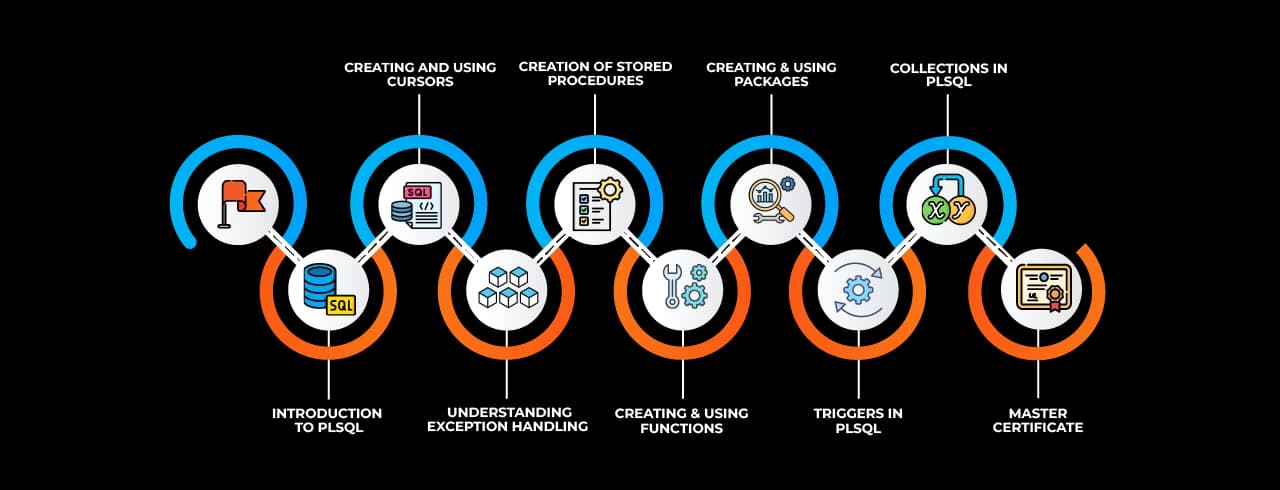
 Introduction to PL/SQLOverview of PL/SQL, structure, and database programming advantages.
 Understanding Exception HandlingManaging errors gracefully using predefined and user-defined exceptions.
 Creation of Stored ProceduresDefining reusable blocks of PL/SQL code to perform specific tasks.
 Creating & Using FunctionsWriting functions to return values and enhance modularity in PL/SQL.
 Creating & Using PackagesGrouping related procedures, functions, and variables into modular units.
 Triggers in PL/SQLAutomating database actions in response to events like inserts, updates, or deletes.
 Collections in PL/SQLUsing arrays, nested tables, and associative arrays to handle multiple data elements.
 Creating and Using CursorsHandling query result sets efficiently using explicit and implicit cursors.