What Is an RPA Course and Why Do You Need It for Career Development in the Modern World?
Robotic Process Automation (RPA) is among the fields that companies are paying attention to in order to get rid of the need for human involvement in tedious tasks. An RPA course is a way to learn how to create software robots that can emulate human interactions on a computer. Instead of spending hours and days on end on a repetitive task such as copying and pasting information from various documents, sending hundreds of emails, etc., automation can perform such tasks within a split second without any human intervention. Also, these tasks can be carried out 24/7 without any fatigue. RPA is a bridge between software engineering and a person doing a normal day job of a productivity officer in an office. It helps a person to shift from doing repetitive work to designing processes and improving them.
Taking an RPA course is one of the smartest things you can do for your career, as RPA is going through digital transformation in organizations all over the world. And this transformation is bringing huge demand for skilled professionals who can help in automating the processes in different industries. This automation is not limited to IT processes, but automation is required in finance, healthcare, HRM, supply chain management, and many other industries. With RPA training, you can become a high-value resource and help the organization in reducing operational costs and saving thousands of hours of manual work.
- Massive Industry Demand: Huge demand in industry for automation professionals as companies worldwide are looking to automate their processes. Huge job opportunities in the form of lucrative packages for automation professionals as companies are looking to hire automation professionals to help them streamline their processes and cut down operational costs.
- Accessible to Non-Programmers: Most of the modern automation tools are developed in such a way that they are accessible to the people who are not much into programming. Most of the tools use an intuitive interface that can be accessed using drag-and-drop features of the tool.
- Versatility Across Different Industries: The education one gets during the RPA course includes basic concepts of automation, which can be used in different industries like banking, retail, insurance, logistics, supply chain management, and health care.
- Career Development: With automation training, you will get the opportunity to transform your career into a more strategic one of an automation analyst/process consultant.
Why Should You Choose SevenMentor for Your RPA Training?
SevenMentor is the best RPA training institute, which offers SevenMentor RPA classes with a practical approach. Our RPA training sessions focus on the workflow of an automation, how it integrates into corporate workflow to increase the efficiency of an organization, and how to bring an increase in the bottom line for the organization.
At SevenMentor we have a well-thought-out approach to imparting knowledge, and that is by means of mentorship and a practical approach to learning. Small batches of students are trained on a daily basis, and students are provided with the required feedback with reference to the workflow that they design on a daily basis. Our approach of training students on various tools of RPA in the marketplace, such as UiPath, Automation Anywhere, Blue Prism, etc., helps students in becoming automation experts in the long run and being well equipped to handle any project that comes their way in any organization, using any tool.
- Expert Industry Trainers: Our trainers include automation developers and IT / process design experts with real-world experience and expertise in conducting classroom training.
- Multi-Tool Exposure: Learn Multiple Tools of RPA, including UiPath, Automation Anywhere, and Blue Prism.
- Daily Practical Assignments: In every session, create live bots to automate Excel, scrape data from websites, and read through parsed invoices printed as PDFs.
- Dedicated Placement Support: We assist our students in creating job-ready resumes and in conducting mock interviews and even in connecting with companies that are hiring for automation jobs.
- Flexible Learning Track: Classroom Sessions | Weekend Intensive Sessions | Online Sessions.
What Subjects and Tools are Covered in the RPA Course Syllabus?
The key to a very effective RPA course syllabus is a mix of basic logic and the practical implementation of that logic in a comprehensive manner. In the RPA Training Course by SevenMentor, our syllabus is specially designed for candidates to learn the process from the very basic level of understanding what can be automated in any organization and go on to develop into automation experts. As a starter, in the RPA course, candidates will know about creating logical workflows for automating processes that are rule-based and are performed repeatedly in any organization. Candidates will first learn to create processes in software using recorders to capture their screen actions and then learn to create a logical workflow in software and make it run autonomously.
Moving on to the implementation of the automation software, the courses will focus on how to make the bots work seamlessly with other software systems within the organization. The students will learn how to integrate the automation bots with Microsoft applications such as Excel and Outlook, as well as web applications and enterprise databases. A very critical part of the courses will also be focused on error handling and logging. In a corporate setting, the failure of the bot without notifying anyone can do more harm than good to the company's processes. In the course, therefore, students will be taught how to create programs that can deal with any error and inform the user in case of an anomaly.
- Automation Architecture Introduction: What Is Business Process Management? Where to find high ROI automation opportunities.
- UiPath Studio & Tool Workflows: We cover the basics of creating workflows in UiPath Studio using drag-and-drop features of the tool, creation of variables and data types and control flow activities such as sequence container, flow deck containers, etc.
- Advanced Workflow Logic: You can learn how to create more complex bots by using conditional statements, data loops, etc.,., and also know how to trigger a system.
- Deep Application Integration: Learn to integrate your automation with reading email from your inbox, extracting data from PDFs, and updating data in spreadsheets.
- Exception Handling & Debugging: Use of try-catch blocks to handle exceptions as well as creation of logs for a diagnostic purpose to prevent silent failures of workflow.
- Capstone Portfolio Project: Develop an end-to-end automation solution for an enterprise problem to create a functional and practical automation work.
How Does the RPA Distance Learning Program Replicate the Classroom Experience?
Many students are looking for alternatives to on-campus education, as they are already employed or based outside of main educational hubs. The RPA Distance Learning program is an excellent alternative to the traditional format of pre-recorded video lessons and combines live, interactive learning with the ability to ask and receive immediate answers to questions posed in class, replicated to the exact same standard of support and learning found on campus with certified experts in automation.
Our cloud-hosted lab is what powers our remote learning environment. As a student on our RPA Distance Learning Program – Distance Learning version, you don’t have to spend thousands of dollars in software licenses that corporations typically purchase for their IT teams. You get to use the full enterprise versions of software such as UiPath right from your web browser. So when you encounter a logical bug or a workflow link that is not working in a practical session that you are doing as part of your learning, your trainer is able to view your screen and even co-control it to help debug the software bot that you have developed. This is a critical feature that prevents you from feeling abandoned or stuck when you need help the most.
- Live Interactive Classrooms: Attend the same live lecture tracks as students studying full-time on campuses across the world, delivered by industry experts and seasoned consultants with many years of hands-on automation experience.
- RPA Cloud Lab Environment—Access the RPA Software in the Cloud: Avoid the installation of big software from your workplace and start immediately working in the virtual RPA Cloud Lab with the enterprise version of the software.
- Real-Time Collaborative Debugging: Use your screen to display your failed software bot and have your mentor screen-share into your desktop to debug your workflows together in real time!
- On-Demand Lecture Libraries: The complete set of all the structured class sessions recorded for anytime viewing by students to refresh on complex logical issues or to fill in any gaps in their knowledge.
- On Demand Lecture Library for students to view session recordings as and when required. Active Peer Chat Network for students and trainers to connect with each other for any technical help / clarification during and outside class hours.
What Custom Solutions Does Our Corporate RPA Training Offer for Businesses?
Most companies have a set of recurring bottlenecks that are eating up employees time and money. Our Corporate RPA Training program addresses this specific cost and pain point. Instead of teaching through generic, generic examples from generic industries, our training is developed within a specific industry vertical and within a company’s existing technology stack. We work closely with team leads and managers to develop a training program that teaches their employees to develop automation using the specific documents, systems, processes, and technology that they currently use on a daily basis to complete their work.
Our corporate bootcamps are a revolutionary approach to develop a workforce of system innovators. These employees will be able to automate tasks, such as invoice processing, client data migration and scheduling of daily reports in just minutes. By automating tasks that currently eat up employees’ time, they can then focus on higher value activities to drive growth and profit for their organization.
We use your real databases, invoices, and CRM systems to create the training parameters for the workshop to ensure the participants learn to automate workflows within their current enterprise systems.
- Flexible Delivery Modes: Live on-site corporate RPA bootcamps or virtual RPA workspaces.
- Enterprise Architecture Best Practices: Train your IT staff on version control, scheduling of the bots, and safety of deployment.
- Immediate Productivity Gains: Our courses immediately create functional prototype automation workflows with very high Return on Investment (ROI) to be run by the trainees during the training itself.
- Scalable Long-Term Solutions Training: The management team is trained on how to audit and scale out a large number of bots.
What career prospects do you get after taking this course?
With the best training course, you get the chance to be placed in a high-growth global job market. Since automation is becoming cross-functional, your RPA course will provide you with sufficient technical knowledge to apply for various different roles. Whether you are an IT engineer by education or come from a background of operations and commerce, companies are now looking for professionals who can identify process bottlenecks and build stable automation solutions.
The training at SevenMentor is just the starting point. After the course, the relationship does not end there. SevenMentor also focuses on the placement of the candidate. SevenMentor makes sure the portfolio created by the candidate is of international standards. SevenMentor also helps the candidate in clearing the certifications like the UiPath Certified Associate (UA) track. SevenMentor has a huge network of multinational companies, and SevenMentor connects the candidate with them for placement. At the end of the course, the candidate would have created a collection of portfolio bots, which would visually showcase his skills to the employer.
- RPA Developer: RPA Developer role involves creation of workflows for RPA (Robotic Process Automation) and also testing and fine-tuning the created RPA workflows using automation tools like UiPath, Blue Prism, etc.
- Automation Analyst: Investigating within large enterprises’ current processes to determine and document potential high returns on investment (ROI) opportunities, which can then be developed into efficient automated processes.
- Process Consultant: A Process Consultant works with large multinational companies to set up and manage RPA governance, risk, etc. to scale up automated solutions.
- RPA Support Engineer: Support deployed bot networks, manage the Orchestrator panel, and troubleshoot exceptions in workflows.
- Business Intelligence Specialist: This professional integrates automation with data analytics (business intelligence) tools to create automated corporate dashboards.
How Does Our RPA Training Ensure Total Quality Control and Transparent Student Outcomes?
SevenMentor is committed to creating a superior RPA training course that keeps evolving, is accountable to its stakeholders, and is completely transparent and operational. It tackles two biggest challenges faced by the industry today—variable quality of training provided and unverified job descriptions. A set of the highest corporate standards has been framed and is being stringently implemented across all learning tracks. We support RPA online training as well as on-campus training, and the same high-end quality RPA training is provided to all our students, whether they are pursuing RPA online training or have opted for RPA distance learning.
To mitigate these risks, SevenMentor has established an architecture that is designed to ensure that learners’ financial investments in RPA training are protected while helping them to attain the highest levels of skill enhancement. As part of this architecture, SevenMentor holds its trainers to a set of strictly defined milestones regarding delivery of the RPA course syllabus while clearly spelling out the placement blueprint that it follows for helping learners attain automation jobs.
- Accountability - All instructors at SevenMentor go through internal audit to ensure that all trainers are teaching RPA Course of study to the same standards. No module is being rushed through to meet some milestone of that instructor.
- Rigorous Job Description Vetting: All job descriptions for jobs posted by our large corpus of corporate partners are vetted by our placement cell prior to any interview calls being set up to confirm that the automation job description is legitimate for the role of an automation professional. 100% Financial Transparency—No Hidden Charges or Post-Placement Fees Ever.
- Guaranteed Batch Integrity: SevenMentor strictly maintains a learning environment for all on-campus classroom sessions for students enrolled in the offline program / learning track. The batch of a student is never merged / switched to an online mode of learning / virtual classroom sessions in between.
- Flexible Placement Policies: We respect your job choices and will not penalize you for low-paying jobs or for rejecting bad job offers. We only stop supporting you once you have found a good automation job that pays well.
How Does Interdisciplinary Tech Upskilling Maximize Your Process Automation Career?
Automation in software development is not an isolated process. Modern enterprise software development in particular needs to be automated in a way that it can be integrated with the rest of the enterprise IT infrastructure (e.g. network, data, cloud). By expanding your automation skills beyond simple script scheduling, you will be able to set up complete systems that fetch, secure, analyze, and process data from across an entire enterprise ecosystem of different software systems.
By learning more about the surrounding domains of automation, you will be able to collaborate with a web developer, data scientist, or security engineer and become an enterprise solutions architect able to drive a full digital transformation at a company.
- Data Science & Data Analytics: Use statistical models in data-driven web applications to new heights and understand the in-depth analysis of user behavior and application performance.
- Python & Java: The two most used frameworks for backend development of enterprise web applications.
- Cloud Computing & DevOps: Run your applications in scalable remote hosting environments. Deploy applications easily. Set up continuous integration and deployment pipelines.
- Cyber Security: Learn how to protect web applications from outside threats using encryption and authentication.
- Generative AI, AI Course & ChatGPT Course: Moving from rule-based logic to developing smart applications by learning to integrate AI-powered chatbots.
- Power BI: Create interactive data visualization reports from large data sets of operational data and share with stakeholders in real-time.
- SAP & Salesforce: Integrating with very large enterprise software solutions and specialized web applications for CRM.
Got Questions? Here Are Some FAQs
1. What is an RPA Course?
RPA Course: Robotic Process Automation using UiPath, Automation Anywhere, Blue Prism. Develop practical skills to automate repetitive business processes.
2. Who can join an RPA Course?
Anyone interested in Automation can enroll for an RPA Course. RPA Courses are designed for fresh graduates, software professionals, IT support engineers, test engineers, working professionals and many more looking to get into automation as a career.
3. Do I need coding knowledge to learn RPA?
No, as most of the RPA Courses which are designed for the beginners do not require any prior coding knowledge. Even most of the RPA Tools like UiPath, Automation Anywhere and Blue Prism etc. has inbuilt drag and drop features.
4. What jobs can I get after completing an RPA Course?
Jobs for RPA Course: After completing the RPA Course, candidates can get placement in various roles like RPA Developer, Automation Engineer, RPA Consultant, Process Automation Analyst, or Intelligent Automation Developer.
5. How long does it take to complete an RPA Course?
Duration of RPA Course varies from 6 weeks to 6 months or more depending upon the training methodology and the schedule of learner. Advanced programs are for more experienced learner and may take some more time to complete.
Anthropic AI Tool
What is Writesonic
What is Claude AI
AI Engineer Roadmap
What is JasperAI
What is Copy AI
Do visit our channel to know more: SevenMentor
 Master in-demand RPA skills with SevenMentor’s expert-led training.
 Learn efficient automation strategies to excel in UiPath, Blue Prism, and Automation Anywhere.
 Boost your career prospects with certified RPA expertise and unlock high-growth job opportunities
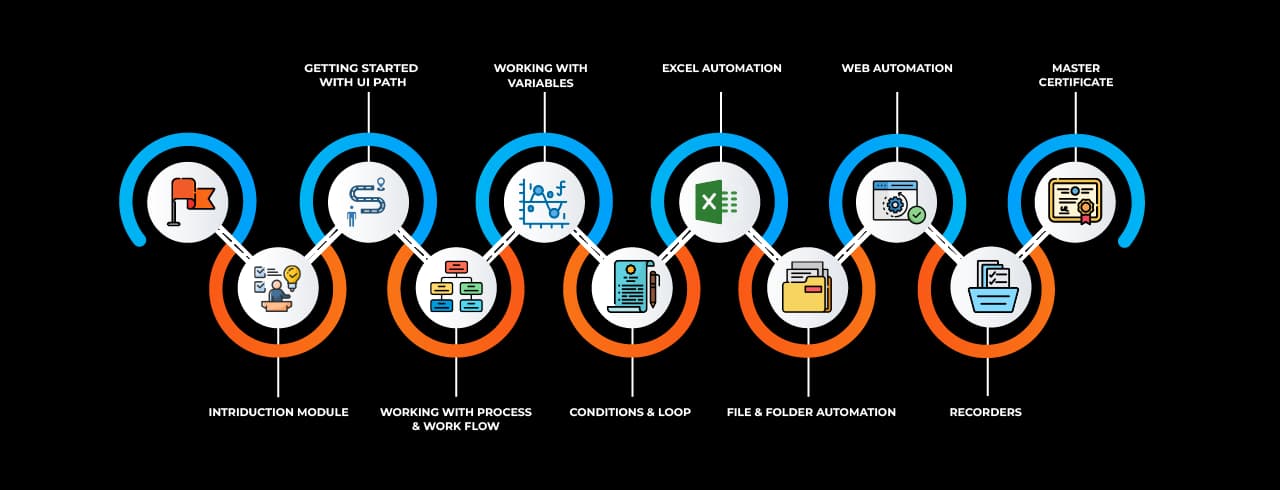
 Introduction ModuleOverview of RPA concepts, benefits, and UiPath fundamentals.
 Getting Started with UiPathInstallation, UiPath Studio interface, and basic project setup.
 Working with Process & WorkflowUnderstanding sequences, flowcharts, and state machines.
 Working with VariablesCreating and managing variables for data storage and manipulation.
 Conditions & LoopsImplementing decision-making (If/Else, Switch) and loops (For, While, Do-While).
 Excel AutomationReading, writing, and manipulating Excel data using UiPath.
 File & Folder Automation Handling file operations (create, copy, delete) and folder management.
 Web AutomationAutomating browser interactions, data extraction, and form filling.
 RecordersUsing UiPath recorders for desktop and web automation.
 Email AutomationSending, receiving, and processing emails via Outlook or SMTP.
 PDF & Image Automation Extracting text/data from PDFs and processing images.
 Release ManagementDeploying, scheduling, and managing RPA processes in production.