SAP ABAP Course in India
 Ready To Elevate Your Tech Career with In-Depth SAP ABAP Training?
 Learn SAP ABAP from Industry Veterans at SevenMentor Institute
 Master ABAP Programming with Hands-On Training and Live Project Experience
Start Today!
CONSULT WITHOUR ADVISORS
- Course & Curriculum Details
- Flexible Learning Options
- Affordable Learning
- Enrollment Process
- Career Guidance
- Internship Opportunities
- General Communication
- Certification Benefits
Learning Curve for SAP ABAP in India
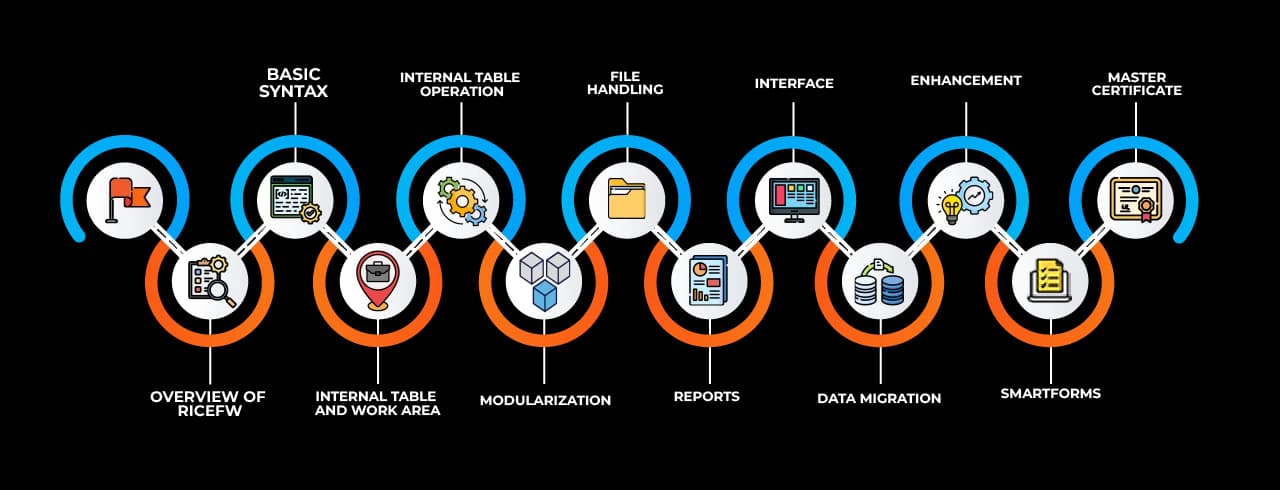
Master In SAP ABAP in India Course
OneCourseMultipleRoles
Empower your career with in-demand data skills and open doors to top-tier opportunities.
Skills & Tools You'll Learn -
 ABAP Data DictionaryThink of the ABAP Data Dictionary as a storage space where we define and manage database tables, views, and structures, ensuring that data is consistent across the system.
 Data Dictionary ObjectsIn SAP, Data Dictionary Objects include tables, views, data elements, domains, and structures that help us define how data is stored and processed.
 Internal Table and Work AreaAn Internal Table is like an in-memory database table that stores temporary data, and a Work Area is a single-row storage used to process this data.
 String Operations in ABAPWe often need to manipulate text, so string operations in ABAP help us modify, split, and format text data for better processing and output.
 Internal Table OperationsIn ABAP, we perform various operations on internal tables like inserting, updating, deleting, and sorting data efficiently.
 Database Table OperationsWith Database Table Operations, we retrieve, modify, and delete records directly from SAP's database using Open SQL statements.
 Condition StatementSAP ABAP provides condition statements like IF, CASE, and LOOP to control the flow of a program based on specific conditions.
 Modularization TechniquesTo keep our code structured and reusable, we use modularization techniques like subroutines, function modules, and classes.
 Include ProgramAn Include Program is a reusable piece of code that we can insert into multiple programs to avoid duplication.
 SubroutineA Subroutine (FORM/ENDFORM) is a modular block of code that we define once and call multiple times within an ABAP program.
 Functional ModulesA Function Module is a predefined block of reusable code stored centrally in SAP, allowing us to perform standard operations across different programs.
 MacrosSAP Macros are short reusable code snippets, mainly used for writing repetitive operations within reports
 Selection ScreenA Selection Screen is the input screen we create for users to enter parameters before running an ABAP report.
 File Handling on Presentation ServerThis allows us to read and write files on the user's local system using OPEN DATASET and GUI_DOWNLOAD methods.
 File Handling on Application ServerUnlike the Presentation Server, the Application Server file handling deals with storing and processing files directly on the SAP server.
 RICEFWThis stands for Reports, Interfaces, Conversions, Enhancements, Forms, and Workflows, which are key components in SAP customization.
 Reports Classical Reports: A Classical Report is the simplest type of ABAP report, which displays output in a list format without any interactivity.
 Interactive ReportsUnlike Classical Reports, Interactive Reports allow users to click on a row to get detailed data on a second screen.
 ALV ReportsALV (ABAP List Viewer) Reports offer a more user-friendly display with sorting, filtering, and export options in SAP reports.
 Interface IDoc: An IDoc (Intermediate Document) is a standard data format used in SAP to exchange information between different systems.
 RFC (Remote Function Call)An RFC allows communication between different SAP systems or between SAP and external applications.
 BAPI (Business Application Programming Interface)A BAPI is a standardized function module provided by SAP that allows external applications to communicate with the SAP system.
 Data MigrationLSMW, BDC, BAPI: These are techniques to transfer data into SAP; LSMW (Legacy System Migration Workbench), BDC (Batch Data Communication), and BAPI help in migrating large amounts of data efficiently.
 Enhancement Implicit Enhancement: An Implicit Enhancement lets us modify SAP standard programs without modifying the original code, using predefined enhancement points.
Enhancement Point and SectionEnhancement Points allow us to insert additional logic, while Enhancement Sections replace standard SAP code with custom logic.
Enhancement Implicit Enhancement: An Implicit Enhancement lets us modify SAP standard programs without modifying the original code, using predefined enhancement points.
Enhancement Point and SectionEnhancement Points allow us to insert additional logic, while Enhancement Sections replace standard SAP code with custom logic.Why Choose SevenMentor SAP ABAP in India
Empowering Careers with Industry-Ready Skills.

Specialized Pocket Friendly Programs as per your requirements

Live Projects With Hands-on Experience

Corporate Soft-skills & Personality Building Sessions

Digital Online, Classroom, Hybrid Batches

Interview Calls Assistance & Mock Sessions

1:1 Mentorship when required

Industry Experienced Trainers

Class Recordings for Missed Classes

1 Year FREE Repeat Option

Bonus Resources
Specialized Pocket Friendly Programs as per your requirements
Live Projects With Hands-on Experience
Corporate Soft-skills & Personality Building Sessions
Digital Online, Classroom, Hybrid Batches
Interview Calls Assistance & Mock Sessions
1:1 Mentorship when required
Industry Experienced Trainers
Class Recordings for Missed Classes
1 Year FREE Repeat Option
Bonus Resources

Fastest 1:1 doubt support

Flexible EMI Plans

Adaptive LMS

Free Wifi Facilities

Flexible Scheduling

Ongoing Career Support

Placement Drives

GitHub Project Implementations

Real World Topics

5/5 rating for 99% doubt Solutions

Be Different With Master Certificate

Latest Market Technology & Practical Training

Resume Building Session & Job Portals Training

Enhanced Capstone Projects for learning

Stand Out with an impressive Certificate

Weekday and Weekend Batches

Workshops & Seminars with Industry Experts

Unlimited Interview Calls

AWS Cloud Project Deployments

Live Quizzes

Resolve doubts any time through chat, voice notes, calling or meeting with instructors.
Curriculum For SAP ABAP in India
BATCH SCHEDULE
SAP ABAP in India Course
Find Your Perfect Training Session
Jul 5 - Jul 11
1 sessionsJul 12 - Jul 18
3 sessionsLearning Comes Alive Through Hands-On PROJECTS!
Comprehensive Training Programs Designed to Elevate Your Career

Develop ALV or Interactive Reports Based on Business Need

Design Smart Forms for Business Documents

Enhancement of Standard SAP Functionality

Data Migration

Business Process Automation Using BDC
No active project selected.
Transform Your Future with Elite Certification
Add Our Training Certificate In Your LinkedIn Profile
Our industry-relevant certification equips you with essential skills required to succeed in a highly dynamic job market.
Join us and be part of over 50,000 successful certified graduates.



KEY Features that Makes Us Better and Best FIT For You
Expert Trainers
Industry professionals with extensive experience to guide your learning journey.
Comprehensive Curriculum
In-depth courses designed to meet current industry standards and trends.
Hands-on Training
Real-world projects and practical sessions to enhance learning outcomes.
Flexible Schedules
Options for weekday, weekend, and online batches to suit your convenience.
Industry-Recognized Certifications
Globally accepted credentials to boost your career prospects.
State-of-the-Art Infrastructure
Modern facilities and tools for an engaging learning experience.
100% Placement Assistance
Dedicated support to help you secure your dream job.
Affordable Fees
Quality training at competitive prices with flexible payment options.
Lifetime Access to Learning Materials
Revisit course content anytime for continuous learning.
Personalized Attention
Small batch sizes for individualized mentoring and guidance.
Diverse Course Offerings
A wide range of programs in IT, business, design, and more.
Course Content
Frequently Asked Questions
Everything you need to know about our revolutionary job platform
What is the salary range for an SAP ABAP Consultant?
Do I need a programming background to learn SAP ABAP?
Is SAP ABAP in demand in the Indian market?
What career opportunities are available after completing the SAP ABAP course?
Do I need to learn other programming languages to work with SAP ABAP?
Is SAP ABAP only for big companies?
How long does it take to learn SAP ABAP?
Will I get hands-on practice in this course?
Do I need SAP experience before learning SAP ABAP?
Will this course help me prepare for SAP ABAP certification?
Is SAP ABAP a good career choice for freshers?
Will I get placement assistance after completing SAP ABAP Course at SevenMentor?
What’s the difference between SAP ABAP and other programming languages?
Can I work as a freelancer after learning SAP ABAP?
Will I receive a certificate after completing the course?
Explore Other Demanding Courses
No demanding courses available at the moment.
Debug: courses prop type: object, isArray: yes, length: 0
Invest In Your Future With Skills That Matter.
Investing in the right skills at the right place paves the way for long-term career success and growth. SevenMentor Institute equips you with industry-relevant expertise, ensuring you stay ahead in an evolving job market.
Career Support:
Beyond technical training, we provide comprehensive career assistance, including resume building, interview coaching, and job placement support.
Recognized Certification:
Earn globally recognized certifications that validate your expertise and enhance your employability.
Company Tie-Ups:
We collaborate with leading corporations, startups, and multinational companies to provide our students with exclusive job opportunities, internships, and industry exposure.
Take the first step to fast-track your future!