Introduction
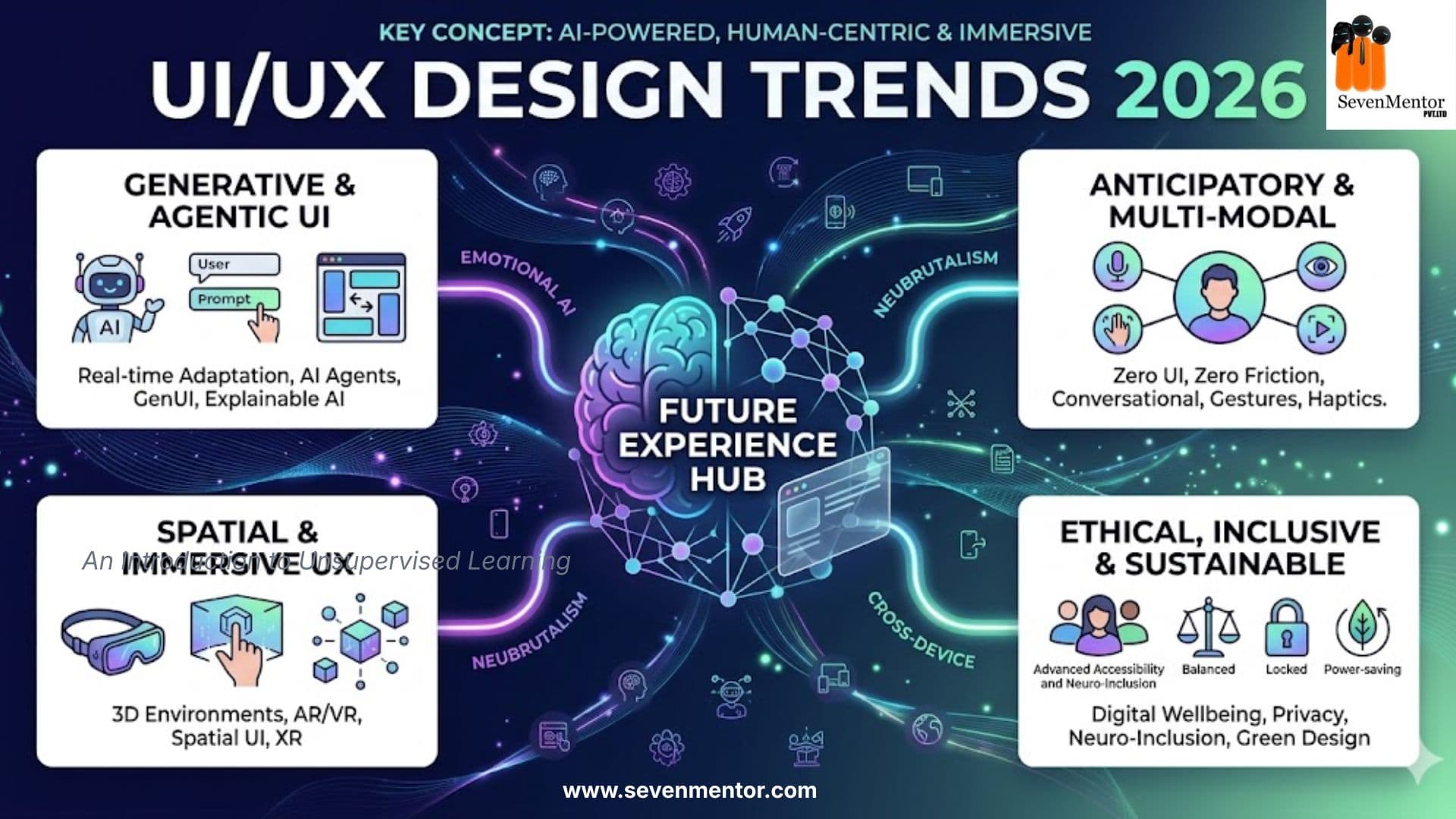
UI/UX design in 2026 is no longer just about making interfaces look good—it’s about creating intelligent, human-centered, and immersive experiences. With rapid advancements in AI, accessibility standards, and user expectations, designers are now focusing on building products that are intuitive, personalized, and emotionally engaging.
In this blog, we explore the top UI/UX design trends 2026 and how designers can stay ahead in this evolving landscape.

1. AI-Driven Personalization & Adaptive UI
Artificial Intelligence is transforming UI/UX by enabling real-time personalization. Interfaces now adapt based on user behavior, preferences,
and context.
Key Features:
- Smart recommendations
- Dynamic layouts
- Predictive user flows
Example: Apps suggesting actions before users even search for them
2. AI Copilots & Generative Design
AI is no longer just a tool—it’s becoming a design partner. AI copilots assist users by automating tasks, generating content, and improving
workflows. Even design tools are evolving—new systems allow designers to create UI using natural language prompts, speeding up the design
process significantly.
3. Human-Centered & Emotional Design
In 2026, design is deeply focused on user emotions, inclusivity, and accessibility. Designers are prioritizing experiences that feel meaningful
and easy to use.
Focus Areas:
- Emotional connection
- Inclusive design for all users
- Clear navigation and usability
4. Accessibility-First Design
Accessibility is no longer optional—it’s a necessity. Products must be usable for people with visual, cognitive, and physical disabilities.
Examples:
- Voice navigation
- Screen reader optimization
- High-contrast UI
Ethical UX is becoming a core requirement in product design
5. Immersive 3D & Spatial Design
With advancements in technology, designers are integrating 3D elements and spatial interfaces into digital products.
Why it matters:
- Enhances storytelling
- Improves engagement
- Creates interactive experiences
6. Multimodal Interfaces (Voice, Gesture, Touch)
Users now interact with products beyond screens—through voice, gestures, and multiple input modes.
Examples:
- Voice assistants
- Gesture-based navigation
- Cross-device experiences
7. Advanced Dark Mode & Visual Simplicity
Minimalism still exists—but it has evolved. Instead of just removing elements, designers focus on reducing cognitive load and improving
clarity.
Trends:
- Smart dark mode
- Clean layouts with clear hierarchy
- Focus on usability over aesthetics
Explore Other Demanding Courses
No courses available for the selected domain.
8. Micro-Interactions & Motion Design
Small animations and interactions are making interfaces feel alive and responsive.
Examples:
- Button feedback
- Loading animations
- Hover effects
These enhance usability - not just decoration
9. Privacy-Centric UX
Users are more aware of their data, and privacy-focused design is becoming essential.
Key Elements:
- Transparent data usage
- Consent-driven UI
- Secure user flows
Trust is now a major UX factor
10. Hyper-Personalized & Context-Aware Experiences
Modern UX is shifting toward context-aware systems that understand user intent and environment.
Examples:
- Location-based UI
- Behavior-driven dashboards
- Personalized onboarding
What Designers Should Focus on in 2026
To stay relevant, UI/UX designers should focus on:
- AI integration in design workflows
- Strong UX thinking & problem-solving
- Accessibility and ethical design
- Data-driven decision-making
- Continuous learning of new tools
Integration with Other IT Courses
Web development skills can be enhanced by combining them with other in-demand technologies. Many training institutes, including SevenMentor, offer integrated learning paths with courses such as:
- Data Science – For data-driven web applications
- Data Analytics – To analyze user behavior and performance
- Python – Popular for backend development
- Cloud Computing – For deploying scalable applications
- Cyber Security – To secure web applications
- SAP – For enterprise-level solutions
- Generative AI & AI Course – To build intelligent applications
- ChatGPT Course – For AI-powered chatbot integration
- DevOps – For continuous integration and deployment
- Power BI – For data visualization dashboards
- Salesforce – For CRM-based web solutions
- Java – Widely used for enterprise web applications
Learning these technologies alongside web development can significantly boost your career prospects.
UI/UX design in 2026 is evolving beyond visuals into a strategic, user-first discipline. The most successful designs are not the most complex—
but the ones that are simple, intelligent, and meaningful.
Designers who embrace AI, accessibility, and human-centered thinking will lead the future of digital experiences.
Final Thought -
“Good design is not just what users see—it’s how effortlessly they experience it.”
Frequently Asked Questions (FAQs):
1. What are the top UI/UX design trends in 2026?
The top UI/UX design trends in 2026 include AI-driven personalization, immersive 3D interfaces, voice and gesture-based interactions, minimalist design, and accessibility-first experiences. These trends focus on creating more intuitive, engaging, and user-centered digital products.
2. How is AI influencing UI/UX design in 2026?
In 2026, AI in UI/UX design plays a major role by enabling personalized user experiences, predictive interfaces, and smart recommendations. Designers are using AI tools to analyze user behavior and create adaptive interfaces that respond in real time.
3. Why is accessibility important in UI/UX design trends 2026?
Accessibility in UI/UX design ensures that digital products are usable by everyone, including people with disabilities. In 2026, businesses prioritize inclusive design to meet legal standards and improve user satisfaction across diverse audiences.
4. What is the role of immersive design in UI/UX trends 2026?
Immersive UI/UX design involves using AR, VR, and 3D elements to create interactive and engaging user experiences. In 2026, it is widely used in gaming, e-commerce, and education to enhance user engagement and realism.
5. How can beginners keep up with UI/UX design trends in 2026?
Beginners can stay updated with UI/UX design trends 2026 by following industry blogs, practicing with modern design tools, learning from real-world projects, and taking professional UI/UX courses. Continuous learning is key to staying relevant in this fast-evolving field.
Related Links:
React Application Optimization Techniques
How to deploy React Applications?
Do visit our channel to know more: SevenMentor
Author:-
Roshani Kolekar
Roshani Kolekar
Expert trainer and consultant at SevenMentor with years of industry experience. Passionate about sharing knowledge and empowering the next generation of tech leaders.
Call the Trainer and Book your free demo Class..... Call now!!!
| SevenMentor Pvt Ltd.
© Copyright 2025 | SevenMentor Pvt Ltd.